




On Jan 15, shares of the chip powerhouse touched an all-time high of US$351.33 ($449.69) after it reported that net income in its October to December 2025 quarter rose 48.3% on revenue growth of just 25%. The main driver of profits was expanding gross margins, which grew to a software-like 62.3%. It’s unheard of for a chip manufacturer to have such high margins.
With a market capitalisation of US$1.73 trillion, TSMC is now the sixth-largest firm on earth by market value, just behind e-commerce and cloud giant Amazon.com. The Taiwanese chip juggernaut is a much more valuable company than consumer-facing firms like social media behemoth Meta Platforms, which owns Instagram and electric vehicle pioneer Tesla. Its stock is up 52% over the past year and 440% since October 2022. If you had invested just US$1,000 in TSMC shares at the bottom of the global financial crisis in 2008, when it briefly traded at just over US$7 a share, you would have more than US$50,000 today.
TSMC was founded in 1987 in Hsinchu, Taiwan, by Morris Chang, an American-Chinese electrical engineer and a former senior executive of Texas Instruments, with Taiwanese government backing. Chang conceived it as the world’s first dedicated “pure play” semiconductor foundry. The Taiwanese government had identified semiconductors as a key sector it wanted to develop. Dutch electronics giant Philips was roped in as a partner. TSMC’s aim was to revolutionise the chip industry by focusing solely on manufacturing chips for other companies, rather than designing its own. “We knew we couldn’t compete with the Intels of the world, so we thought its might be best to just make chips for others,” Chang was quoted as saying.
Philips became an early customer, provided expertise and took a 27.5% stake, which it has since sold. Taiwan’s National Development Fund remains TSMC's largest shareholder with 6.5% stake. It retains a seat on the board. The government also supports TSMC by providing infrastructure, subsidised water and electricity, and tax credits to TSMC’s fabs — all located in state-built industrial parks in western cities such as Hsinchu, Taichung and Tainan.
See also: SoftBank's Son calls AI bubble talk an ‘insult’, delays retiring
TSMC is now widely considered one of the most important companies in the world. It accounts for 73% of global contract chip manufacturing and makes 96% of the world’s AI chips. For Taiwan, such dominance is a good thing from national security perspective. The country’s semiconductor industry is often referred to as a “silicon shield”, acting as an incentive for the international community to keep Taiwan out of Beijing’s control. The world’s reliance on high-end Taiwanese chips dwarfs the European reliance on Russian energy before Moscow’s invasion of Ukraine in 2022, notes Michael Cembalest, an investment strategist at JP Morgan Asset Management.
At its core, TSMC is an arsenal builder at the epicentre of the ongoing global AI arms race. It’s helping the US retain its edge on chips over emerging challenger China. During a gold rush, often the best way to make money isn’t to start digging, anywhere or everywhere, but to stick to supplying pans, picks and shovels as well as essential services such as food, lodging, transport and infrastructure to prospectors who do the actual digging.
Driven by AI infrastructure spending
See also: When decisions outrun evidence: how agentic AI rewires insight for Singapore
So, what’s driving TSMC’s phenomenal growth? The Big Five global tech players building large-language AI models (LLMs) — Amazon, Microsoft, Google, Meta, and Oracle — are forecast to spend US$602 billion on capital expenditure (capex) this year — a 36% increase from 2025. That’s roughly equal to the Manhattan Project (a research and development programme to produce nuclear weapons during World War II), farm electrification, the moon landing, the US Interstate Highway System and several Roosevelt-era public works projects in the US combined, measured as a share of gross domestic product, notes Cembalest. Amazon and Microsoft have indicated that they are likely to splash out US$160 billion and US$155 billion, respectively, on AI infrastructure in 2026. Search giant Google’s parent Alphabet has budgeted US$125 billion, while social media behemoth Meta has indicated it could spend up to US$120 billion. Software firm Oracle is expected to spend more than US$42 billion on capex this year.
Nearly 75% of the US$600 billion in capex in 2026 is expected to be spent on AI infrastructure, including data centres, AI chips like Nvidia’s Vera Rubin as well as Blackwell, Advanced Micro Devices or AMD’s Instinct 325 or upcoming MI450 chips, and ASICs, Application-Specific Integrated Circuits, or customised chips that Broadcom makes for Google or Amazon. Nvidia, AMD and Broadcom are all asset-light “fabless” firms that don’t have their own wafer fabrication plants. They rely on foundry operators such as TSMC to fabricate their cutting-edge chips. TSMC currently accounts for 96% of all AI chip manufacturing, leaving Samsung Electronics, which makes some chips for AMD, with just 4%. Beleaguered chip maker Intel is also expected to enter the fray, making chips for fabless customers next year. Last year, the US government took a 9.9% stake in Intel as part of a push for America to make more AI chips onshore. TSMC’s competitors have a hybrid model; they make chips for themselves as well as for their customers. By making chips only for others TSMC can focus on improving its own manufacturing techniques.
How did a relatively unknown Taiwanese firm become one of the world’s biggest and best? For starters, a relentless focus on customers’ needs. TSMC goes out of its way to make things easier for customers so that Nvidia, Apple and others can focus on what they do best — designing cutting-edge chips. In 2014, it lured Apple into becoming its anchor customer by promising to build a dedicated top-of-the-line fab.
Semiconductor chips, the brains of advanced technology, are the essential building blocks of modern electronics, powering virtually everything from smartphones, computers and cars to medical devices, as well as home appliances, advanced satellites and data centres, controlling and processing electrical signals to enable functions like computing, communication, sensing, as well as AI, and making devices faster, smaller and ever more powerful. A single chip can carry the tens of billions of transistors required to make electronic goods work.
Over a trillion semiconductors were sold in 2023, according to the Semiconductor Industry Association, while the final tally is not yet in, global chip sales likely topped US$800 billion last year. Since the chip industry is growing between 22% and 25% annually, sales are likely to top US$1 trillion this year. The chip manufacturing process and its complex supply chain is almost as intricate as the chip itself. Here’s how the typical manufacturing and assembly of a semiconductor chip works: From research and development in the US, where most of the top chip design firms like Nvidia, AMD and Broadcom are located to Taiwan and South Korea where base silicon ingots are cut into wafers, to the microchips that are embedded into end-products in China such as full self-driving autonomous vehicles, a chip goes from quartz sand to a silicon wafer to the brains of a smartphone or a humanoid robot. Book-ending the making of the chip are two companies that are neither from the US or China. Dutch chip equipment giant ASML makes the tools that help TSMC make chips under contract for Nvidia, Broadcom, Apple and others.
Crucial supply
Eight of the 10 largest companies in the world by market value depend heavily on TSMC’s supply (the only exceptions are TSMC itself and Saudi Aramco). More than a third of the combined US$2 trillion in revenue of the eight giants comes from hardware that uses TSMC chips. The digital economy, autos and industrial firms rely on TSMC. “Without it, the world economy would sputter,” notes a recent JP Morgan report.
Sink your teeth into in-depth insights from our contributors, and dive into financial and economic trends
TSMC not only raised its five-year AI revenue compound annual growth rate from the mid-40% to mid-to-high 50% last week but also upgraded its long-term revenue growth target to 25% from 20% previously. The chip giant also raised its capex outlook. It now expects this year’s capex spending to be between US$52 billion and US$56 billion, dramatically exceeding market expectations of US$50 billion for the year. Yet the huge increase in capex is unlikely to weigh on TSMC’s improving margins. Last week, it raised its long-term gross margin target to “56% and higher” from “53% and higher”, driven largely by stronger-than-expected productivity and cost improvements. Analysts expect TSMC’s gross margins to grow to 63.2% in 2026 and to 64.0% in 2027.
High-performance computing chips, or high-end AI chips, now account for 55% of TSMC’s total production, while chips used in smartphones, once the main driver, account for just 32% of its total revenues. Sixty-three per cent of revenue now comes from 3nm or 5nm chips. TSMC will begin producing state-of-the-art 2nm chips later this year with Apple as its first customers.
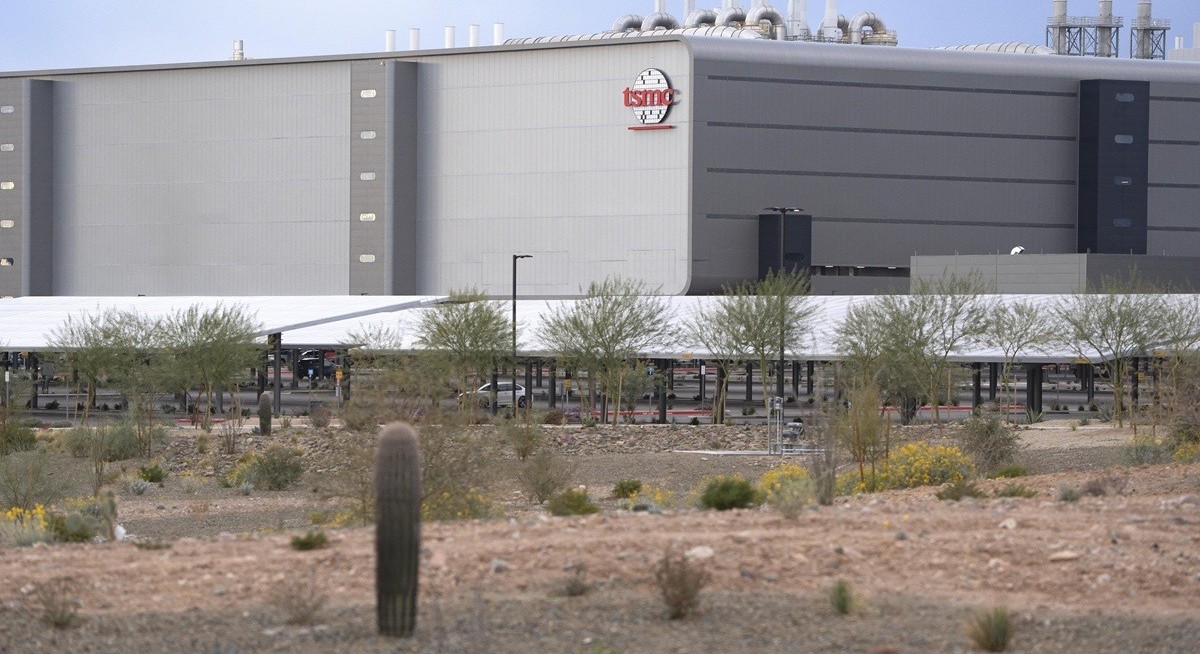
Earlier this month, Washington and Taipei hammered out a new trade and investment deal, with the US agreeing to cut tariffs to 15% and Taiwan agreeing to invest up to US$250 billion to build and expand advanced semiconductor, energy and innovation capacity in the US. TSMC has a chip plant in operation in Arizona and another under construction that will come online next year. The chip giant has committed to investing US$165 billion for an Arizona cluster that will include a total of six plants. It aims to eventually have up to 40% of its logic production onshore in the US by 2030.
How does TSMC measure up to its fast-growing Chinese foundry rivals? A year ago, the US was at least three years ahead of China in leading edge AI, and TSMC was up to five years ahead in top-of-the-line chip manufacturing as it moved to 2nm chips. China’s LLMs now trail the performance of American LLMs by no more than six months. “While the performance of their frontier models continues to lag, China dominates the open weight landscape with eight of the 10 most performant open models on the market, all eclipsing the once-dominant Meta Platforms,” notes a recent report from tech-focused fund management firm ARKInvest. “To remain competitive, China must access more compute capability, a tall task as TSMC is producing 38 times more compute than Semiconductor Manufacturing International Corp (or SMIC), China’s top chip manufacturer and TSMC’s key rival,” the report noted.
Aside from Arizona, TSMC is building new fabs in Germany and Japan. Whatever actionChina takes on Taiwan over the next decade, one thing is clear: TSMC will remain a key player in the next race as the battle moves from AI to quantum computing and other emerging technologies.
Assif Shameen is a technology and business writer based in North America




