


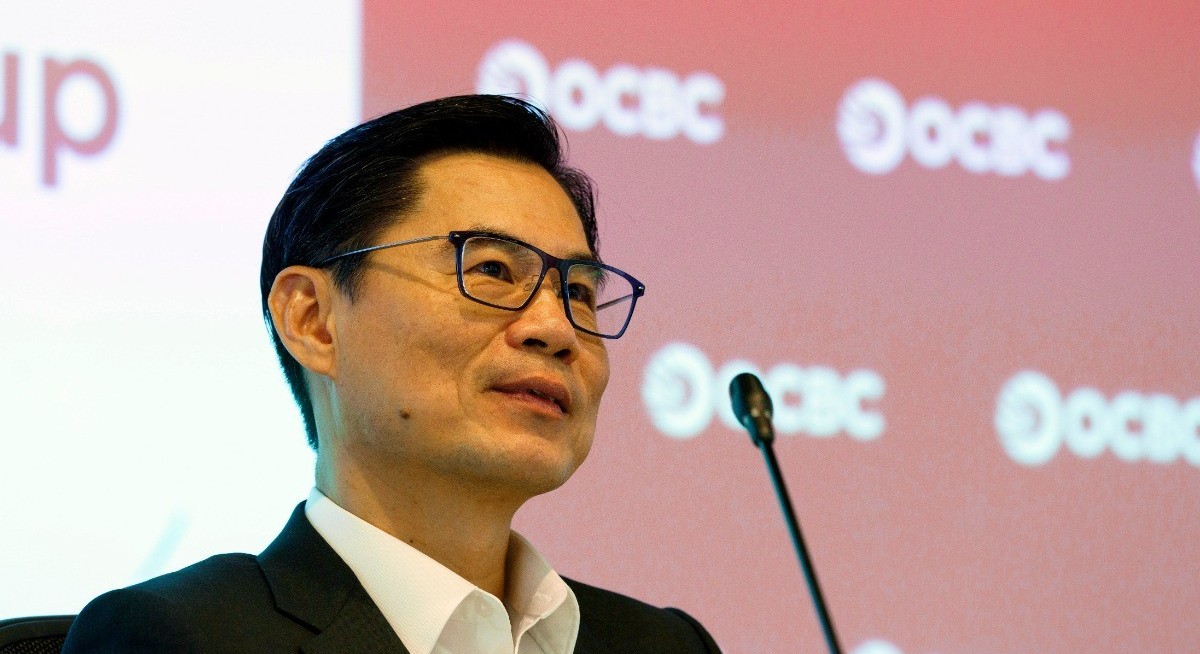


(Feb 5): As Tan Teck Long takes the helm of Oversea-Chinese Banking Corp (OCBC), one of his main challenges may be winning over the billionaire sitting across the boardroom table.
Lee Tih Shih, whose family has been the largest shareholder of Southeast Asia’s No 2 bank by assets for almost a century, has long kept a firm grip on spending at the firm, limiting big ticket investments or risky acquisitions to preserve capital, according to people familiar with the matter. They asked not to be identified discussing private issues.
Tan, a relative newcomer to Singapore’s longest-running bank, may need to change that to keep up with rival DBS Group Holdings Ltd even as his own stock hits record highs. In recent years, investors and analysts have pushed Tan’s predecessors to expand faster via takeovers and boost dividends to match DBS.
“Teck Long will have to walk a tightrope,” said Gerard Lee, former head of an OCBC investment unit who’s not related to the Lee family. “The market expects him to lead a transformation at OCBC; on the other hand, the bank’s substantial shareholders may prefer something more conservative.”
Opening the purse strings at one of Asia’s richest clans won’t be easy. About half of the Lees’ roughly US$38 billion ($48.39 billion) fortune, as measured by the Bloomberg Billionaires Index, is tied to a 28% stake in OCBC. The holding pays annual dividends of more than US$1 billion, supporting the family’s philanthropy.
Risky moves by the bank could jeopardise that wealth. In recent years, several planned investments were derailed after the family baulked at ponying up, according to the people. These include a $2 billion renovation of the bank’s 50-year-old headquarters, and a sweetened bid to take its Great Eastern Holdings Ltd insurance business private. Despite pitches from bank executives, the potential returns in each case weren’t seen to justify the costs, said the people.
See also: OCBC maintains top position in Bloomberg’s Bookrunner League Table for SGD bonds
Lee declined to comment.
Tan, who took over as chief executive officer on Jan 1, said in a response to Bloomberg that support from the board is strong, and that the team is “galvanised to hit even higher notes”.
“Our next chapter of growth will be exciting,” he said. “Transformation is bread-and-butter at OCBC, with a culture of innovation and growth that flourishes at every level.”
See also: UBS profit beat overshadowed by worries over US wealth outflows
Past deals
Though the family has signed off on big takeovers in the past — including a US$5 billion deal for a Hong Kong bank in 2014 — jumbo deals have been few and far between in recent years. For the clan, fiscal discipline and low appetite for risk are signs of strength.
By contrast, DBS scooped up Citigroup Inc’s Taiwanese consumer bank in 2023 and has made major investments in China and India. United Overseas Bank Ltd, another Singapore rival, paid US$3.6 billion for Citigroup’s Southeast Asian consumer-banking units.
OCBC passed on Citigroup’s Southeast Asian deal after reviewing the assets, while the Taiwan business didn’t fit its strategy, a person familiar said.

Key decisions still require the family’s blessing, according to more than a dozen people with knowledge of the Lees and bank management.
It was Lee Tih Shih who helped poach Tan from DBS with a pitch that he could eventually land the top job, according to two people. In a sign of his influence, Lee Tih Shih is chair of the board’s executive committee, which oversees management of the business and reviews strategies. At DBS and UOB, the chairman of the board runs that committee.
To stay ahead of Singapore and the region’s corporate and economic trends, click here for Latest Section
The Lee family’s roots run deep at OCBC. The empire dates back to Lee Tih Shih’s grandfather, Lee Kong Chian. Born in China’s Fujian province in 1893, he married into a wealthy family in British Malaya, the colonial predecessor of Malaysia and Singapore. The fortune included rubber and pineapple plantations — and a stake in a small bank.
In the early 1930s, as the world reeled from the Great Depression, the bank merged with two rivals to form OCBC. Lee Kong Chian served on the board until just before his death in 1967, gradually increasing the family’s stake. He also expanded holdings to food processing and timber, though OCBC is the dominant asset.
Reluctant bankers
Despite the long history, the Lees have been somewhat unwilling bankers. Lee Tih Shih, 62, took a board role in 2003, mostly to fulfil a family obligation, despite his passion for medicine. After his father, Lee Seng Wee, passed away in 2015, he became the sole family director.
Lee Seng Wee didn’t plan to run the bank either. He “reluctantly” took up the roles of CEO and chairman after his predecessor was appointed deputy prime minister. “Someone had to quickly take over to ensure continuity of the bank,” according to his obituary published in the 2015 annual report.
The bank split the jobs of chairman and CEO in 1998, and have appointed outside professionals for both positions since 2003.
Lee Tih Shih combines bank duties with his professor role at the Duke-NUS Medical School, where he started the Brain-Computer Interface Lab for research on neurocognitive disorders and autism. Armed with a doctorate from Yale University and an MBA from Imperial College London, he also sits on the board of family entities including the Lee Foundation, which held about $14 billion in assets at the end of 2024. More than half of the family’s assets are held by its foundations in Singapore and Malaysia.
At the same time, some family members without roles at the bank tend to weigh in on matters that affect their investments. Tensions have flared over the bank’s dividend policy, people familiar said. The current yield of 3.8% is well below DBS’s 4.8%.
Today, numerous family members benefit from the OCBC stake, though none of them are deeply involved in the bank, according to people close to the family.
There are typically three paths that work for family-owned businesses like OCBC, said Yupana Wiwattanakantang, associate finance professor at National University of Singapore: active involvement, passive ownership through a family office, or a complete exit. In OCBC’s case, the Lees are still very much involved.
“It’s best for a family to choose one path and commit to it,” she said. “Reluctant participation doesn’t work — banking is a fiercely competitive industry.”
As he settles into his new role, Tan will need family support for major strategic moves, along with buy-in from non-executive chairman Andrew Lee. Though not part of the clan, Lee, 73, is a trusted lieutenant of the family who assumed his role in 2023. Helen Wong, the CEO for the past four years, had a difficult relationship with Lee, according to people familiar with the matter who asked not to be identified due to the sensitivities of the matter.
Wong and Andrew Lee declined to comment.
Andrew Lee is known to be very hands-on, according to many existing and former employees interviewed by Bloomberg News.
The Great Eastern saga was just one example. For years, OCBC has tried to take the insurer private by buying up the minority stake it doesn’t already own. The move would save listing and administrative costs, while integrating some of the insurer’s more than $100 billion in assets into the bank’s wealth management business.
The bids have faced resistance from Great Eastern shareholders — including some distant Lee family relatives — who have pushed for higher offers. Two decades of takeover attempts have led to resentment, turning annual meetings increasingly acrimonious.
In January 2025, Wong was tasked by Andrew Lee to meet with key Great Eastern shareholders who rejected a $1.4 billion bid for a 12% stake the previous year, people familiar had said. The chairman also tried to meet with some holdouts, according to the people.
A fresh bid was scuttled for a fourth time in July after the bank’s improved offer came in at least $230 million short of minority holders’ demands. OCBC, which was advised by JPMorgan Chase & Co, said it didn’t plan to make another offer in the foreseeable future.
That same week, OCBC announced that Wong, 64, would step down as of Dec 31. Wong said she had planned to leave for family reasons. A bank spokesperson said her retirement wasn’t related to Great Eastern.
Tan’s agenda
It’s now up to Tan, 56, to push the bank’s agenda. His first three-plus years as head of wholesale banking went well after he boosted revenue and improved the credit review process. The Singaporean is decisive and not afraid to speak his mind, according to people who know him.
A Mandarin speaker, he spent five years in China with DBS, handling the country’s biggest corporate clients. He joined OCBC in 2022 after almost three decades at DBS.
It’s been “energising” to be part of Tan’s senior management team working on a strategic review, said Tan Chor Sen, OCBC’s Malaysia head. “I have seen first-hand his clarity, drive and belief in the team.”

The new CEO will be competing with Tan Su Shan, 58, his former colleague at DBS who became that firm’s first female CEO last March. Wong, meanwhile, raised the bar by delivering a series of strong earnings reports. She’s also credited with setting clarity on the dividend policy, elevating the payout to 60% of profit for 2024 and 2025 after including a $2.5 billion capital return plan. DBS, with state investor Temasek Holdings Pte Ltd as the largest shareholder, is likely to pay out more than 70% for 2025, according to analysts.
OCBC had excess capital of $2 billion as of September, and “needs to offer clarity” on how it will use the money following the Great Eastern bid, said Bloomberg Intelligence analyst Rena Kwok.
“We will look into more ways to further optimise our strong capital position,” chief financial officer Goh Chin Yee, a 38-year veteran of the bank, said in an emailed response. “I am confident about OCBC’s next growth phase.”
Though OCBC shares have rallied, investors still tend to prefer DBS, which has posted an annualised total return of 27% over the past five years, topping OCBC’s 22%. The market value gap between the two lenders has never been wider.

Tan has yet to lay out his strategy publicly, though he said in response to Bloomberg that he plans to “double down” on core markets of Singapore, Malaysia, Indonesia and Hong Kong. He added that embedding AI, digital and data across the group will be central to accelerating value creation. The bank reports earnings later this month.
Whether Tan can get backing from the Lee family for major moves remains to be seen.
“Surrounded by long-serving executives could make it challenging for him to deliver anything truly transformational,” said Gerard Lee, now non-executive chairman of the Singapore unit of Arabesque AI Ltd.
Uploaded by Chng Shear Lane




