


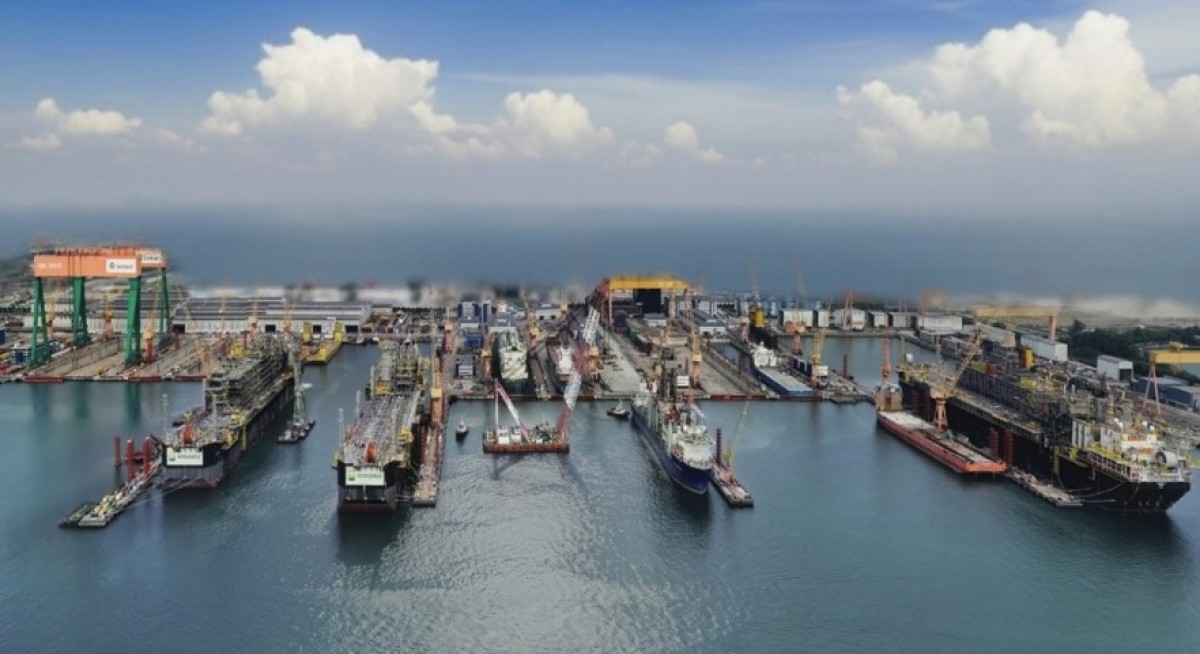


Seatrium helps shape global energy infrastructure as a leading provider of specialised offshore and marine engineering, alongside vessel repairs, upgrades and conversions.
Our work supports today’s energy needs while advancing cleaner energy solutions for the future. Our repeat customers include energy majors, offshore wind developers and global vessel fleet owners.
Our business is organised around four core segments, positioning us strongly as the world shifts towards cleaner energy sources:
- Oil and gas: We are a leading global builder of offshore floating production assets such as Floating Production Storage and Offloading (FPSO) units, Floating Production Units (FPUs), and Floating Liquefied Natural Gas (FLNG) facilities, and fixed platforms.
- Offshore wind: We design, build and install offshore High Voltage Direct Current (HVDC) and High Voltage Alternating Current (HVAC) substation platforms and construct specialised installation vessels for wind farms.
- Repairs and upgrades: We are one of the world’s largest providers of ship and offshore vessel repairs, dry-docking services, retrofits, life-extension projects and conversions, with expertise in higher-value works for LNG carriers, cruise ships, powerships, offshore and naval vessels.
- Carbon capture and storage (CCS) and new energies: A growing segment that develops sustainable technologies relating to carbon capture systems, hydrogen-ready and ammonia-ready vessels, electrification solutions and other next-generation technologies that advance the energy transition and maritime decarbonisation.
See also: Serial Achieva: From traditional IT distribution to technology infrastructure and solutions
2. What is the group’s current dividend policy, and what are its plans to reward shareholders?
We are committed to driving long-term total shareholder returns through growth, dividends and share repurchases.
In determining dividends, we consider Seatrium’s financial performance, capital requirements, as well as business outlook and opportunities. While we do not have a formal dividend policy, our goal is to balance between reinvesting for growth and rewarding shareholders. Following a return to profitability in FY2024 post-merger, Seatrium distributed a dividend of 1.5 cents per share for the year, to share the fruits with our shareholders.
As we execute our growth strategy — building a resilient order book, expanding margins and managing capital actively — we commit to delivering long-term returns to shareholders.
3. What is Seatrium’s current order book, and what does it mean for revenue visibility?
As of the end of September 2025, Seatrium’s net order book stood at $16.6 billion, comprising 24 projects with deliveries extending through 2031. This robust order book provides strong near-term revenue visibility. Since then, we have secured more than $3 billion in new orders, comprising bp’s FPU Tiber and TenneT’s 2.2 GW HVDC BalWin5 project.
This net order book excludes our repairs and upgrades business, which has shorter project cycles. These projects are underpinned by long-standing strategic partnerships with large global customers and provide a steady, recurring revenue stream.
We are actively pursuing a healthy order book pipeline ($30 billion as at June 30, 2025) and are focused on converting these opportunities into contract wins to bolster longer-term revenue visibility. We are also moving towards higher-value repairs and upgrades activities that strengthen margins.
4. What are the key focus areas for driving revenue and profit growth in the coming years?
To drive top-line growth and revenue visibility, we are focused on converting pipeline opportunities across oil and gas and offshore wind into new orders. These opportunities are backed by sustained demand for offshore energy infrastructure and maritime decarbonisation.
For more stories about where money flows, click here for Capital Section
To drive margin expansion, our priorities are disciplined project execution to achieve margin efficiencies, reducing overheads and continued cost and financial management. Post-merger, we have been disciplined in applying risk-adjusted project margin hurdle rates in the mid-teens.
We also leverage our One Seatrium Global Delivery Model, which centralises project planning and enables seamless execution across our strategic network of engineering offices and yards. Our “series-build” approach — design once, build many — reduces execution risks, shortens schedules and improves margins, while ensuring projects are delivered safely, on time, to quality and within budget.
We have also implemented rigorous cost management, yard optimisation and initiatives such as digitalisation and automation to improve operational efficiency. The ability to centrally manage our global footprint, assets and resources is also an opportunity for optimisation. We have been actively streamlining our asset base by divesting non-core assets to reduce costs and improve utilisation, with proceeds reinvested into growth opportunities.
With an improved credit profile and favourable benchmark rate movements, we have seen a meaningful reduction in cost of debt, alongside deleveraging efforts that have resulted in lower finance costs and a healthy net debt-to-ebitda ratio of about 1.0 times (as at June 30, 2025). We will continue to evaluate opportunities to lower financing costs.
5. Offshore wind projects have faced rising costs and permitting delays. How is Seatrium positioning itself to remain competitive in this segment?
The offshore wind sector has faced challenges, particularly in the US, where new project commitments have slowed. The US wind market remains nascent for us compared to Europe and Asia.
Strong demand in Europe and Asia is underpinned by energy security, clearer project visibility, attractive economics and well-defined regulatory frameworks. We are targeting opportunities in these markets, focusing on projects with balanced risk-sharing and strong cash conversion.
Our competitiveness is reflected in repeat wins, including our consortium’s fourth contract with Europe’s leading Transmission System Operator (TSO), TenneT, in 2025 for the BalWin5 2.2 GW HVDC project in Germany, alongside three ongoing HVDC platforms for the Netherlands, under TenneT’s 2 GW programme.
6. As offshore wind revenue grows, will Seatrium prioritise traditional oil and gas, or will offshore wind take a larger share of the portfolio?
Diversification across energy segments — traditional, renewable and new energies — keeps Seatrium resilient and well-positioned for long-term growth as the world transitions progressively to sustainable energy sources.
We are not fixated on a particular portfolio mix. Instead, we pursue projects with world-class customers that meet our internal margin hurdles and include risk-sharing mechanisms such as price indexing for bulk materials, while targeting positive cash flow throughout the project lifecycle.
7. How does Seatrium assess its competitive position and differentiate itself in the broader market?
Seatrium is a leading engineering solutions provider, distinguished by a proven track record, industry-first achievements driven by innovation and know-how, the One Seatrium Global Delivery Model and enduring customer relationships.
We serve highly discerning global energy majors, with most of our revenue coming from repeat customers — a strong testament to our execution capabilities on complex projects that are the backbone of global energy systems.
We have also delivered numerous world-firsts across more than 1,300 offshore projects over the past six decades:
- Industry-first achievements: These include delivering the world’s largest semi-submersible crane vessel (Sleipnir, 2019) and the world’s first FLNG vessel converted from an LNG carrier (Hilli Episeyo, 2017).
- Petrobras FPSOs: Building six of the seven latest-generation newbuild P-series FPSOs, supported by our presence in Brazil and strategic footprint across Asia, leveraging the One Seatrium Global Delivery Model for end-to-end delivery at scale.
- FSRU conversions: Completed above 90% of FSRU/FSU conversions worldwide, with three ongoing projects.
- Guyana FPSOs: Integrated all four FPSOs operating in Guyana, with the fifth and sixth currently undergoing integration at our yards.
8. Beyond offshore wind, oil and gas, which other segments is Seatrium targeting?
To build long-term resilience, we are expanding into adjacent high-growth markets and extending our series-build approach to scale efficiently and lift margins.
Our business is supported by robust R&D, and we take a practical approach to innovation and new technologies to sustain our long-term competitive edge.
In early 2025, we completed the world’s first onboard CCS retrofit on Clipper Eris, enabling up to 70% CO2 emissions capture and subsequently signed an agreement with the vessel owner to support its broader fleet decarbonisation goals. We are also developing a proprietary onboard CCS system and designing the world’s first CO2 handling hub in Norway, among other initiatives.
These activities reflect our commitment to advancing decarbonisation technologies and delivering innovative offshore and marine solutions.
9. What is the group’s medium to long-term roadmap for achieving net-zero targets?
The group’s net-zero roadmap is structured across two horizons. By 2030, Seatrium targets a 40% reduction in Scope 1 and 2 emissions from 2008 levels, and by 2050, full net-zero emissions.
Following a comprehensive review in 2024, key action areas identified include generating renewable energy, improving energy efficiency and optimising production and capacity. These initiatives form the foundation of Seatrium’s decarbonisation strategy, which is continuously reviewed and refined to ensure progress toward the group’s net-zero target.
10. What is Seatrium’s value proposition for shareholders and potential investors, and what may investors have overlooked?
We are uniquely positioned as a proxy to global energy megatrends — growing energy demand and the energy transition — anchored by our strong leadership in offshore engineering solutions for oil and gas, offshore wind and new energies sectors. We deliver offshore energy infrastructure assets globally that shape the backbone of the world’s energy systems. Complementing this, our repairs and upgrades business provides a stable financial base with healthy margins, contributing to resilience.
In 2024, we recorded our first full-year profit since 2017, marking a significant milestone in our financial turnaround. We are now on a strong trajectory progressing towards our 2028 steady-state financial targets, driven by a growing mix of higher-margin projects, strong execution through the One Seatrium Global Delivery Model, productivity improvements and disciplined cost management.
We are committed to delivering long-term total shareholder return through business growth, dividends and share buybacks, supported by a healthy balance sheet and improving cash flows.
What is often overlooked is how far we have come since Seatrium was formed just over two years ago. Today, Seatrium is leaner, more disciplined and clearer in its strategy to capture global energy opportunities.
10 in 10 — 10 Questions in 10 Minutes with SGX-listed companies
Designed to be a short read, 10 in 10 provides insights into SGX-listed companies through a series of 10 Q&As with management. Through these Q&As, management will discuss current business objectives, key revenue drivers and the industry landscape. Expect to find wide-ranging topics that go beyond usual company financials. This report contains factual commentary from the company’s management and is based on publicly announced information from the company. For more, visit sgx.com/research.
For more company information, visit https://seatrium.com/
Raphael Lim is an associate director of the capital market development team at SGX Group




