


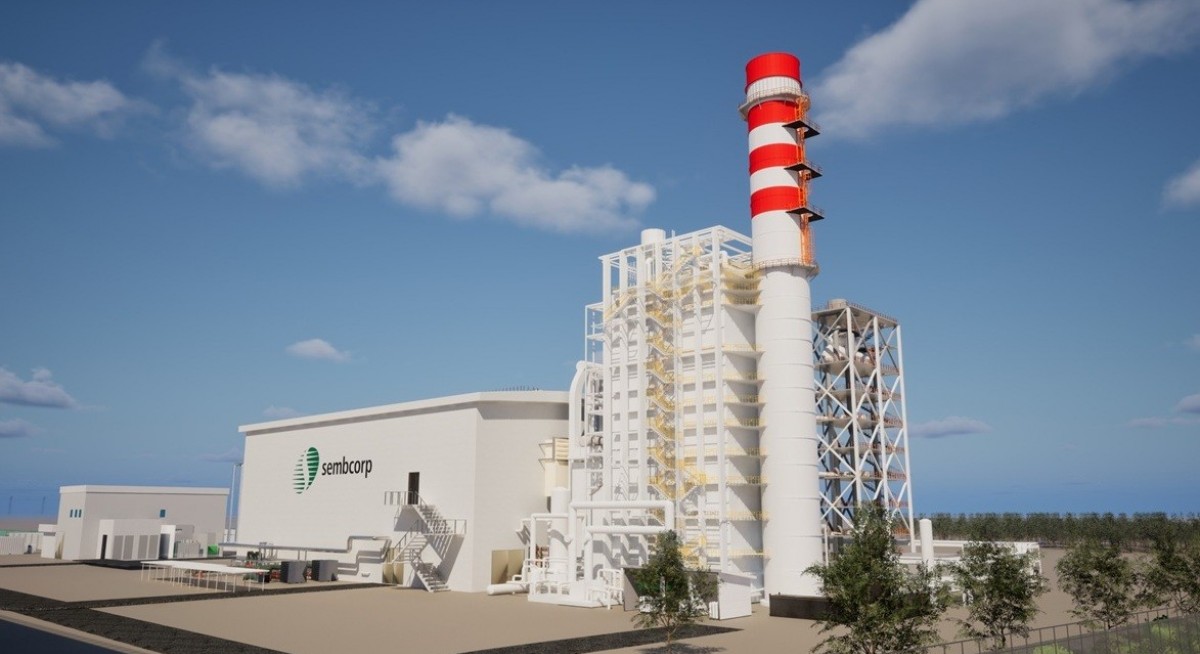


On March 9, Singapore-listed Sembcorp Industries issued a statement refuting reports that its Middle East asset, specifically the Fujairah F1 independent water and power plant (IWPP) in the United Arab Emirates (UAE), where it owns a 40% stake, was attacked.
Sembcorp adds that besides Fujairah, its Salalah IWPP and Manah II solar independent power project in Oman have not ceased operations. It updates that its employees are safe at the moment and that it is monitoring the situation “closely”, with contingency measures in place to ensure the safety and well-being of staff while maintaining operational stability.
Other than the Middle East, Sembcorp is also a power supplier in various markets, including China, the UK and various South Asian and Southeast Asian countries. At home in Singapore, Sembcorp operates gas-fired power plants alongside renewable energy and battery storage assets.
According to Sembcorp, it does not anticipate near-term disruptions to its Singapore gas operations due to supply diversification, with upcoming liquified natural gas cargo deliveries in 2026 not sourced from the Middle East.
See also: With no ‘sell in May’, SGX enjoys higher target prices on ‘strong’ May
Near-term positive; long-term trend
Just days before the company’s reassurances on Middle East operations and gas supply, amid a wider market sell-off, DBS analyst Ho Pei Hwa had already pointed out that Sembcorp could potentially be a beneficiary of higher gas prices and volatility. In her March 5 research report, Ho points out that in addition to “actively” hedging gas-price exposure, Sembcorp’s long-term power contracts for its gas-fired power plants generally have cost pass-through mechanisms with a fixed spread. These mean that Sembcorp’s earnings are unlikely to decline in the event of sudden spikes in gas prices.
Ho also notes that Sembcorp has historically benefited from higher gas prices and volatility, via positive fair value gains on gas hedges and potentially higher gas trading volumes and margins for its gas trading arm. She adds that earnings could be impacted by $30 million to $100 million in the event of prolonged supply disruption.
See also: DBS lays out case for DFI Retail to move ahead with Hong Kong supermarket consolidation
However, if investors were to take a half-step back, they might observe that turnover for Sembcorp’s gas and related services (GRS) segment has been on a y-o-y downtrend since FY2022, from $6.5 billion to $4.1 billion in FY2025. Its ebitda increased in FY2023 to $1.1 billion before declining to $719 million in FY2025. However, adjusted FY2025 ebitda, which includes the performance of joint ventures and associates, was $1.0 billion, roughly in line with FY2024.

In its financial statements for 1HFY2025 and 2HFY2025, Sembcorp attributes the addition of Senoko Energy as one of the main reasons for the increase in share of results of associates and joint ventures (JVs) from FY2024 to FY2025. From the figures, JVs and associates contributed around $287 million in FY2025, an increase of $155 million from FY2024’s $132 million. This also presumably contributed to GRS’s FY2025 adjusted ebitda remaining stable.
Sembcorp first acquired a 30% stake in Senoko in November 2024, before increasing it to 50% in June 2025. Without Senoko’s contribution, net profit from continuing operations for GRS would have likely decreased for a second straight year instead of the slight $10 million rise to $738 million in FY2025.
In its FY2023 to FY2025 results briefings, Sembcorp attributes the y-o-y decline in group turnover to the GRS segment.
Several factors have contributed to declining GRS revenue over the past few years. According to Sembcorp, these include lower wholesale electricity and gas prices in Singapore, reduced gas offtake in Singapore, lower power prices in the UK and planned maintenance.
To reduce volatility and maintain earnings stability for the GRS segment, Sembcorp has pursued a strategy of signing long-term power contracts with customers over the past few years. As at Dec 31, 2025, nearly 80% of contracts of Sembcorp’s Singapore portfolio of gas-fired power plants are five years and above. However, around 5% of this portfolio and 47% of Senoko’s portfolio have to be recontracted in 2026. Sembcorp has warned of lower spark spread, especially for Senoko, and increasing supply, which will further put pressure on recontracting prices.
For more stories about where money flows, click here for Capital Section
“Since 2023, you know that we have been transforming our portfolio by leveraging our position as an integrated gas and power player as well as the largest renewable player in Singapore to secure long-term contracts,” says Sembcorp CEO Wong Kim Yin. “So what was previously a very merchant-heavy portfolio is now a largely contracted one.”
In its financial statements for 1HFY2025 and 2HFY2025, Sembcorp attributes the addition of Senoko Energy as one of the main reasons for the increase in share of results of associates and joint ventures (JVs) from FY2024 to FY2025. From the figures, JVs and associates contributed around $287 million in FY2025, an increase of $155 million from FY2024’s $132 million. This also presumably contributed to GRS’s FY2025 adjusted ebitda remaining stable.
Sembcorp first acquired a 30% stake in Senoko in November 2024 before increasing it to 50% in June 2025. Without Senoko’s contribution, net profit from continuing operations for GRS would have likely decreased for a second straight year instead of the slight $10 million rise to $738 million in FY2025.
In a Feb 26 report, CGS International (CGSI) highlights that current market spark spreads in Singapore are in the $30–$35 range, compared with the $70–$80 range in 2023. Analysts Lim Siew Khee and Meghana Kande also suggest some uncertainty for the Senoko portfolio in signing long-term contracts, describing the process as “lumpy” and dependent on new customers and/or demand from the AI sector. Paul Chew from PhillipCapital is more cautious. In his March 2 report, Chew warns that Senoko would be severely impacted.
In response to these headwinds, Sembcorp points out that it currently supplies one-third of Singapore’s data centre energy demand and more than 690 megawatts (MW) to high-tech manufacturing, and has also signed a new 150 MW contract with semiconductor giant Micron. As such, Sembcorp says it is well-positioned to capture demand from these growth sectors. Adrian Loh of UOB Kay Hian (UOBKH) notes in his Feb 26 report that the 4Q2026 completion of Sembcorp’s hydrogen-ready power plant “strengthens" the company’s positioning to capture AI-driven demand as “reliable” baseload capacity remains essential.

Notwithstanding Singapore’s plan to eventually reduce its reliance on gas to 50% of the energy mix by 2035, the outlook for the GRS business in Singapore seems fairly stable, with opportunities for growth balanced by some downside from recontracting. The South Asia, Southeast Asia and Middle East GRS businesses also seem stable, with at least 85% of installed capacity on long-term contracts.
However, the UK segment deserves some closer scrutiny. In the UK, Sembcorp operates flexible generation assets with 684 MW of installed capacity and Wilton energy assets with 162 MW of installed capacity under the GRS segment.
As at Dec 31, 2025, around 493 MW of the flexible energy assets are on long-term contracts, a decline of 60 MW from 553 MW at the end of 2024. CGSI’s Lim and Kande add that the closure of key customer SABIC’s chemical plant in June 2025 could lead to a y-o-y earnings decline in FY2026. Another headwind noted by Chew from PhillipCapital is that UK power is facing “weak” demand.
Based on operational data published on Sembcorp’s website, the Wilton energy assets are generating less electricity y-o-y, from 850 gigawatt-hour (GWh) in 2019 to 301 GWh in 2025. For the flexible energy assets, electricity generation increased to 721 GWh in 2021, before declining yearly to reach 213 GWh in 2025. These figures seem to support Chew’s observation and highlight potential underutilisation of these assets.

According to the International Energy Agency (IEA), the UK has been reducing its reliance on gas since 2000. Total energy supply from gas decreased from 3.65 million terajoules (TJ) to 2.21 million TJ, while electricity generated from gas decreased from a peak of around 176k GWh in 2008 to 87k GWh in 2024.
Sembcorp has noted the weakening contribution from the UK GRS segment and says it is undertaking “active cost management” and repositioning itself to capture data centre opportunities and broaden customer reach as mitigation measures.
At the FY2025 results briefing on Feb 25, Wong says, “Wilton offers 138 hectares of ready land with immediate grid connection and supporting infrastructure. And that is naturally attractive for potential data centre developments.”
With the strategic pivot, it may be premature to conclude that the UK GRS business is in structural decline, despite sustained y-o-y declining demand for gas-generated energy in the UK, both nationally and from Sembcorp’s assets, over the past few years.
Renewables profit growth hit a (slight) bump
Before becoming the CEO of Sembcorp in July 2020, Wong was the CEO of SP Group, which owns Singapore’s power transmission network. Under his watch, Sembcorp in 2021 embarked on a mission to transform its portfolio from “brown” to “green”. It achieved its 10 GW of gross installed renewables capacity ahead of schedule and has updated the target to 25 GW by 2028.
Turnover from Sembcorp’s renewables segment has grown strongly, increasing from $281 million in FY2020 to $856 million in FY2025, with net profit from continuing operations rising over the same period, albeit with FY2024 and FY2025 slightly lower than FY2023.

Sembcorp has attributed the lower earnings from renewables in FY2024 and FY2025 to curtailment, tariff pressure, market-based pricing reforms, and the cancellation of value-added tax refunds for onshore wind projects in China. At the FY2025 results briefing, Wong says these developments affect the entire sector.
“We will remain very disciplined in managing our portfolio exposure in China in terms of thinking through project additions or even divestments,” he adds. “We will allow time for expansion of the transmission network and also pursue contracts to try to stabilise earnings.”
As for the analysts, CGSI’s Lim and Kande project FY2026 renewables earnings to be “flattish” or slightly positive, with the aforementioned headwinds expected to persist for the next 12 to 18 months. PhillipCapital’s Chew sees the build-up of renewable capacity in India as the remaining source of growth and believes that the listing of the Indian renewable energy portfolio provides upside for the share price. UOBKH’s Loh views renewables as the company’s “primary growth engine”, noting the new projects Sembcorp has secured in Singapore and Oman.
Analysts weigh in on FY2025 results
Following Sembcorp’s FY2025 results announcement, several analysts believe that future earnings, inclusive of Alinta Energy’s contributions, will stabilise at slightly above $1 billion.
Lim and Kande from CGSI project a dip in net profit to around $740 million for FY2026, mainly due to costs related to the Alinta deal, with earnings breaching the $1 billion mark for FY2027 and FY2028. They maintain their “add” rating at a lower target price of $7.68 from $7.77. Maybank Securities analyst Krishna Guha projects Sembcorp’s earnings to be on a similar trajectory; he reduces his target price by five cents to $5.60 while maintaining a “hold” rating.
UOKH’s Loh expects net profit to exceed $1.1 billion in FY2028, maintaining his “buy” rating at an unchanged target price of $7.10 from December 2025. Meanwhile, DBS’s Ho believes Sembcorp will resume its growth trajectory from 2027 and calculates net profit to reach nearly $1.1 billion in FY2027. She also maintains her “buy” call at a target price of $7.30 on Mar 6. Ho previously valued Sembcorp at $7.40 per share in a flash note on Feb 25.
PhillipCapital’s Chew downgrades the counter from “buy” to “accumulate” while cutting the target price by 10 cents to $7.00. For FY2026 and FY2027, he expects patmi to be only $900 million and $926 million, respectively.
Alinta – a calculated gamble to maintain earnings buoyancy?
On Dec 11, 2025, Sembcorp announced an earnings-accretive acquisition of Australian energy supplier Alinta Energy from Chow Tai Fook Enterprise for an agreed enterprise value of $5.6 billion. The deal would be funded by cash on hand and borrowings, and the purchase price would exclude Alinta’s debt.
On a pro-forma basis, Sembcorp’s net tangible assets (NTA) will fall to 44 cents from $2.40 as a result of the substantial goodwill (which equates to the amount Sembcorp pays over and above Alinta’s valuation). In addition, Sembcorp’s net debt will rise to around $13.6 billion, with net debt to ebitda rising from 3.6 times to 4.6 times. Maybank’s Guha notes that the debt will remain within Sembcorp’s “comfort range” in December 2025.
After the deal was announced, criticism focused on whether Sembcorp overpaid for Alinta. According to The Australian, investment firm KKR had valued Alinta at A$4 ($3.6) billion to A$4.5 billion, while the Australian Financial Review had a “they’ve [Sembcorp] overpaid” headline. A spokesperson from Sembcorp says those A$4.5 billion offers exclude Loy Yang B, Alinta’s main asset, a coal-fired plant.
Loy Yang B is part of Alinta’s current 3.4 GW of installed and contracted generation assets, which provide immediate earnings and returns accretion. On a pro-forma basis, Sembcorp’s earnings per share (EPS) will increase by 9% from $0.575 to $0.626 and return on equity (ROE) from 20.3% to 22.3% for the financial year ended Dec 31, 2024. For the 12 months ended June 30, 2025, EPS will increase by 14% from $0.572 to $0.651.
“This acquisition gives us a strong position in a key developed market and provides a scalable platform for Sembcorp to grow renewables and low-carbon solutions,” says Wong when the transaction was announced. “While we remain focused on driving the energy transition in the markets we operate in, we recognise the importance of Alinta’s existing power generation assets toward energy security and affordability.”
Sembcorp says that Alinta opens the door for Sembcorp to expand into Australia, a AAA-rated country with “significant” growth opportunities, including a 10.4 GW renewables pipeline. Coupled with its portfolio of low-cost generation assets that support a cost of supply below average wholesale prices in Australia’s electricity markets, a 1.1 million customer base and stable adjusted ebidta margins ranging from 15% to 20%, Sembcorp believes Alinta offers strong fundamentals to drive the energy transition.
“We have very strong cash flows coming in,” says Wong at the FY2025 results briefing. “In fact, we struggle to find the type of growth opportunities like Alinta, where we can deploy that cash flow.”




