


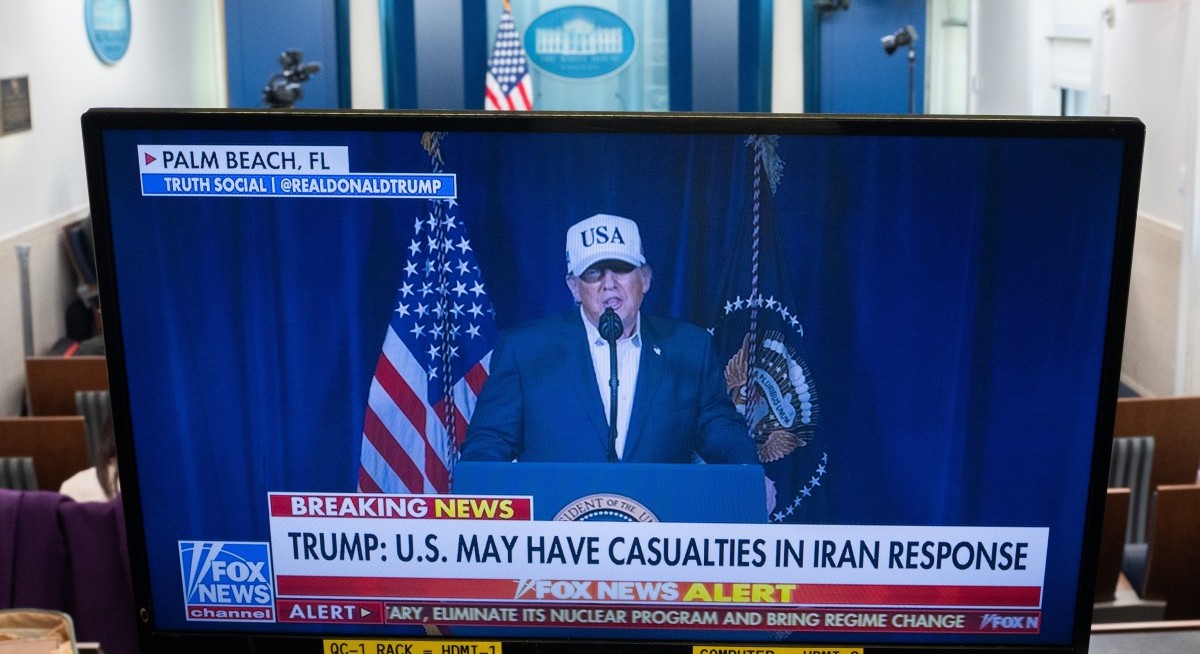


The Trump administration and Israel made two serious miscalculations. They assumed that decapitating the Iranian leadership would cause the regime to collapse in a few weeks and that Iran would prove unwilling or unable to block the Strait of Hormuz or damage Gulf energy-production facilities. They were wrong, and now the market is pricing in US President Donald Trump’s desperation for an off-ramp — the famous Taco (Trump Always Chickens Out) scenario.
But expecting Taco also looks like a miscalculation. If Trump ends the war and locks in the status quo, the threat to shipping in the Strait of Hormuz will remain, risk premia on oil prices will stay permanently higher (at least 20%), and Trump’s popularity will sink even further ahead of this year’s midterm elections. Not only would the current Iranian regime still be in power, but it would almost certainly pursue a nuclear weapon and double down on its production of ballistic missiles, drones, and other means of threatening the Gulf, Europe and the global economy.
So, normative judgments aside, Trump (and Israel) will feel the need to escalate to try to “finish the job.” That means seizing Kharg Island, from which 90% of Iran’s energy flows and intensifying the daily bombing campaigns to degrade the regime’s (new) leadership and capacity to project power militarily. Such a strategy is inherently high-risk, but it could lead — in two or three months — to effective regime collapse and a more stable Middle East. The world economy and markets would no longer be subject to perennial blackmail by a regime with a chokehold on the Strait of Hormuz. The Gulf states and their oil facilities would be safe and secure.
That is the optimistic scenario. If Kharg Island is taken but the regime does not collapse, the Strait of Hormuz and the Bab-el-Mandeb Strait off the Houthi-controlled Yemeni coastline will remain vulnerable, as will the Gulf states and their energy facilities. If the regime holds on, the stage could be set for a repeat of the 1970s stagflation.
See also: Fewer ships transiting Hormuz along Oman coast after U-turns
Nonetheless, I see escalation and a US-Israeli victory (with regime collapse in a few months) as more likely than escalation and a US-Israeli defeat. The first scenario is obviously better for everyone and better than the unstable status quo. But, of course, the second scenario could be worse than the status quo. Ultimately, the decision comes down to Trump and Israeli Prime Minister Benjamin Netanyahu, both of whom are politically doomed if they cannot improve on the current situation in a way that allows them to save face.
The case for eliminating Iran’s fanatical Islamist regime remains strong. For 47 years, the Islamic Republic has been a curse on its own people and the wider region. While subjecting Iranians to oppression and economic misery, it has consistently threatened Israel and meddled in Sunni-majority countries or in countries with large Shiite populations, many of which — including Lebanon, Syria, Iraq, Yemen, Sudan and Libya — have become failed or semi-failed states. In addition to destabilising the entire Middle East, it has sponsored terrorism around the world, helped fuel mass migration into Europe and supported Russia’s war of aggression in Ukraine. Iran’s long-range ballistic missiles can reach all of Europe, while an Iran with nuclear weapons would be a direct threat to all of the Middle East and Europe.
Regardless of what one thinks about Trump’s choice to go to war, everyone should want an endgame in which the current regime can no longer threaten global economic and financial stability or security. Trying to finish the job is better than the alternatives, even given the obvious risks.
See also: Tankers U-turn in Hormuz with some taking Iran route
German Chancellor Friedrich Merz put it well during the Twelve-Day War last June: “Israel is doing the dirty work for all of us.” That was true then, and it is true now. Even though Europe, China and Asia would benefit more from the end of the Islamic Republic than America would, US escalation is likely. The best-case scenario is global economic turmoil in the short run followed by greater global stability, but medium- or long-term disruptions are a very real possibility. — © Project Syndicate, 2026
Nouriel Roubini, a senior economic strategist at Hudson Bay Capital Management, is Professor Emeritus at New York University’s Stern School of Business and the author, most recently, of Megathreats: Ten Dangerous Trends That Imperil Our Future, and How to Survive Them (Little, Brown and Company, 2022)




