


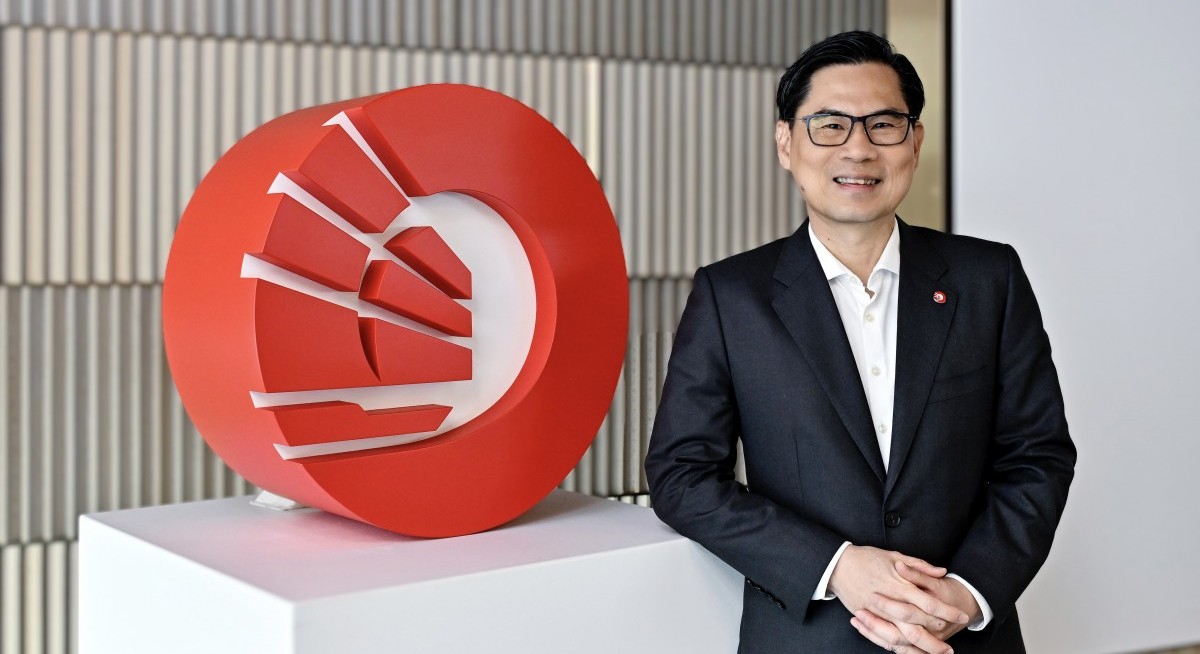


Group CEO Tan Teck Long previously indicated his preference for dividends at the group’s FY2025 results briefing in February. “Given our investor base, which are long-term shareholders, the preference would be for special dividends. Personally, Teck Long prefers special dividends, so that’s certainly an area of flexibility for us,” Goh adds.
The return of the $800 million in special dividends would complete OCBC’s plan to return $2.5 billion of excess capital to shareholders by FY2026, paid out in May 2027.
Group’s 1QFY2026 performance checks 'every box’
Shares in OCBC opened 68 cents higher or 3.11% up at $22.56 on May 8 after the bank’s 1QFY2026 results release.
See also: OCBC boosts hiring for Indonesia wealth business as assets rise
During the quarter, group net profit rose by 5% y-o-y and 13% q-o-q to $1.97 billion, led by double-digit growth in wealth management.
CEO Tan Teck Long said the group’s performance checked "every box” in terms of growth. “We expanded our loan book, we expanded our policy book even faster.”
The group’s non-interest income, which rose by 23% y-o-y and 22% q-o-q to $1.61 billion — making up 42% of the group’s total income — experienced broad-based growth across all of its business units. Notably, the group reported “robust” fee income growth led by wealth management, record customer flow treasury income and strong increase in insurance income.
See also: Local banks unaffected by revised liquidity coverage rules effective Sept 1
When asked about maintaining the group’s earnings momentum amid declining interest rates, Tan said the decline slowed down. “The quarter to quarter fluctuation is because we’ve got some recovery of NPL (non-performing loans),” he explains.
HSBC Indonesia acquisition builds on OCBC’s strengths
On May 4, OCBC announced that it was acquiring HSBC Indonesia’s international wealth and premier banking portfolio (IWP) for a premium of $480 million. The deal is expected to bolster the size of OCBC Indonesia’s wealth management talent pool by 1,300 staff. The acquisition will also help to grow the Indonesian subsidiary’s assets under management (AUM) by 25% and increase its credit card balances by more than 150%.
“When I look[ed] at the IWP portfolio, I realise[d] this is a perfect fit for our ‘Next Frontier’ strategy,” Tan says. “Most of the portfolios we have seen in the marketplace available for M&A (mergers and acquisitions), tend to be a mix of loans and deposits. This portfolio is very clean. It’s largely deposits and AUM.”
Tan unveiled the bank’s “The Next Frontier” strategy at its February briefing, which includes growing OCBC Private Bank in Indonesia among other focus areas.
“Why is that a good portfolio? If a portfolio has loan content, we have to worry about two things. [Firstly,] downside risk due to credit cost. Secondly, if the portfolio is large, we actually reduce value because of single borrower risk concentration. So, we have to manage that.”
In particular, Tan says he was attracted by the sizable number of current accounts and savings accounts (CASA) present in HSBC Indonesia’s IWP portfolio. “So, CASA to the bank, if you put on the CASA, you actually make money straight away because CASA is a low cost [way] for us to help fund our loan business.”
For more stories about where money flows, click here for Capital Section
“As a wealth portfolio, IWP is highly complementary to our existing Indonesian franchise, with clear synergies across customers and capabilities. It will add further scale to our AUM customer base,” Tan continues, adding that OCBC enjoys significant economies of scale in Indonesia due to its status as one of the top three privately owned banks in the country.
S&P Global Ratings’ analysts Ivan Tan and Sue Ong write in a note dated May 5 that the acquisition is a “good fit to incrementally grow its Indonesia franchise” and will help to “grow its fee-based business at a time of flattening bank-lending margins.”
According to Tan and Ong, the immediate financial impact of the acquisition on OCBC will be “limited given the small size of the acquisition.” The pair expect the bank to remain well capitalised following the acquisition and for its risk-adjusted capital ratio to stay at 8.5% - 9.0% over the next two years.
Some analysts, however, are not as optimistic on OCBC’s acquisition. In a report published on May 5, UBS analysts Aakash Rawat and Benjamin Tan say that the deal “looks a bit overvalued based on the reported PBT (profit before tax) of $3.9 million in 2025” for HSBC Indonesia’s IWP business.
“Apart from the price paid execution remains a key risk: a 20% – 30% deposit attrition post-migration would materially compress the earnings base underpinning any valuation, turning it into an even more expensive deal,” Aakash and Tan say in their May 5 report.
OCBC’s deal comes as its rivals, DBS Group Holdings and United Overseas Bank (UOB) are striving to grow their market share in the wealth business. On May 7, UOB’s deputy chairman and CEO Wee Ee Cheong told reporters during the bank’s 1QFY2026 earnings briefing that UOB wants to double its wealth income by 2030. UOB’s net fee and commission income from its wealth management business in FY2026 was $822 million.
“Competition has been intense over the last 10 years,” says OCBC’s Tan. “It’s not a new thing to us, but the more important thing is our capabilities.”
According to Tan, the competitive landscape in Asean for wealth management has actually become less competitive as some players have exited from the field. This presents an opportunity for OCBC since the bank can leverage on its strong franchise as well as its product capabilities within the Asean market to tailor products for specific countries.
“In that sense, that is a differentiating advantage for us,” Tan says, adding that the bank’s goal was to achieve double digit y-o-y growth in its wealth fees and AUM.
OCBC more concerned over third order impact from Middle East
The ongoing conflict in the Middle East remains very much a concern, because it will directly impact businesses in Southeast Asia in terms of energy supply and prices.
While the group does not see credit quality issues in its portfolio, it has put in general provisions for non-impact loans.
Like UOB, the bank is not as worried on the first order impact given that only 3% of loans or 1% of total assets — which includes the petrochemical and refinery sector as well as other direct Middle East nexus — are exposed.
Instead, the group is more concerned about the effects of a third order impact, which will have wider implications on the macroeconomic front.
It is also business as usual (BAU) for OCBC’s private bank arm, Bank of Singapore, which has an office in Dubai. Departures — including that of Ranjit Khanna, Bank of Singapore's (BoS) global market head of Middle East and chief executive of Dubai — have not had much impact on the bank’s assets under management (AUM).
“Dubai, while it’s a centre for BoS, the contribution [from the city] is actually not that much,” says Tan. “Even if there are some temporary outflows or impact, we don’t expect material impact to our franchise.”
He adds that the situation in Dubai is so volatile that the bank will have to “see what’s happening”. However, overall, the bank has seen increased inquiries from its customers in Dubai in general, which should mitigate any impact of any staff leaving.
As at 12.40pm, shares in OCBC are trading 10 cents higher or 0.46% up at $21.98




