


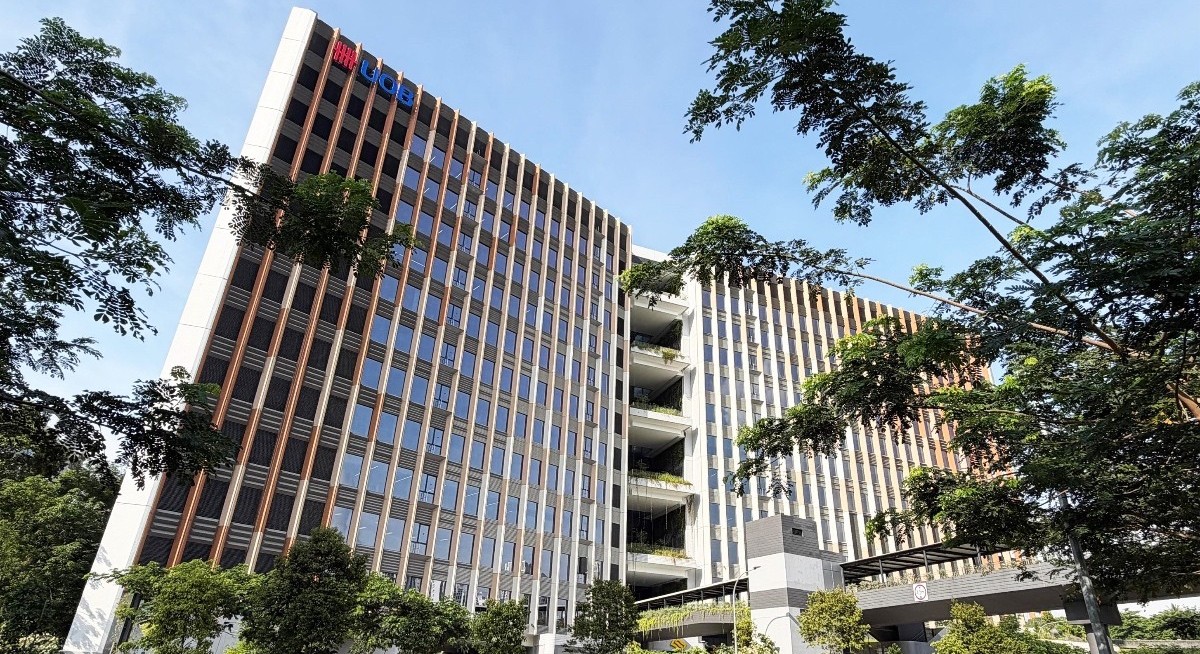


Lawrence Goh, head of group technology and operations, says on May 5 that the relocation will allow the bank to “bring ideas and talents together” within a broader innovation ecosystem, contributing to Singapore’s Smart Nation push.
With the first cohort of about 400 employees now operating from Tower 80 as of May 4, UOB says more than 3,000 staff will progressively relocate to the facility by October, consolidating its technology, digital and innovation teams into a single campus.
The development comes as PDD itself comes online as Singapore’s first enterprise district, a 50-hectare mixed-use hub integrating business parks with Singapore Institute of Technology (SIT)’s campus to encourage collaboration between industry and academia, supporting the testing and scaling of new technologies.The district is expected to create up to 28,000 jobs and has been opening in phases since 2024, with convenient transport links via Punggol Coast MRT station and bus interchange.
The new facility will act as a regional hub to “design and deploy next-generation banking solutions across Asean,” says UOB, as it scales its use of artificial intelligence and data-driven platforms. This includes its model analytics platform (MAP) for enterprise AI deployment, as well as initiatives such as the UOB-IMDA AIDA Centre of Excellence, which trains early-career professionals in AI and data analytics through placements in live business and innovation teams. IMDA refers to the Infocomm Media Development Authority while AIDA refers to the Artificial Intelligence and Data Analytics grant under the Monetary Authority of Singapore (MAS).
See also: Cisco, Digital Defence Alliance Singapore launch a three-year AI and cybersecurity training push
Beyond internal capabilities, the bank is extending its digitalisation push to businesses. Through programmes run by UOB FinLab – the AI Ready Programme launched in partnership with AI Singapore, IMDA and Microsoft; and the UOB SME Elevate Programme – SMEs are offered expert advisory, tools and training to adopt AI. UOB says these initiatives, which include structured training and workshops, will also be hosted at the new PDD site.
According to UOB, among the first employees housed at the district are teams behind its digital banking app, UOB TMRW. UOB TMRW hosts many services, including integrating payments, lending, and investment services. UOB says its app delivered 530 million personalised insights to 5 million customers across Southeast Asia in 2025, with about half of users engaging with these recommendations.
Efforts in workforce transformation have been stepped up as well, as UOB reports that about 90% of its employees globally trained in generative AI in 2025. The bank also launched an internal Innovation Academy in October the same year to encourage employees innovating, from which it produced Ask#1, a generative AI chatbot now used by more than 85% of branch staff in Singapore to support customer service.
See also: When billions watch, every impression counts
On sustainability
The Tower 80 facility has been designed in line with PDD’s broader green infrastructure, featuring over 100 collaborative workspaces. It contains AI-enabled meeting tools and robotic systems for building operations, alongside sustainability features such as smart energy management and solar panels.
Located within a car-light district, the site is supported by infrastructure such as district cooling, electric vehicle charging and integrated waste management systems. UOB says additional features, such as smart energy management systems and rooftop solar panels, will help reduce its environmental footprint.
The move marks a significant step in UOB’s broader digital transformation strategy, as it seeks to consolidate its technology capabilities while embedding itself within Singapore’s evolving innovation landscapes.
As of 2pm, shares in UOB are trading 12 cents lower, or 0.33% lower, at $36.04.




