


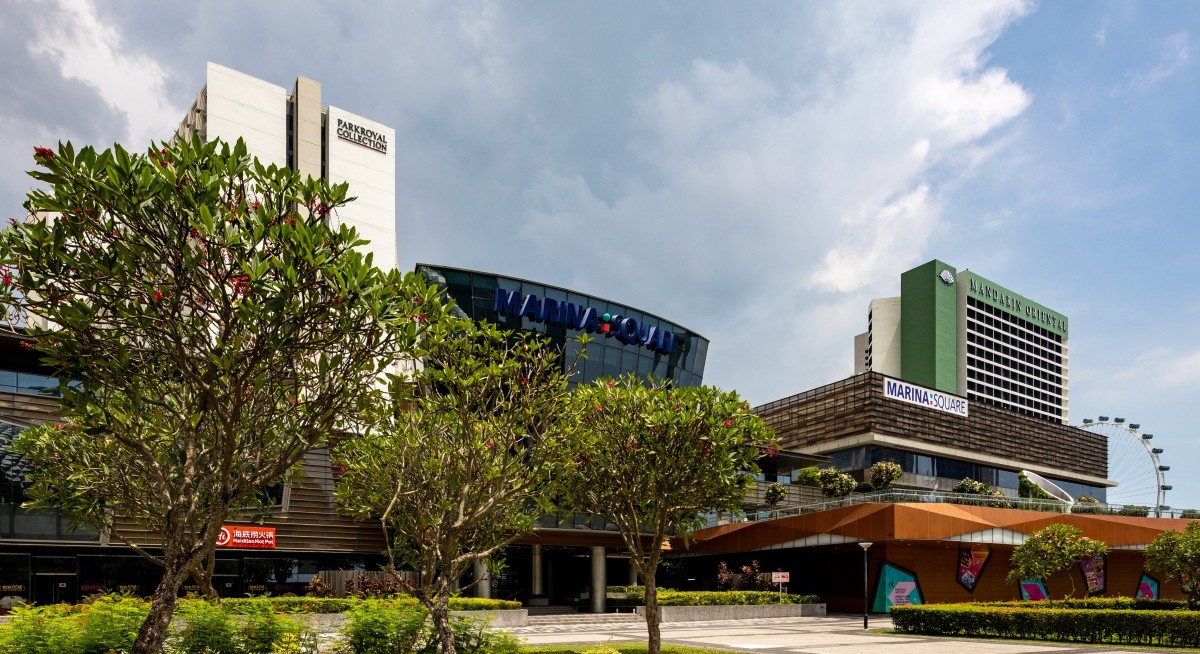


At approximately 3,992 sqm, the land parcel is part of the Marina Square complex, which comprises shopping mall Marina Square and three hotels: Pan Pacific Singapore, Parkroyal Collection Marina Bay and Mandarin Oriental. The total site area stretches over some 92,197.3 sqm.
Mandarin Oriental and the adjoining Ritz-Carlton, which are linked to the Marina Square complex, are owned by different entities.
SingLand plans to consolidate the holdings and transfer the land parcel to Marina Residential Development, a wholly-owned subsidiary of Marina Centre Holdings, which is 77.34% held by SingLand subsidiary Singland Properties Limited and 22.66% held by UOL.
SingLand says it is “working on more detailed plans” while the proposal is under review by the authorities. The Mainboard-listed group says it will provide further updates in 1H2026.
See also: Freehold five-storey shophouse at 42 South Bridge Road for sale at $33.4 mil
The Marina Square complex is a 99-year leasehold mixed-use development with about 54 years remaining on the lease. Marina Square shopping mall, opened in 1986, is a five-storey retail mall with a net lettable area of 0.8 million sq ft and was valued at $1.05 billion as at 1H2025.
Marina Square last underwent major renovation works about a decade ago. Over three phases, the mall added a restaurant-focused wing, an extended retail area and PSB Academy’s city campus.

See also: S’pore property sentiment index plummets into ‘pessimistic territory’
SingLand’s announcement is not entirely surprising to the market. Its shares began climbing in July and are up nearly 80% year to date.
SingLand obtained provisional permission from the Urban Redevelopment Authority (URA) in 3Q2023 for the partial redevelopment of the Marina Square complex, including rezoning a portion of the existing site for residential use. Sometime in 2H2025, SingLand submitted a revised proposal to URA.
Citi Research analyst Brandon Lee notes that SingLand’s 3Q2023 plan outlined a mix of office (some 0.2 million sq ft in GFA), retail (0.94 million sq ft in GFA) and 702 residential/service apartments.
While SingLand has not provided details on the size of the components under the revised proposal, Lee thinks they “should not differ significantly” from the 3Q2023 plans, and the three existing hotels are unlikely to be involved as they are “relatively new”.

Two substantial shareholders
According to SingLand’s latest annual report, released April 7, UOL holds a 50.37% stake in SingLand, while JG Summit Holdings holds 37.05%.
To stay ahead of Singapore and the region’s corporate and economic trends, click here for Latest Section
JG Summit is one of the largest conglomerates in the Philippines. Controlled by the Gokongwei family, the investment holding company bought a 23% stake in what was then UIC in 1999. It mounted a takeover offer in 2005 after its stake grew past the 30% threshold.
Filipino billionaire Lance Yu Gokongwei has been president and CEO of JG Summit since 2018. The second child and only son of tycoon John Gokongwei Jr, who founded JG Summit, Lance was first appointed to the board of SingLand in 1999. He was re-elected as a non-executive and non-independent director of SingLand in April this year.
Meanwhile, Wee Ee Cheong is UOL’s largest shareholder, with a 29.73% deemed stake as at March 7. Wee’s youngest brother, Wee Ee Lim, holds about 140,000 fewer shares, giving him a 29.71% deemed stake in UOL; while Wee Ee-chao has a 16.09% deemed interest in UOL’s shares.
SingLand’s ongoing projects
The redevelopment marks another of SingLand’s projects, following ongoing works at Singapore Land Tower and the former Clifford Centre. SingLand, which was renamed from United Industrial Corporation (UIC) in 2021, posted revenue of $368.3 million for 1HFY2025 ended June 30, 8% higher y-o-y; and patmi of $103.0 million, up 6% y-o-y.
SingLand CEO Jonathan Eu has been at the helm for just over four years. He joined as chief operating officer in 2020 from UOL, where he had spent a decade.
Under Eu, SingLand rebranded itself from UIC and announced major redevelopments. SingLand’s net asset value (NAV) per ordinary share as at end-2020 was $5.12. Its NAV as at June 30 this year was $5.88.
SingLand’s relatively low free float, however, could be a reason for its scant analyst coverage. In April, months before the redevelopment was officially unveiled, DBS Group Research analysts Derek Tan and Tabitha Foo called SingLand “the best proxy” for the project, expecting a revalued net asset value (RNAV) uplift of 52–77 cents, or 8%–12%.
Still, DBS has kept SingLand un-rated till now. In fact, none of the local brokerages has initiated formal coverage on SingLand.
Instead, analysts are more interested in parent UOL. DBS’s Tan and Foo had a “buy” call and $8.40 target price on UOL in April, which has since risen to $8.80 as at Dec 4.
Tan and Foo call the latest news “a step in the right direction” for UOL. “We remain excited that the group is taking incremental steps towards the crystallisation and redevelopment of Marina Square, a key ‘value-unlocking’ thesis that has kept investors’ attention on the group through the year.”
Interestingly, Tan and Foo have a $2.60 fair value estimate on unrated SingLand. “At current price, UOL still trades at 0.6 times price-to-book (P/B) or a 50% discount to RNAV, while SingLand trades at 0.5 times P/B and a 55% discount to RNAV.”
DBS’s Tan and Foo say they will be reviewing their target prices “in upcoming updates”.
Meanwhile, JP Morgan analysts Terence M Khi and Mervin Song see a potential gross development value (GDV) of $4.4 billion and a $1.1 billion (5%–6%) uplift to SingLand RNAV.
They note that SingLand’s revised proposal “appears to have substantially reduced the level of retail space, which had originally amounted to close to half our GDV estimate”. In a flash Dec 3 note, Khi and Song call this a “positive”, “given the strong competition from luxury retail at Marina Bay Sands and mass retail at Suntec City mall”.
Could UOL list a REIT?
Turning their attention to UOL, Citi has a “buy” call with a target price of $9.60, but prefers City Developments for its “more attractive valuations”.
In a Dec 3 note, JP Morgan’s Khi and Song maintained an “overweight” rating on SingLand’s parent, with an even higher $10.15 target price.
The next day, Khi and Song issued a follow-up noting that UOL is the only major Singapore developer yet to list a REIT, musing that UOL’s management “may pursue a REIT strategy” to close UOL’s 36% discount to book value.
Asset monetisation may also help offset capex commitments for the upcoming Marina Square redevelopment, they add, though UOL’s balance sheet capacity “remains strong” with $2 billion to $3 billion capex to lift gearing from 25% to 37%–43%.
At UOL’s annual general meeting on April 28, CEO Liam Wee Sin replied to a shareholder saying that UOL may consider establishing a REIT “under the right market conditions” and that it has a “good pipeline and mature real estate assets” with key considerations such as interest rates, property yields and market sentiment.
Some $14.3 billion in assets could be injected into a UOL REIT, says JPMorgan. To offer a dividend yield above 5%, UOL may have to “preclude” pure-play Singapore office or hospitality portfolios, which would yield only around 3.5% or 4% net property income (NPI), respectively, according to JP Morgan’s calculations.
SingLand owns 100% of UIC Building (valued at $740 million), Singapore Land Tower ($1.93 billion), The Gateway ($1.24 billion), SGX Centre 2 ($582 million) and West Mall ($434 million). UOL owns many properties, including Odeon 331 and 333 ($680.8 million), 70% of Novena Square ($1.47 billion) and United Square ($1.14 billion). Clifford Centre could be a pipeline property in the new REIT.
Interestingly, JP Morgan points out that UOL “has been building commercial and hospitality REIT management expertise”.
UOL CFO Eric Ng, who joined in 2024, was formerly the CFO of Keppel Infrastructure Trust. UOL chief investment and asset officer Shirley Ng, who joined in 2023, was deputy CEO and head of investment for Keppel REIT.
Outside the C-suite, SingLand’s head of investment and portfolio management, Joseph Lim, who joined in 2021, was formerly the deputy head of investment and portfolio management at CapitaLand Integrated Commercial Trust (CICT). Finally, the CEO of UOL’s wholly owned Pan Pacific Hotels Group, Choe Peng Sum, who joined in 2019, was previously CEO of Frasers Hospitality, where he launched Frasers Hospitality Trust.
Photo: Samuel Isaac Chua/EdgeProp Singapore




