




During Ko’s time at Cityneon, now renamed Neon Global, the company was contracted to provide support for various high-profile events across the region, including the F1 races and also key conventions here, such as CommunicAsia.
By Ko’s own account, he was “quite ready” to retire after leaving Cityneon. For two years, he did little more than read newspapers, play golf, meet people for lunch and wait for “things to happen”.
During his “retirement”, some of his former colleagues at Cityneon, who were running the sporting management division which Ko started during this time there, decided to start their own shop — Kin. This team, says Ko, had already built up a certain track record supporting events such Sea Games and Youth Olympics.
Ko believes that Kin is meeting an obvious need, providing the local expertise to run major events, instead of paying through the nose for foreign consultants. The business is part of a broader tourism-related economy — including hospitality, meetings, conventions, exhibitions, which in 2024, generated tourism receipts of $29.8 billion with 16.5 million visitors. This number is estimated to further grow to between $29.0 to $30.5 billion in 2025 with 17 and 18.5 million visitors. Come 2040, Singapore is shooting for $47 billion to $50 billion in tourism receipts, said Minister-in-charge of Trade Relations Grace Fu last April.
See also: Syngenta hiring banks for potential Hong Kong IPO, Bloomberg reports
Besides revenue from running events here in Singapore, such expertise can be “exported” to regional countries too, many of which are also hosting similar events, he says.
Seeing this market potential, and eager to put behind a retiree’s life, Ko decided to join his three former colleagues — Vincent Chai, Adrian Tan and Clement Tan — chipping in enough equity as well to the point that he is also the largest shareholder. “I now have an office to go to, I now have young people to have lunch and dinner with,” adds Ko.
Grew and grew
See also: GIC-backed Thai start-up weighs IPO in Hong Kong or New York
Kin did not have hugely ambitious plans at the start. “It was basically just to keep each other alive, keep each other employed, and then be happy with it,” says Ko. To their surprise, the business grew and grew, winning contracts from one event to another.
Even the pandemic years became a break of sorts for Kin. The World Table Tennis Cup Finals 2021 were supposed to be held in China. However, because of fluid lockdown restrictions, Singapore “very cleverly” put up its hand to be the alternative instead. As Ko recalls, attendance was “very sparse”, but the event was managed smoothly, further boosting the company’s profile in this sector.
With the already sunk-in investment in infrastructure such as the Sports Hub, the Singapore government is keen to have more events. “That’s more activities for us, and more good news for us,” he says.
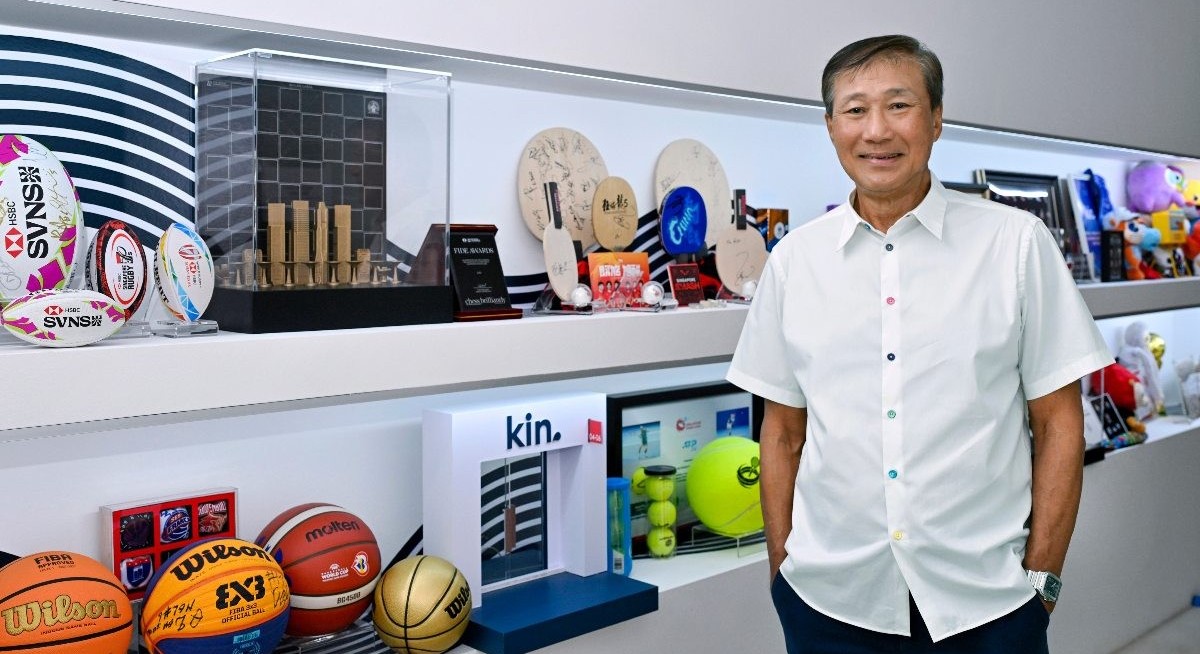
The list of events with Kin’s involvement grew longer and longer: HSBC SVNS Singapore, World Aquatics Championships 2025, WTT Singapore Smash 2025, a martial arts world championship held virtually and even a chess championship. “Yes, chess is also a sport,” says Ko with a laugh. “You must be the first name to recall. When people think of sports, they must think of Kin,” he adds.
Immersive show
Beyond just sports, Kin also has ambitions to gain ground in other markets, namely the arts and culture space. When visitors fly in for a sporting event, they would be open to doing other things, such as visiting galleries or other attractions, like Gardens by the Bay, which drew 14.5 million visitors in 2024, as indicated in its annual report.
With this catchment market in mind, Kin is investing to produce an immersive experience show at a venue within the Gardens, featuring digital light projections, complementing physical exhibits to create an experiential journey. If just 10% of the annual visitors to the Gardens watch the show, that will, in Ko's view, generate sufficient business, reasons Ko, who plans to introduce more of such shows elsewhere, given the scalable nature.
To stay ahead of Singapore and the region’s corporate and economic trends, click here for Latest Section
Kin has assembled a content creation team that Ko believes is “very good” at what it does, and is also exploring preliminary partnerships with overseas content producers. Some of these foreign players may come to Singapore to set up their own shows, but Ko says that’s okay. “If you are the only pub on the street, then it is not so good. But if you have 10 pubs, it is very vibrant, and people can go pub crawling and every night is full,” he says.
Doing fine
Kin, says Ko, is doing fine as it is. “We are already very good at what we do, and actually, we are flush with cash; we have no bad debts,” says Ko, adding that for a company just seven years old, it has a healthy cash balance and no loans.
Realistically, Kin can be a leading player in sports management, but growth may eventually slow. Therefore, if the company wants to grow more meaningfully, it needs to build new pillars — including the immersive experience show at the Gardens, and therefore, the intention to explore corporate actions, including a possible listing so as to raise additional capital.
Ko says another key reason for the listing is so that his three other equity partners, who have a good 20 years to go before retirement, certainly harbour bigger ambitions. “If you want to grow and grow fast, you need to do M&As. You need to buy existing companies that have already grown. You take them, you join them, you merge with them, and you take them to the next level.”
Besides immersive experience, Ko is eyeing another new pillar. “We are not happy just to stay as an event logistics provider. We are not happy to stay just as an event delivery specialist. We want to go up the value chain, and we want to develop a business that grows, we want to be a promoter and an organiser and a possible owner of sports IPs, of international sports IPs,” says Ko.
As an organiser, pretty hefty capital will be required. Besides paying the IP owner for the rights, there are also the event costs, publicity and marketing costs to take care of. Ko has not quite confirmed what kind of sports events he wants to organise. The company is in talks with a few potential prospects.
Lumpy, or not
Ko, who is an active investor himself, understands perfectly that the investment community here like certainty of dividends and are not especially thrilled to see companies reporting lumpy earnings.
Ko explains that Kin’s business is both “lumpy” and “not lumpy”. When Kin takes on new contracts of sporting events, they typically go for multi-year terms of three or more years. So, every year is a recurring business for him. There are, of course, ad hoc events that for one reason or another show up in the event calendar on short notice; or, it can be the same event, but on a rotation across numerous host countries, he says.
Ko recognises that Kin should not rely on event-based contracts, and immersive experience theatre is a way to grow a bigger recurring revenue base. “Our market is not Singapore. Our market is the 16 million tourists who visit Singapore a year,” he adds.
Ko is also keen to grow a bigger share in the Mice (meetings, incentives, conferences and exhibitions) market. Show and event organisers like to commit to multi-year contracts. On one hand, they aim to sign up more exhibitors, enticing them to put downpayments to secure prime spots. On the other hand, they work with the same vendors and similarly pay them deposits to secure their commitment. “I believe my business is better than McDonald’s. You open a shop, and you only collect cash when people come in and buy a burger. Before my shop opens, I collect cash already,” adds Ko.
There’s business too when preparation works are underway as well. “They keep coming to me: hey, I want to lease two more tables, six more lights,” says Ko. The cost he spent buying each chair can be recovered after leasing them out a couple of times. Similar to other almost essential items, such as power plugs, coffee machines, and printers. Exhibitors might baulk at what they have to pay, but they also realise they are paying for the service and the convenience. When not in used, these fittings are kept in a warehouse. “I don’t want to see any stocks in the warehouse. Stocks going out means more money,” adds Ko.
Exciting company
Kin’s intent to explore corporate actions comes at a time when the market activity in Singapore has picked up strongly. To Ko, the state of the market is not the only consideration as he cannot time the market. Rather, his priority is to find the optimal ways to drive growth. If raising funds to fuel new growth is something in mind, then just do so. Of course, on the companies’ part, they need to be active in their investor relations efforts.
Ko is aware of all the criticisms of SGX, how the local bourse suffers from low liquidity, how it is not easy to trade and make money — arguments which Ko disagrees with. “If you spot quality companies in Singapore in SGX, you can make good money. Personally, I did,” he says, citing multi-baggers like Centurion Corp and Hong Leong Asia. “You invest in the right space. The timing will take care of itself at the right time. If there are some very basic, fundamental problems, then, say, you made a mistake and get out,” he says.
Meanwhile, he is upbeat about the business. “We are going to be a very, very exciting company. Whether we continue to make or generate this type of growth, I cannot promise, but we have that intention, and we have shortlisted some of possible targets, and we have identified this space, which I find very, very exciting.”




