




The testbed will validate HVDC power systems under real AI computing conditions, including racks operating at power loads of at least 325 kilowatts using current-generation AI servers. STT GDC says the platform is designed to assess whether direct current (DC) systems can support higher-density computing with lower energy losses and improved reliability compared with conventional alternating current (AC) designs.
As AI and high-performance computing workloads scale, traditional AC power systems face efficiency and infrastructure limits. According to STT GDC, HVDC systems can cut overall energy losses by up to 30%, reduce carbon emissions by as much as 400 tonnes of CO2 equivalent per megawatt each year, and shrink the physical footprint of power infrastructure by 30% to 40%. DC systems are also believed to be more compatible with renewable energy sources, which generate power natively in DC form.
Bruno Lopez, president and group chief executive officer of STT GDC, says the company plans to deploy the HVDC architecture in future data centres in Singapore and expand its use across its global portfolio if trials are successful. "The FutureGrid Accelerator is a strategic investment in Singapore's long-term digital leadership. By bringing together global industry leaders like LITEON with local deep-tech talent such as Amperesand, we are building infrastructure that is ready for future AI workloads while pioneering sustainable practices and setting new benchmarks for energy efficiency and carbon-conscious innovation."
The FutureGrid platform integrates LITEON's data centre reference architecture with Amperesand's solid-state transformer technology, which converts medium-voltage electricity directly to the levels required by servers. STT GDC said HVDC systems can support ultra-high-density racks exceeding 1,000 kilowatts with higher reliability and lower cost.
See also: Asia-Pacific data centre market set to triple by 2030 as AI drives demand: Aprea
Alongside the technology rollout, STT GDC signed memoranda of understanding with four local education institutions: the Institute of Technical Education (ITE), Singapore Polytechnic (SP), Nanyang Technological University and the National University of Singapore.
The partnerships are aimed at building a workforce trained in AI infrastructure and energy-efficient power systems, with programmes expected to reach more than 8,000 Singaporeans over five years.
STT GDC will provide internship placements across operations and corporate functions, sponsor professional certification for data centre technicians, and work with schools to co-develop curricula focused on sustainable infrastructure and high-density computing environments.
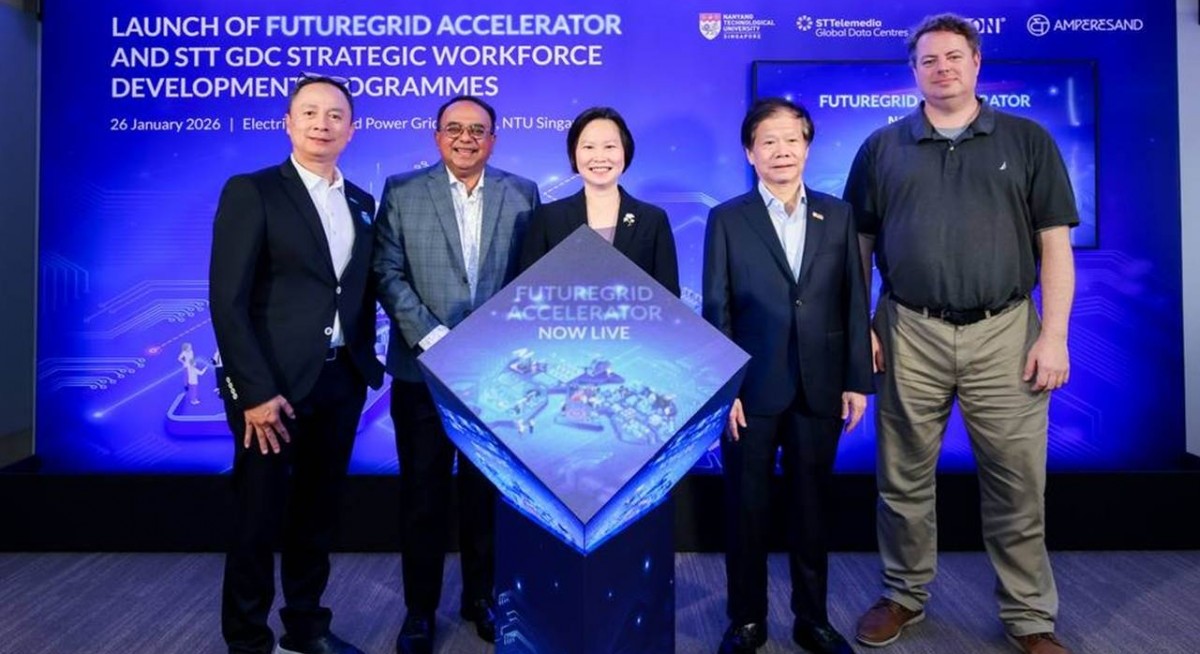
The launch of the FutureGrid platform was officiated by Gan Siow Huang, Singapore's Minister of State for Foreign Affairs and Trade and Industry. He says: “The FutureGrid Accelerator demonstrates how industry and academia can work together to drive innovation and strengthen Singapore’s global leadership in cutting-edge technologies. I also welcome STT GDC’s partnerships with ITE and SP, which will add to the suite of training options for the rapidly growing areas of AI and energy-efficient systems.”




