


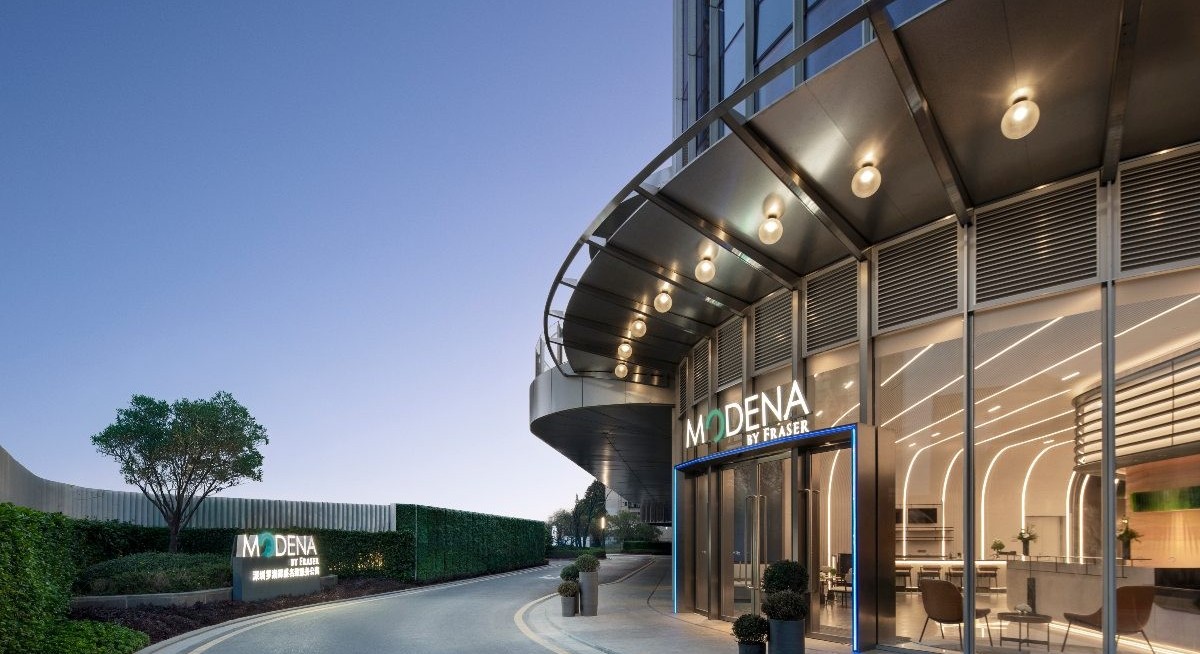


It is this structural shift that Frasers Hospitality is looking to tap on. On Jan 22, the hospitality operator announced the launch of Modena by Fraser Shenzhen. The 325-room premium rental apartment in Shenzhen’s Luohu district marked the Modena by Fraser brand’s flagship entry into the sector in China.

At the launch of Modena by Fraser Shenzhen. From left: Tyler Li, general manager of Modena by Fraser Shenzhen; Jason Leong, executive director and head of investment & asset management of Frasers Hospitality; Carrie Liu, managing director and head of asset management of Tishman Speyer China; Eu Chin Fen, CEO of Frasers Hospitality; Wilson Chen, CEO and senior managing director of Tishman Speyer China; Cindy Xin, managing director of Tishman Speyer and COO and legal director of Tishman Speyer China; Chew Hang Song, COO of Frasers Hospitality. Photo: Frasers Hospitality.
The 16-storey Modena by Fraser Shenzhen is housed within the 25,076 sqm (269,916 sq ft) 54-floor Shennan 1001 building. It was acquired in May 2023 through a 50:50 joint venture (JV) with global real estate development and investment firm Tishman Speyer for an estimated RMB717 million ($132 million), and is managed by Frasers Hospitality.
See also: The Great Room grows to 10 locations with ‘managed solutions’ to debut
The launch brought the group full circle to where it all began. In 2010, the Modena by Fraser brand, then a JV, was launched to offer “affordable and stylish” fully serviced residences in fast-growing cities. The brand debuted with the Modena by Fraser Putuo Shanghai.
The Modena brand has traditionally been positioned at the upper-mid-scale level within Fraser’s portfolio, says Chew Hang Song, chief operating officer (COO) at Frasers Hospitality. “Typically, we target the white-collar professional who is looking for more premium accommodations with lifestyle offerings. [They are also looking for] peace-of-mind type of package deals that can be put together according to their needs.”
The brand refresh, says Chew, can be deemed as an upgrade of its previous iteration.
See also: The greenest building is the one already standing
CEO Eu Chin Fen, who was already part of the group when Modena was first formed, recalls that the brand’s earlier days targeted the “road warriors” — referring to China’s food deliverymen and domestic business travellers — with mostly one- and two-bedroom apartments on offer.
To her, things have evolved since the launch around 15 years ago. The group has also taken full control of the Modena by Fraser brand since April 2015. It was an amicable parting, says Eu.
When asked, Eu adds that the Covid-19 pandemic that shook the global hospitality industry was one of the catalysts, but there were other factors at play too. Even before the pandemic, young people were already priced out of home ownership, especially in gateway cities such as Shenzhen and Shanghai. Despite the property downturn, it would still be difficult for regular workers to own their homes, she says.

The living room for Modena by Fraser Shenzhen’s one-bedroom deluxe units, which measure 52 to 56 sqm. Photo: Frasers Hospitality
The tech and artificial intelligence (AI) boom also changed lifestyles, with more young professionals preferring to “live for the now”, shunning marriage to instead experience what the rest of the world has to offer. With that also comes the decision to simply rent than to buy a property.
Given these trends, Frasers Hospitality felt it was time to reconsider its portfolio of brands. Modena, in particular, has been a “very mixed bag”.
Serving young professionals
The Modena brand targets the younger segment who can afford to pay a premium and Shenzhen, famous as home to the headquarters of Huawei and BYD, and not merely adjacent to Hong Kong, is an ideal testing ground. According to Frasers, the city has a population of around 18 million, with roughly 70% from other parts of China —many of whom are professionals drawing monthly salaries of RMB50,000 or $9,129 a month.

Eu Chin Fen, CEO of Frasers Hospitality. Photo: Frasers Hospitality
“The profile of our guests are evolving,” says Chew, noting that the needs of expats, which used to make up a bulk of demand in China, are seeking different features compared to locals. “Expats are mainly looking for comfort and peace of mind. But if you’re catering to the local domestic market, you’ve got to do a bit more. That’s why we are trying to push the boundaries in terms of our product design.”
“I don’t suppose you can find any similar product like us in the market,” he adds, referring to the layout and fixtures, such as movable wardrobes and Murphy beds, for their studios. Thanks to these fixtures, or what Frasers calls transformable furniture, a 25 sqm studio can be configured to accommodate 10 to 12 people easily, according to Chew.
Modena by Fraser Shenzhen’s rooms are priced from RMB6,800 without services for 25 sqm studios and RMB7,500 including services. Prices can go up to RMB28,800 for a two-bedroom apartment measuring 75 to 103 sqm, including services. Cleaning services are provided twice a week.
The refreshed design feels more cosy, too. Where the previous serviced residences resembled hotels, Frasers is now making a concerted effort to include more storage and wardrobe spaces to cater to residents’ daily living needs.
The latest project also includes sporting amenities like a pickleball court. Such amenities are “very scarce” in China, says Chew. Other facilities include a gym, yoga room, reception services, and a breakfast lounge for guests. The property also offers a curated programme of neighbourhood walks to introduce residents to local experiences. Resident ambassadors are on hand to provide guidance and day-to-day support for newcomers settling into the city.
Pricing in, not out
Modena by Fraser Shenzhen’s pricing strategy seems to fill a sweet spot in Shenzhen’s rental market. “We have a very good price point. [We provide] value for money options for this particular segment. If [our target market] chip in part of the rental together with their friends, they’ll be able to afford a kind of lifestyle they can’t find anywhere else in Shenzhen,” says Chew.
To Eu, these prices are affordable considering the average salary range, though they are leaning towards the “premium rental market”.
Chew thinks the offering is still reasonably priced, noting that a “typical good quality serviced residence” would easily cost double. While their target market may opt to rent a condo at half the price, Chew notes that these apartments would not come with the property’s facilities and hygiene standards.
A scalable blueprint
What excites the Frasers team most is the model’s potential beyond Shenzhen. Beyond seeing structural trends in its favour, the group believes that the room sizes — while smaller — are comfortable enough for long-stays, says Jason Leong, executive director and head of investment and asset management of Frasers Hospitality.

Jason Leong, executive director and head of investment & asset management of Frasers Hospitality. Photo: Frasers Hospitality
The product, he argues, works anywhere with similar dynamics, such as Tokyo and Singapore. Eu reckons there will always be demand for long stays. In addition, the gross operating profit (GOP) margin is significantly higher compared to shorter-stay properties such as hotels. “While you get a lower rate — because longer stay is typically at a 20% to 25% discount compared to short-stay [or] overnight — if your margin is much higher, it more than makes up for the 20% to 25% price difference between short- and long-stay. The long-stay model is a lot more resilient.”
Margins are better compared to hotels because of operational advantages, says Leong. For instance, without the constant churn of people checking in and out, the manpower requirement is lower.
Currently, Modena by Fraser Shenzhen has 70% long-stay guests and 30% short-stay. The group aims to push this towards an 80:20 ratio. “By virtue of the business model, it is a very defensive kind of play,” says Chew.
“Of course, dealing with risk is part and parcel of the business, but the beauty of the operating model is such that we can pivot towards shorter stay if we see a sudden weakness in long-stay demand,” he adds. “We’re always keeping a very close watch, and we can always make tweaks, make adjustments to the different market segment contributions we need.”

Amenities include sporting facilities like a pickleball court, gym and yoga room. Photo: Frasers Hospitality
Post-REIT privatisation plans
The launch of Modena by Fraser Shenzhen comes just months after Frasers Hospitality Trust (FHT) was delisted last August in its second attempt. The REIT first tried to privatise in September 2022 with a 70-cent per unit offer but missed out by a narrow margin. It offered 71 cents per unit in its second offer, representing 1.11 times its net asset value (NAV).
“We were the ones who mooted the privatisation,” says Eu, who was CEO of FHT from its listing in July 2014 to June 2019 and from April 2021 to January 2023. Her rationale was straightforward: the REIT had to deliver value to investors. It freed the business from certain constraints that come with being under the REIT structure, such as gearing limits and distribution per unit (DPU) pressures, particularly when considering asset enhancement initiatives, she says.
Post-privatisation, the business — which took in the REIT’s properties — has more flexibility. “Once it’s private, we don’t have the REIT’s kind of constraints. We can gear as much as we can in local currencies,” Eu adds.
Importantly, the privatisation does not change the fundamental business structure. Frasers Hospitality had already separated its operations into two distinct pillars more than five years ago. One pillar, led by Chew, focuses on fee-based brand management and operations, examining profit and loss at the property level. The other pillar, overseen by Leong, handles capital-intensive ownership and balance sheet management.
“There’s a lot more money flowing into the lodging space as well. Having that distinction allows us to be clear as to what the business pillars can deliver,” says Leong.
Quality over quantity
As Frasers looks ahead, the emphasis remains on quality over quantity. “For Frasers Hospitality, we don’t chase numbers,” Eu states. “Because we are in the business for the very long term, and we value our brand a lot, we want to do projects that accentuate our brand.”

Chew Hang Song, COO of Frasers Hospitality. Photo: Frasers Hospitality
“Even in a bear market, there will be pockets of bright spots for us to explore,” says Chew. “It’s never really about the quantity compared to some of our competitors [though] you might see that their expansion pace is definitely a lot faster than ours.”
He adds: “If you look at our portfolio across the different regions in China and even beyond China, we’re quite focused on specifics like location, the quality of the ownership, the quality of the product, being able to partner well and providing very good offerings to our customers.”
Frasers Hospitality currently operates more than 70 properties globally under its various brands, including Fraser Suites, Fraser Residence, Capri and Modena. In China, the group operates around 30 properties, with another seven to eight in the pipeline.
Within the next two years, Chew says the group is looking at new openings in key cities, such as Chengdu, Shanghai, Guangzhou in China; and in Hanoi, Kuala Lumpur, Penang and Indonesia.
For the Modena brand, the group currently has properties in several Chinese cities, including Shanghai, Changsha and Wuhan. With the Shenzhen launch, the brand refresh will gradually roll out to existing properties in phases, depending on whether the properties are suitable to be repositioned as premium rental apartments.
Beyond owned properties, Frasers is pursuing management contracts that allow for growth without heavy capital commitments. For instance, Tishman Speyer has invested in a property in Shanghai that Frasers does not own but will manage under the Modena brand.
Resilient demand in tier-one cities
Despite headwinds in China’s broader property market, the team remains optimistic about first-tier cities. “China may be facing some difficulties right now, but it’s still a huge market [with a] population of 1.4 billion,” says Chew. “We’ve been looking at quality sites, mainly focusing on first-tier cities.”
Foreign demand is still strong, he adds, with at least 60% of the segments coming from outside of China. “We have the expats [from Southeast Asia, Korea and Japan for Shanghai] who are staying long-stay with us.
“We’re also seeing an increasing short-stay segment coming from countries like Singapore, Malaysia, Indonesia and parts of Europe. For the first-tier cities, both short- and long-stay demands are still very strong, especially [in] Shanghai, Shenzhen [and] Guangzhou.”
Frasers Hospitality’s Chinese portfolio has seen stable occupancy rates of 70% over the past three years, with Guangzhou and Shenzhen’s occupancy rates hovering around 90%, which are mainly made up of long stays.

The residents' lounge on the fifth floor is designed for relaxation and social gatherings. Photo: Frasers Hospitality.
By December 2025, Modena by Fraser Shenzhen had achieved over 80% occupancy following its soft launch in March 2025, primarily from domestic Chinese professionals and Hong Kong-Shenzhen commuters.
The resilience of first-tier cities stands in contrast to second- and third-tier locations and contrary to the Chinese economy on the decline. While Chew acknowledges that the property segment is “facing some difficulties”, the group’s properties in Guangzhou and Shenzhen achieved record high revenues last year.
This could be attributed to brands such as BYD, which is from Shenzhen and currently the best-selling car brand in Singapore. “There’s definitely some form of restructuring going on in the economy, and we are seeing the first-tier cities reaping the benefits. But I believe that for the second-tier cities, they will eventually catch up, [though] right now, there is this gap that we are observing,” says Chew.
Beyond China, the hospitality sector will still continue to see an upward trend. “Personally, I think the hospitality industry is a very good industry,” says Eu. “Travelling is not discretionary spending; living abroad is not a luxury I will not dream of. People will work towards wanting to live abroad.”




