


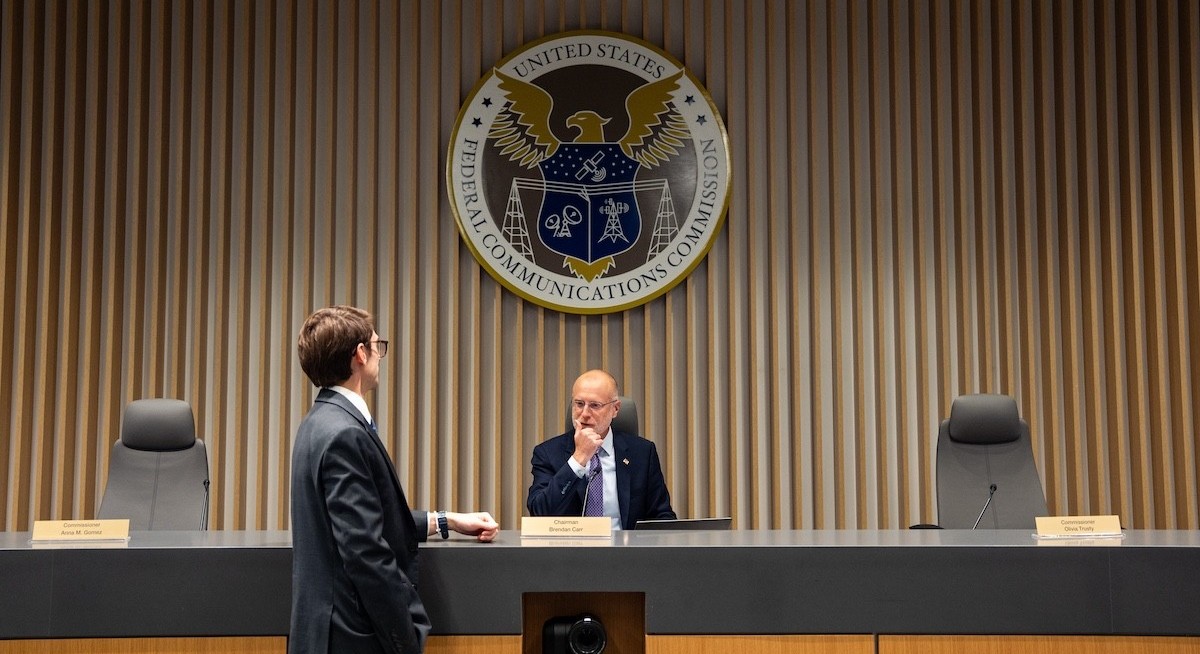


Delve into your smartphone, turn over your computer keyboard, or peek behind your flat-screen TV. Moulded into the plastic, or attached as a label, is an alphabet soup of approvals. Among them is the FCC logo.
FCC stands for the Federal Communications Commission, an independent US government agency that regulates interstate and international communications via radio, television, wire, satellite and cable.
These standards are designed to ensure that your smart TV does not interfere with your smartphone or laptop Wi-Fi connection. Different countries have their own processes for certifying that a product conforms to these standards.
So far so good. It is not very pleasant, but the relevant approval testing can be done at the point of manufacture.
See also: Epic Fury vs True Promise
However, manufacturers now cannot obtain FCC approval in China because FCC testing is no longer permitted there.
Product samples must now be shipped to Taiwan or the US for certification testing before an FCC compliance stamp can be applied.
The necessary laboratory tests were previously conducted on-site in China or in laboratories just next door. This enabled quick product development turnaround and offered predictable, established schedules. It was part of an efficient manufacturing process for everything from audio speakers to cloud servers.
See also: The time has come to shutter the World Economic Forum
Currently, approvals require cross-border shipment of sample products. Development lead times have increased by three times or more. In many cases, the laboratory test fees are approximately 50% higher.
There is no genuine justification for this decision. It is not a response to fraudulent FCC certification. It is not a standards compliance issue. It is simply a malicious handful of grit thrown into the wheels of freely flowing trade.
This is merely a minor procedural change that slows China-based manufacturing, adds to the hidden costs of production and reduces product development flexibility. Nothing has been blocked or sanctioned. This is trade warfare by stealth and it affects Chinese products such as Xiaomi, whose designs originate in China. It impacts every product manufactured in China, including my Logitech wireless keyboard and mouse.
No bold headlines are trumpeting these changes, but they lead to higher prices and slower product development. This moves weaponises the use of already agreed standards and becomes a new tripwire in the disruption of trade with China.
Technical outlook of the Shanghai market

The Shanghai index has smashed through the technical target objective at 4,100. This is a very strong upmove. Any retreat from recent highs will find support near 4,100.
For more stories about where money flows, click here for Capital Section
The index could retreat to 3,888 and still remain in a strong uptrend.
The Guppy Multiple Moving Average (GMMA) shows just how strong this uptrend is. The short-term group of averages is widely separated. This shows that traders are strongly engaged with this extended rally.
Perhaps more importantly, the long-term group of averages is also well separated. This indicates strong investor buying support for the trend.
The steady degree of separation between the two groups of moving averages is also very bullish as it shows continued confidence in trend continuation. Variation in the degree of separation indicates trend instability.
The Shanghai index moves in well-defined trading bands. The width of these bands is used to set upside and downside targets. These are calculated targets. They help determine the probable consolidation areas for each trend move. The trading bands do not tell us how the move will develop. For that analysis, we use the GMMA.
The December breakout from 3,888 had a calculated upside target near 4,100. Using the same trade band projection method, the next upside target is near 4,300.
The GMMA relationships suggest a strong probability of an uptrend continuation. The market’s behaviour is reflected in the trend analysis, which remains bullish.
Daryl Guppy is an international financial technical analysis expert. He has provided weekly Shanghai Index analysis for mainland Chinese media for two decades. Guppy appears regularly on CNBC Asia and is known as “The Chart Man”. He is a former national board member of the Australia China Business Council




