


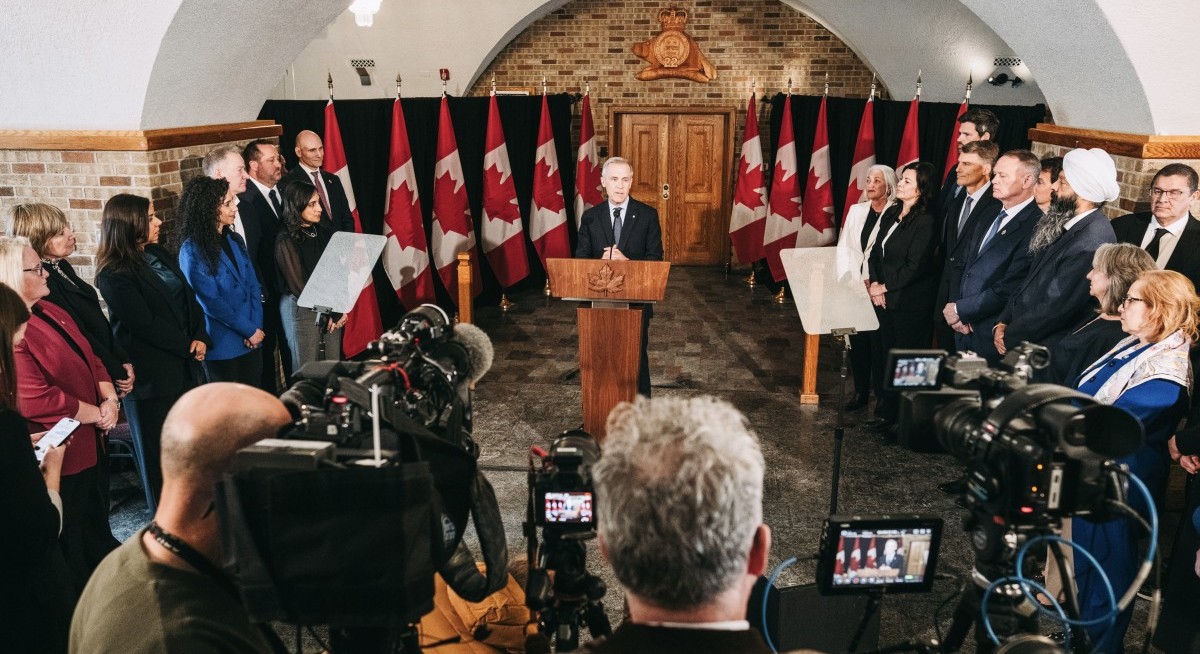


In his seminal speech at the World Economic Forum, Carney laid down clearly that the international rules-based world is now a “fiction”, where the chimera of multilateral United Nations-umbrella institutions are no longer “architectures of collective problem-solving” but irrelevant and defunded bodies. The reality for middle powers, Carney argued, is that they “must act together because if we are not at the table, we’re on the menu”.
As a sign that Carney and other like-minded “middle powers” are intent on being the former, Canada’s supposed purchase of F-35s from Lockheed Martin might be dropped in favour of Saab’s Gripen. Europeans, on their part, are finally standing together, mostly, to say “non” to Trump’s Greenland overtures and are about to sign a free trade agreement with India and a trade deal with Mercosur.
Domestically, Americans are facing a new reality: federal agents may once again shoot to kill, while the administration’s apologists dispute what has been captured on video. After all, who is to know, when the White House itself has admitted to using AI to doctor footage of its perceived enemies to suit its narratives?
We marvel at the might and daring of Trump in bringing Venezuelan oil home to right a historical wrong done to US companies decades ago; it no longer seems to be about drug smuggling or narco-terrorism as a pretext.
See also: Asia growth improves but ADB warns of persistent headwinds
At least it is out in the open, though it is unsettling that there is no longer any need to maintain appearances through hypocrisy or a false cover story.
Trump’s Board of Peace, launched in Davos, looks similar to the United Nations logo except for the map of the world reduced to the Americas with Greenland on the map (and Canada), but not Gaza, and of course it’s decked in gold laurels.
His son-in-law, Jared Kushner, is there, and why not, since he is also intimately involved in delicate Ukraine-Russia peace negotiations over territories.
See also: S&P Dow Jones signals possible frontier-market cut for Indonesia
We have not seen impressions of the contested Donbas with skyscrapers; however, unlike the Gaza Strip, there is no Riviera Mediterranean alongside.
Ironically, a couple of board members — Russia’s Vladimir Putin and Israel’s Benjamin Netanyahu — could not attend as they would be arrested for war crimes under the International Criminal Court if they showed up.
Uninvestable US
Still, the story in recent weeks is Trump doing yet another TACO (Trump always chickens out) after threatening war or offering US$100,000 ($126,883) per Greenlander buyout in the lead-up to his own Davos speech, where he mixed up Iceland with Greenland.
Perhaps he was surprised by Europeans’ willingness to stand up collectively, including his right-wing ally Giorgia Meloni of Italy, which hosts key American air bases. Or by reports that Dutch pension funds were unloading US Treasuries amid growing doubts about their “risk-free” status. Or by German economists calling for Europe to bring back gold from the US.
More practically, markets assumed, correctly for now, that he didn’t like the 2% decline in the S&P 500 at the height of the Greenland threats, and thus backed off as US Treasury yields ticked up. The US equity markets have stabilised since, but unlike other global peers, including Singapore’s Straits Times Index (STI), not made new highs this year.
The risk-off indicator gold headed to new highs of US$5,000, leaving Bitcoin meandering in no man’s land well below US$100,000. Digital gold seems to be floundering a tad like Trump’s poll ratings — fake, however, he declares.
Sink your teeth into in-depth insights from our contributors, and dive into financial and economic trends
The US dollar continues to fall, as yet another tariff threat of 100% is unleashed on Canada, which is inching towards a bilateral trade deal with China. And why not — the middle powers hitting it off with the Middle Kingdom. It is 2026.
The US market is becoming uninvestible as its policies on credit cards, banks, energy, pharma and the drama over the independence of the Fed are shifted by Trump’s frequent midnight Truth Social pronouncements.
TACO is hopeful that US equity markets lagged global equity performance last year largely because of USD declines. Hedging of bond and stock portfolios gathers momentum; some funds were being repatriated back to Europe and Asia.
They have good reasons why. Trump has upended both the rules of global order as well as polite civility, and the equity or bond markets can no longer rein him in when he lobs the next grenade in a by now familiar pre-negotiation overture.
When the TACO chimera too crumbles in the next Tempest, it might be too late for legions of Make America Great Again (MAGA) believers, as well as US equity market investors.
A Midsummer Night’s Dream
As Daniel Drezner and Elizabeth Saunders argue in Foreign Affairs — Trump’s Year of Anarchy, due to this “unconstrained presidency”, American Primacy has ended, where hitherto advantages, including strong scientific research, have been gutted. In their place, a culture of extraction and corruption.
The contrast with Singapore’s big AI push and maintenance of integrity in Parliament over the matter of the Leader of the Opposition is almost night and day. This, even if businesses in Singapore have been encouraged by the US Embassy to make “substantially larger gifts than in previous years” for its 250th Independence Day celebration.
The Singapore market started this month on a canter, even before the Year of the Horse kicks off from the middle of February.
Investors cashed up on banks rejoiced with United Overseas Bank and Oversea-Chinese Banking Corp making new all-time highs. JP Morgan looked like a minor party pooper with its downgrade of UOB, but the market behaved like a four-horse chariot, bolting out of the 2026 gate towards the US bank’s own STI 5,000-point target made last October, with 6,000 possibly next.
With Equity Market Development Programme (EQDP) funds catalysing new institutional, private wealth and retail money into the market, increased liquidity across large and small caps has attracted some hot money from Hong Kong, as well as portfolio flows seeking more SGD assets. Belated recognition by local investors has driven gains of 16.9% and 22.7% in the STI over the past two years.
Further tailwinds are emerging. In tandem with the “value-up” announcements last December to help listed companies tell their story, SGX RegCo debunked misperceptions about forward guidance and removed another barrier holding back companies from telling their stories.
However, investors too must grow up and recognise that forward guidance is by its nature uncertain, and take their own responsibility for investing decisions made.
Developers, pawnbrokers
Meanwhile, a host of undervalued small and mid-caps flagged by this column in 3Q last year have almost unrecognisable prices compared to then.
This includes marine stocks like Nam Cheong, Pacific Radiance, Marco Polo Marine, Beng Kuang Marine and Samudera Shipping, up between a modest 35% to more than double.
For a few of them, their valuations do not yet look stretched for some in high single-digit multiples, high cash or in a turnaround cycle. Although having bought and sold much earlier, it is psychologically difficult for me to re-enter at higher prices, and I have to adjust my lens.
The construction super-cycle we identified in July last year, too, has seen construction stocks re-rated in a similar magnitude from new initiatives and placements from Wee Hur Holdings to OKP Holdings and KSH Holdings. My favourite, Soilbuild Construction Group, after a belated value discovery last year, had stagnated at around $3.40 from November. It has since gained further after a one-to-four share split for better tradability. With increasing coverage, including CGS International affirming its $1.20 call, and the results season to come, I am holding on to expectations of further upsides from contract wins as well as the spin-off of its precast business at the right opportunity.
Real estate companies, the likes of UOL Group, Singapore Land Group, and Bukit Sembawang Estates, too, are on the move, buoyed by new launches of homes. City Developments, meanwhile, has another catalyst in the form of potential corporate capital initiatives. The accommodative interest rates cycle has awakened the likes of Banyan Tree Holdings, Wing Tai Holdings and Tuan Sing Holdings. Others like Ho Bee Land and Stamford Land have also started to gain attention. It is still fashionable and profitable to seek out the laggards before the market discovers them, and I have recycled my capital from accepting the revised privatisation offer for Low Keng Huat.
Even new business models like The Assembly Place debuted well, with Coliwoo Holdings and its parent LHN back on the run after consolidation, and there is talk of JustCo finally coming into the market, even if its business model isn’t asset-heavy for those looking for IPOs.
Whilst consumer heavyweights with more global and regional exposure like Olam Group, Thai Beverage or Wilmar International have lagged, smaller caps with fundamental growth stories may have more sustainable support. This includes a current thesis that pawnshops and jewellers sitting on pots of gold assets may like property companies sit on unrealised “RNAV” of gold inventory. This includes Valuemax Group, Aspial Corporation or Taka Jewellery.
Short of the US imploding dramatically, we will have a pre-Lunar New Year run in the next two weeks, with the biggest deltas seen in the small caps just like the 1990s.
Now, they come with the biggest risks too. Punters who have been running with the wind on stocks like the former Biolidics — now known as Embracing Future Holdings (EFH), or drug plans in the US like iX Biopharma — that have risen multi-fold in weeks or a couple of months should beware slithering with the tail of the Snake year, lest the dream leads to a hangover the morning after.
Chew Sutat retired from Singapore Exchange after 14 years as a member of its executive management team. During his watch, the exchange transformed from an Asian gateway into a global multi-asset exchange, and he was awarded FOW’s lifetime achievement award




