


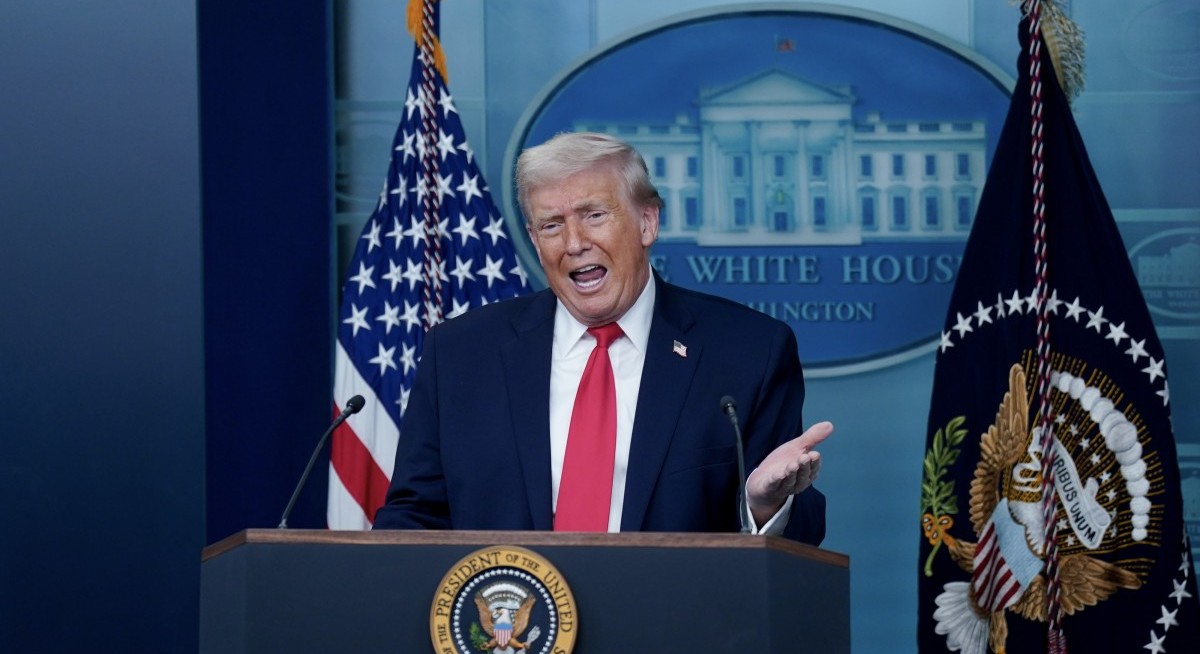


“We need it for security purposes. We need it for national security and even world security,” Trump says of his reasons for wanting to bring the Danish territory under US control.
Observers have taken Trump’s long-running threats to annex Greenland more seriously since his administration launched a surprise military strike on Venezuela on Jan 3, leading to the capture of President Nicolas Maduro and his wife, who now face drug trafficking charges in the US.
When European countries protested against Trump’s demands, he turned to his favourite negotiating tool — tariffs. On Jan 17, Trump announced a 10% tariff on goods from Denmark, Norway, Sweden, France, Germany, the UK, the Netherlands and Finland. He says the tariffs will be raised to 25% in June unless “a deal is reached for the complete and total purchase of Greenland.”
Trump has since walked back the tariffs, writing in a Jan 21 Truth Social post that he had “formed the framework of a future deal” on Greenland after meeting Nato Secretary General Mark Rutte.
See also: STI’s reserve list is more interesting than the STI itself
While one should not rule out the possibility of a military conflict breaking out over Greenland, it pays to understand the man making these threats. In his 1987 book The Art of the Deal, Trump is candid about using bravado and exaggeration to his advantage in negotiations.
“I play to people’s fantasies. People may not always think big themselves, but they can still get very excited by those who do. That’s why a little hyperbole never hurts,” writes Trump. “I call it truthful hyperbole. It’s an innocent form of exaggeration, and a very effective form of promotion.”
Trump’s rhetoric on Greenland should not be taken literally. The real question that people should be asking isn’t, “What does Trump get from taking over Greenland?” but “What can Trump get out of trying to take over Greenland?”
See also: New Temasek must be more than old wine in new bottles
For Trump and the US, Greenland’s rare earth minerals are the prize — and keeping them out of China’s reach is the point.
In that sense, Trump’s actions have already had an effect. European countries have begun deploying troops to the region, and Denmark has said it wants a “larger and more permanent” Nato presence on Greenland.
“Trump’s negotiation style follows a very predictable pattern,” writes Bilahari Kausikan, a former permanent secretary at Singapore’s foreign affairs ministry, in a Facebook post on Jan 18.
“First, a maximalist — even outrageous — demand,” the former diplomat adds. “Then threats, and if there is pushback, as in this case, escalation of threats. Finally, the deal, which, as Trump is pragmatic, may bear little resemblance to the original demand, but which will be hailed as a great victory. Greenland is unfolding according to this pattern.”




