


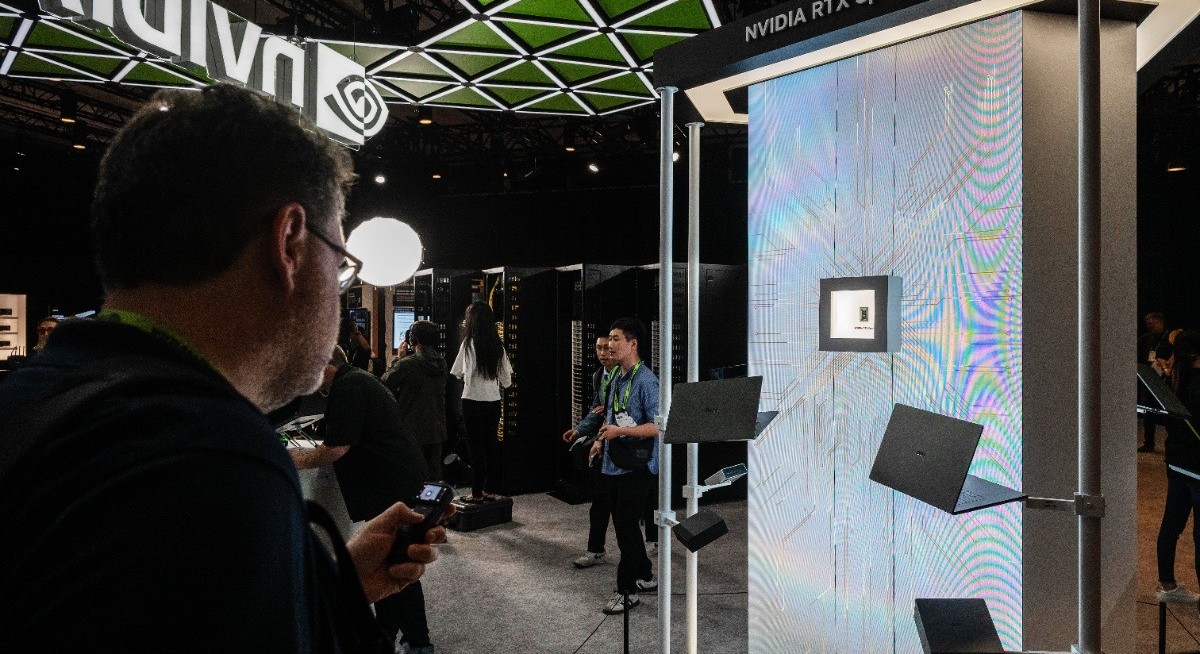


(June 4): The future of the personal computer is a hot topic again, courtesy of Nvidia Corp’s announcement this week with Microsoft Corp. The leader in artificial intelligence (AI) hardware is taking another run at making the central component for laptops, promising to bring the biggest change to the devices in decades.
Nvidia’s RTX Spark Superchip announcement overshadowed everything else at a particularly busy edition of the Computex trade show in Taipei. It dinged the stock prices of Intel Corp and Advanced Micro Devices Inc (AMD), lifted Nvidia partner MediaTek In., and set up a fascinating confrontation for this fall, when the first devices built with this technology go on sale.
The RTX Spark processor is the first in a line of new chips that Nvidia says will deliver the most optimised computers for AI work — in the same way its products have become the backbone of AI data centres. The key difference compared with products from Intel and AMD is the ability to run large models on the device without reaching out to the internet.

“This appears less like a laptop launch than a bid to redefine AI PCs,” said Bloomberg Intelligence analyst Steven Tseng. “Many so-called AI PCs currently available in the market still rely heavily on cloud AI, making them hard to distinguish from regular PCs with premium processors. Spark raises the bar by arguing that a true AI PC should be able to run AI agents locally.”
The company that scaled up graphics cards into a half-trillion-dollar infrastructure business intends to overhaul the Windows ecosystem as well, and at Computex it showed off its powers of attraction. Windows creator Microsoft is fully behind the new project, and Nvidia chief executive officer Jensen Huang has every PC maker in the world joining in.
See also: Kioxia becomes Japan’s most valuable firm as AI mania goes on
Lenovo Group Ltd, Dell Technologies Inc and Taiwanese partners like Asustek Computer Inc are all demonstrating RTX Spark devices in Taipei. Nvidia plans to have three versions of each generation — a laptop, a desktop and a workstation — and Huang spoke of his vision of putting an AI supercomputer in every home.
“Microsoft and Nvidia meticulously optimised everything,” Huang said during a keynote presentation on Monday.
The move to extend Nvidia’s reach beyond the data centre helps augment its developer ecosystem, and it also gives consumers something new bearing the Nvidia brand to buy.
See also: Singapore court stays order to jail Byju’s founder, lawyer says
The company said that initial versions of the computers will be in the “premium” tier of the market, but over time it will introduce cheaper versions that allow the company to address other parts of the market.

Nvidia CEO Jensen Huang hands out food to fans outside a restaurant during a dinner event in Taipei.
At an analyst event in Taiwan following his announcements, Huang told his audience the PC needs to fundamentally change from its current role as a tool that sits waiting for its owner to use it.
Future machines will be doing work all the time and choose to communicate with their users as an assistant. He likened them to Luke Skywalker’s trusty robot in Star Wars.
“Not one computer exists in the world today that can do that,” he said. “Tell me that’s not R2-D2. Tell me that’s not cool.”
"Nvidia is becoming more aggressive. It’s likely to enter new markets with negligible share and quickly capture significant share from companies such as AMD and Intel. Spark could benefit from growing interest in personal AI. Enterprise adoption might be particularly important as organizations seek local AI processing in combination with cloud-based services. If agentic AI adoption drives demand for personal AI compute, Nvidia could help reshape a PC market that has historically delivered low single-digit growth, say Bloomberg Intelligence analysts Kunjan Sobhani and Oscar Hernandez Tejada.
To stay ahead of Singapore and the region’s corporate and economic trends, click here for Latest Section
Qualcomm Inc CEO Cristiano Amon echoed that sentiment during Computex. Instead of a smartphone-centered digital ecosystem, we’re moving into an era of more diverse hardware where feeding AI agents with information will be the priority. Amon has declared 2026 “the year of the agent.” Both he and Huang called in to Microsoft’s Build developer conference to tout the promise of their technology.
The response from Intel, which still makes processors for the vast majority of Windows PCs, was much less revolutionary in tone. Now a year into his tenure as CEO, Lip-Bu Tan hosted a number of partners at Intel’s keynote event and stressed the company’s experience and pedigree as a longtime operator both with PCs and in traditional data centre work.
In a roundtable session on Tuesday, Tan said he takes a long-term view and doesn’t see rivals in the industry, describing Nvidia as “a good friend”. Nvidia bought a US$5 billion stake in Intel in September, and Tan said “they’re an investor — we’re delighted to have them”.
Many questions still remain about RTX Spark. While Nvidia and MediaTek have detailed some elements of the chip’s design and said they expect to deliver all-day battery life, they refused to offer up performance comparisons with existing devices. The company will have to show a meaningful advantage over Intel to distinguish itself from the Windows incumbent.
“Despite the potential upside, execution remains the key risk,” Bloomberg Intelligence’s Tseng said.
Uploaded by Felyx Teoh




