


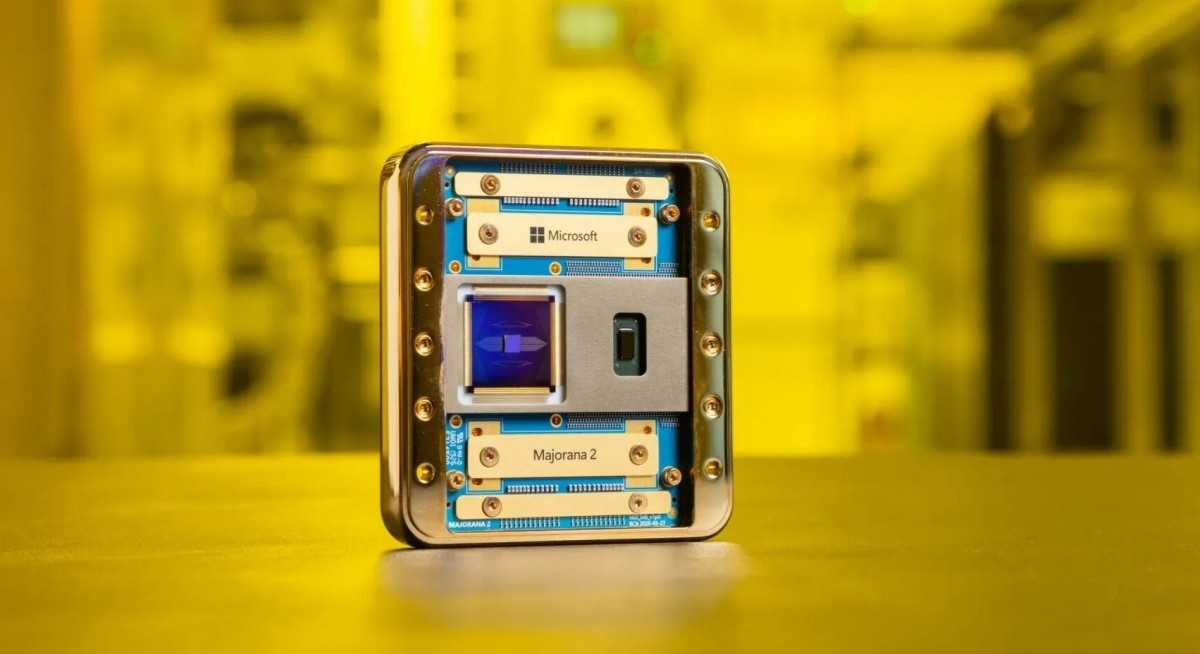


Nadella says the QPU offers “qubits”, or quantum bits, that are significantly more stable and reliable than those of the previous generation, Majorana 1.
Quantum mechanics flipped our understanding of reality upside down. It replaces predictable Newtonian classical physics with a probabilistic model.
Newtonian physics describes how everyday objects like cars and planets move and interact. It relies on strict laws of nature and on absolute space and time.
Physics looks predictable on the macroscopic scale, where objects are large enough to be visible and measurable to the naked eye. This model was the one we mainly studied at O and A Levels.
See also: Meta starts unwinding Manus deal by splitting operations, data — Bloomberg
However, at the subatomic level, particles move randomly and the physical world appears more random, unstable and “fuzzy”, making their behaviour harder to predict.
Neils Bohr, who often worked with Robert Oppenheimer of the A-bomb fame, said: “Those who are not shocked by quantum mechanics... cannot possibly have understood it.”
Microsoft’s QPU was named after Ettore Majorana (1906–1938), a brilliant Italian theoretical physicist who made significant contributions to the study of quantum mechanics before he vanished without a trace while sailing from Palermo to Naples in 1938.
See also: ASML to slash fewer jobs after striking deal with unions
Majorana predicted the existence of fermions, a theoretical subatomic particle that is its own antiparticle, unlike standard particles like electrons or protons that have distinct, opposite antiparticles.
Certain fermions are unaffected by environmental noise and errors, making them ideal building blocks of fault-tolerant quantum computers.
Majorana 2’s new features include new materials that enable a 1,000-fold improvement in reliability over the prior generation of qubits, with a mean qubit lifetime of 20 seconds and instances lasting up to 1 minute.
Instead of aluminium, the chip uses a lead-based material stack that effectively shields the delicate hardware from cosmic and stray radiation.
Strategic interest
Why are nations preoccupied with the development of a quantum computer?
They are vying to build the fastest, most energy-efficient computing systems to drive advancements in AI, defence, climate modelling and medicine.
It is the same reason why Alan Turing and fellow code-breaker Gordon Welchman built the Bombe to help decipher German Enigma-machine-encrypted secret messages during World War Two.
Sink your teeth into in-depth insights from our contributors, and dive into financial and economic trends
The supercomputer race is primarily led by the US and China, with strong contenders in Europe and Japan. Singapore’s flagship national centre for quantum research and education is the Centre for Quantum Technologies (CQT).
A quantum computer is powerful enough to solve complex problems because it processes information using the laws of quantum physics, enabling it to evaluate vast numbers of possibilities simultaneously.
While standard computers use bits (0 or 1), quantum computers use qubits, which drastically speed up calculations in three unique ways.
Qubits can exist as 0, 1 or both 0 and 1, simultaneously. This allows the computer to explore countless options simultaneously, their cascading effects and multiple outcomes, which is highly efficient for scenario planning.
Qubits can be linked so that the state of one instantly affects another, no matter how far apart they are. This lets quantum computers process combinations of information exponentially faster than standard machines. Like a chess game, it is an advantage when you can think multiple steps ahead of the competition.
Lastly, quantum algorithms amplify the correct answers and cancel out incorrect ones, ensuring the final result is highly accurate. This reinforces the accuracy of solutions with probabilistic outcomes.
Assistance from agentic AI
Microsoft now expects to achieve a scalable quantum computer by 2029, cutting its original timeline in half.
Majorana 2 was developed with the help of Microsoft Discovery’s agentic AI, which shows that future problems are becoming so complex that human brain power alone cannot solve them.
The ultimate goal is to build a machine capable of outperforming classical computers in solving commercial and scientific problems, starting at 1 million reliable operations per second and scaling to 100 million for advanced chemistry and materials science.
On a personal note, I have always been fascinated by quantum mechanics since its introduction in my undergrad physics course more than 30 years ago.
However, my maths wasn’t at the top of my cohort, putting an end to my love affair with quantum mechanics.
One classmate could solve a complex quantum mechanics problem with a three-page-long answer in his head, after identifying the correct approach in a split second.
The quantum computing development curve may still be steep. However, I believe we will eventually crack the problem.
For now, I can only find comfort in a quote by Nobel Prize-winning theoretical physicist Richard Feynman: “I think I can safely say that nobody understands quantum mechanics.”




