


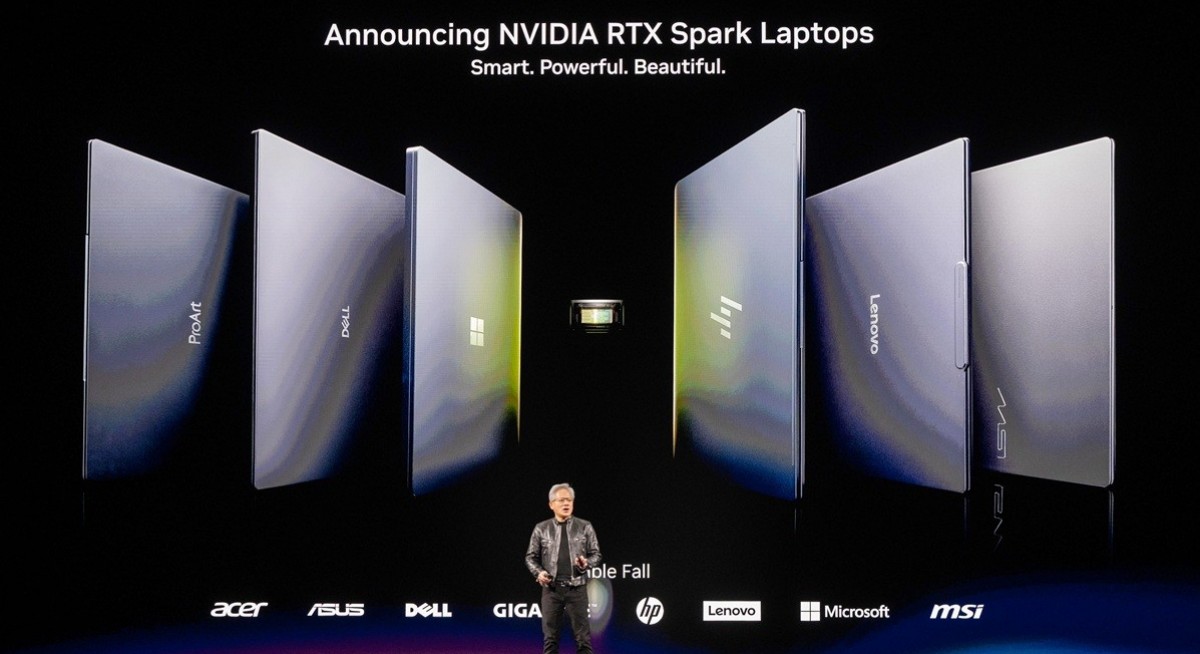


Nvidia plans to offer machines built by the likes of Lenovo Group, Hewlett-Packard Enterprise and Dell Technologies that are better adapted to running AI-powered software and agents. Nvidia calls its new RTX Spark a “superchip” because it fuses two things into one package: a CPU, the brain that runs a personal computer, and a GPU, the graphics engine Nvidia originally built for video games that turned out to be so good at AI that it now powers data centres.
Shares of Intel declined by as much as 7.3% in early trading on June 1 after the announcement by Nvidia CEO Jensen Huang at the Computex technology show in Taiwan.
On the face of it, Huang is not only expanding his sphere of influence in the global chip market but savvily hedging his bets on where AI demand will go. Nvidia’s US$5 trillion ($6.4 trillion) market valuation has long had the whiff of a gamble because so much revenue is dependent on just a handful of large customers. For fiscal 2026, for instance, one customer accounted for 22% of Nvidia’s total sales and another for 14%, meaning two buyers brought in more than a third of turnover.
Nvidia doesn’t name the customers in its filings, but they are likely companies such as Hon Hai Precision Industry, which assemble systems for hyperscalers like Microsoft and Amazon.com.
See also: Can Southeast Asia claim its place in the AI economy?
Now it can also capture business at the so-called edge of the AI business, by pitching its technology to end users like you and me. Lenovo, HP and Dell, three of the manufacturers Nvidia will sell to, account for roughly two-thirds of worldwide PC shipments.
If the new venture doesn’t work out, Nvidia still has the 4% stake in Intel that it recently bought. That particular hedge was worthwhile because while Nvidia has years of experience building for consumer machines from its days making graphics cards for gamers, it doesn’t have a strong track record building the brains of personal computers.
Most laptops today run on chips made by Intel or Advanced Micro Devices, which are relatively thirsty for power. Chips based on Arm Holdings technology, the kind found in smartphones and Apple Macs, are known instead for sipping less energy and being gentler on battery life.
See also: AI assurance may be Southeast Asia’s missing growth layer
But the GPUs that Nvidia makes for data centres are notoriously energy-intensive. That, and their price tag, have made building AI extremely costly for labs like OpenAI and Anthropic, and hyperscalers such as Microsoft.
It’s hard to see how successful a laptop can be if it’s running AI agents or whizzy AI features in Adobe’s Photoshop, but dies within a few hours. Nvidia’s RTX Spark, though, is built on Arm’s energy-efficient blueprints, suggesting it might power laptops in an energy-saving way, too. At least, that’s the idea.
Nvidia is touting “the most efficient PC chip ever built,” and promises “all-day” battery life, but it hasn’t shared figures for energy-intensive tasks like gaming or running AI agents. The company only says that it will release more performance metrics closer to when its chip goes to market this autumn, and that they are “roughly equivalent” to its RTX 5070 graphics chip for laptops.
Is the RTX 5070 graphics chip efficient? Not especially. If pushed hard with a game, it’s been known to drain a laptop’s battery life. And Nvidia wouldn’t give further details on how the new RTX Spark superchip compares to those from the competition. That leaves an open question that could come back to bite later this year if independent testing shows laptops with an Nvidia brain are a power suck.
This won’t be Nvidia’s first run at the market for PC processors. More than a decade ago, Nvidia’s Tegra chips powered Microsoft’s first Windows-on-Arm device, a tablet with a detachable keyboard called the Surface RT. But the device couldn’t run a range of third-party apps like Google Chrome, Photoshop and many PC games because most of those programmes were designed to run on Intel-style chips and not Arm.
These days, chips based on Arm’s designs have a built-in translator that can run many more programmes, which is a promising step forward even if software compatibility for the RTX Spark is still unclear. The bigger question now is whether Nvidia can deliver all that power without battery life paying the price. — Bloomberg Opinion




