




Beyond Singapore’s ageing population, Southeast Asia is often seen as having little need to automate due to its young and growing workforce. However, this view overlooks where labour pressures are already starting to bite.
Charlie Dai, VP and principal analyst at Forrester, sees the shortage as uneven. It is showing up in caregiving, public services and skilled technical roles, rather than on factory floors. “These sectors align closely with humanoid strengths — human-scale interaction, mobility in built environments, and endurance. Adoption pressure in these domains is likely rising faster than global averages, even if manufacturing-led adoption remains comparatively slower,” he tells The Edge Singapore.
This changes the automation case for companies. Globally, 74% of executives cite labour shortages as a primary catalyst for physical AI adoption, while 69% cite rising labour costs, according to Capgemini Research Institute’s 2026 report, Physical AI: Taking Human-Robot Collaboration to the Next Level. In Southeast Asia, where manufacturing wages remain relatively low, the usual cost-saving argument is harder to make. The stronger opening is in jobs employers struggle to fill, where service quality, availability and safety may matter more than simple wage savings.
Beyond the factory robot
For most of industrial history, robots worked best when nothing around them changed. They repeated the same movement, in the same place, on the same object, thousands of times a day. Move the object a few inches, and the system often failed. That brittleness kept automation inside factories and warehouses built around the machine.
Physical AI loosens that constraint. It refers to robotic systems, in any physical form, that can read their surroundings through sensors, interpret what they detect and decide how to act in real time. A robot guided by physical AI can handle a package it has not seen before, move through a corridor it was not explicitly mapped for, or slow down when a person steps into its path.
See also: Science Centre Singapore puts service robots to work in public-facing trial
Market research firm Forrester describes the technology as moving automation away from scripted, task-specific systems and toward machines that can operate in less controlled spaces. It also cautions that even the best systems today are unlikely to match human capability in most situations.
Humanoid robots, which are bipedal and human-shaped, are one form that physical AI can take. While they attract investor and media attention because they are easy to understand at a glance, they are often not the most practical choice.
Other forms of physical AI may be easier to justify. The same technology also powers wheeled delivery robots, quadruped inspection machines and robotic arms that can handle tasks they were not explicitly programmed for. For buyers, the choice of machine is not a branding decision but an operational one that many companies still do not make carefully enough.
See also: Robot maker Kuka eyes US, Asia as Europe lags behind on AI
The data gap
Data, not hardware, is the main constraint on physical AI. William Dally, Nvidia’s chief scientist and senior vice president of research, explains the gap. Large language models were trained on tens of trillions of words scraped from the internet. However, no comparable dataset exists for teaching robots how to operate in the physical world. “There is no corresponding training set for robotics. That’s been the real bottleneck,” he says at the Asia Tech x Summit (ATxSummit) in Singapore last month.
Nvidia’s current approach involves pre-training its GR00T foundation model, which supports a range of physical AI systems, on 21,000 hours of human video. It then refines the model with data from operators wearing motion-capture gloves before moving to direct robot operation. Dally demonstrated a robot assembling a model car from a text instruction alone, without prior programming for that specific task.
Physical AI systems built primarily on training data from the US, Europe, and China must also adapt to different physical environments, social norms, and language contexts before they are genuinely deployable in Southeast Asia. The unresolved question for regional buyers, Dai argues, is not whether physical AI functions technically, “but whether it can be localised fast enough — technically, socially, and institutionally — to deliver value before human and organisational constraints dominate.”
Singapore as a proving ground
Nvidia chose Singapore for its Applied AI Lab, its first outside the US. Each deployment in the city gives the company operational data that can be fed back into model training. A robot moving through Singapore’s public spaces, responding to multilingual instructions and operating around pedestrians, produces data that a controlled lab cannot.
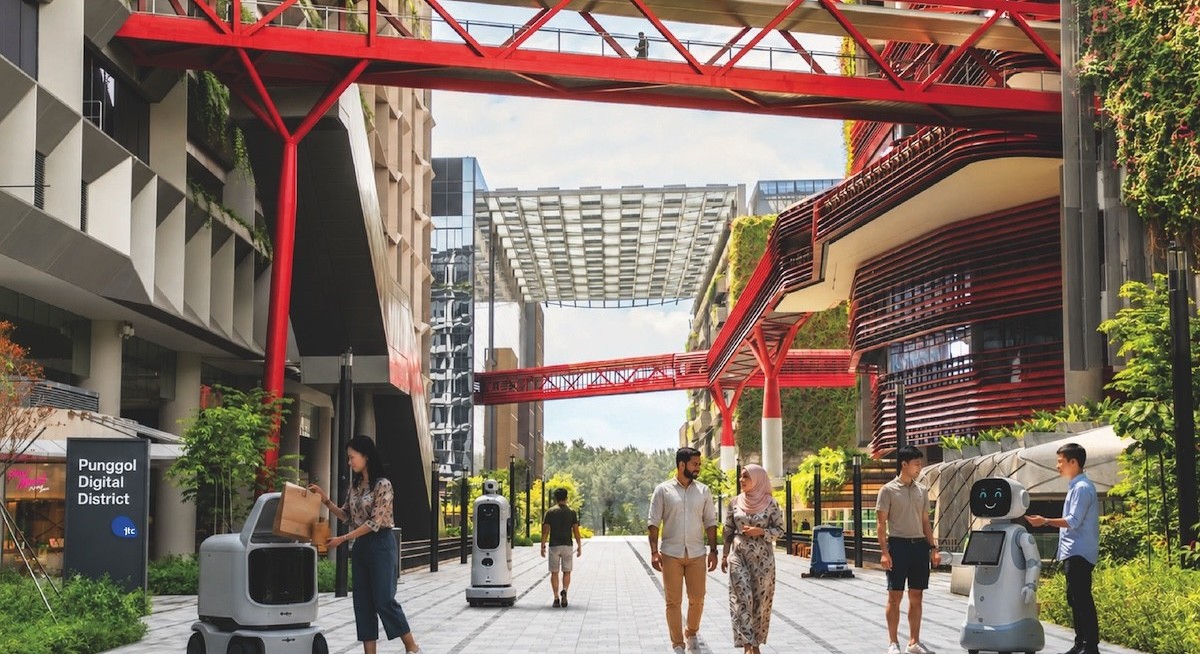
Among the countries surveyed by Capgemini, Singapore had the highest share of executives calling physical AI game-changing for their industry, at 77%, compared with a global average of 67%. Its government is backing that confidence with physical infrastructure. The Infocomm Media Development Authority, JTC and the Singapore Institute of Technology are setting up a living testbed for autonomous robots at Punggol Digital District. The project is set to launch later this year with eight industry partners, including Certis, DHL, Grab and QuikBot.
To stay ahead of the latest tech trends, click here for DigitalEdge Section
It will be Singapore’s first deployment of robots from multiple operators simultaneously in a mixed-use public area. Security patrols, parcel delivery and cleaning services will run in parallel across the precinct. This matters because robots from different manufacturers will have to operate in shared spaces, creating safety and interoperability data that many regulators elsewhere in the region do not yet have. The Land Transport Authority has created a precinct-level exemption framework under the Active Mobility Act to enable the trials. Evidence from Punggol Digital District is expected to inform more durable standards over time.
The testbed also shows why deployment is hard. “The challenge in robotics today is no longer just about building autonomous machines, but integrating robotics, AI systems and human teams into real operations that are safe, coordinated and sustainable over time,” says Raahul Kumar, chief executive for robotics and international at Certis.
Similarly, Dai sees integration work as the main risk for deployments being planned across the region. Although regulatory gaps create friction, pilots can proceed under exemptions and controlled settings. “What consistently fails is day-two operations,” Dai says, referring to integration, workforce training, reliability engineering and cybersecurity hardening.
As robots move into live environments, Forrester flags risks around data breaches, hacking and malicious physical control. Most Southeast Asian markets also lack system integrators with the right experience. Alan Ng, founder and CEO of QuikBot, which operated robots at commercial properties in Singapore before joining the Punggol testbed, put the lesson plainly. “Trust, safety, and governance must be built in from the start, not added as an afterthought.”
Dai is careful about what Singapore’s progress actually transfers to the rest of the region. Reference architectures, safety playbooks and procurement templates can travel, but the conditions that make the testbed possible may not.
Singapore has centralised digital government systems, higher labour costs and a national ageing agenda that gives automation political backing. Indonesia, Vietnam and the Philippines do not share those conditions. In those markets, physical AI may have to prove itself through better service quality rather than lower labour costs. That means Singapore can offer a useful model, but it cannot make the economics work for everyone else.
Humanoids are not always the answer
As physical AI investment grows, companies are often conflating two decisions: whether to adopt physical AI, and whether that necessarily means buying humanoid robots. For sectors with genuine staffing gaps, the first is becoming easier to justify, while the second requires more caution.
Humanoid robots come with a high cost and complexity premium. Reliable bipedal movement and human-like dexterity remain difficult, especially in public-facing environments where failure carries safety and reputational risks. Forrester says even the best systems today are unlikely to consistently achieve human-like capabilities in most situations.
A robot does not need two legs to patrol a corridor, monitor a patient’s medication routine or deliver a parcel. The same physical AI advances that make humanoids possible also make wheeled and quadruped robots more capable, often at far lower cost.
Dai estimates that non-humanoid physical AI platforms can meet roughly 70% to 80% of requirements in eldercare, community health and public safety at materially lower cost and risk. The humanoid form is only clearly justified where the layout of the environment or the nature of human interaction makes it necessary.
“Media and investor hype will push you toward humanoids, but the same advances in physical AI that make today’s humanoid robots possible also improve cheaper and more practical form factors in equally impressive ways,” notes a Forrester report on physical AI.
For buyers moving now, Dai says a vendor’s answer matters more than peak performance. What happens when the system fails? “Vendors that cannot articulate supervised fallback modes, cyber-physical kill switches, and operational handover procedures are not production-ready. For physical AI, failure management matters more than peak performance.”




