


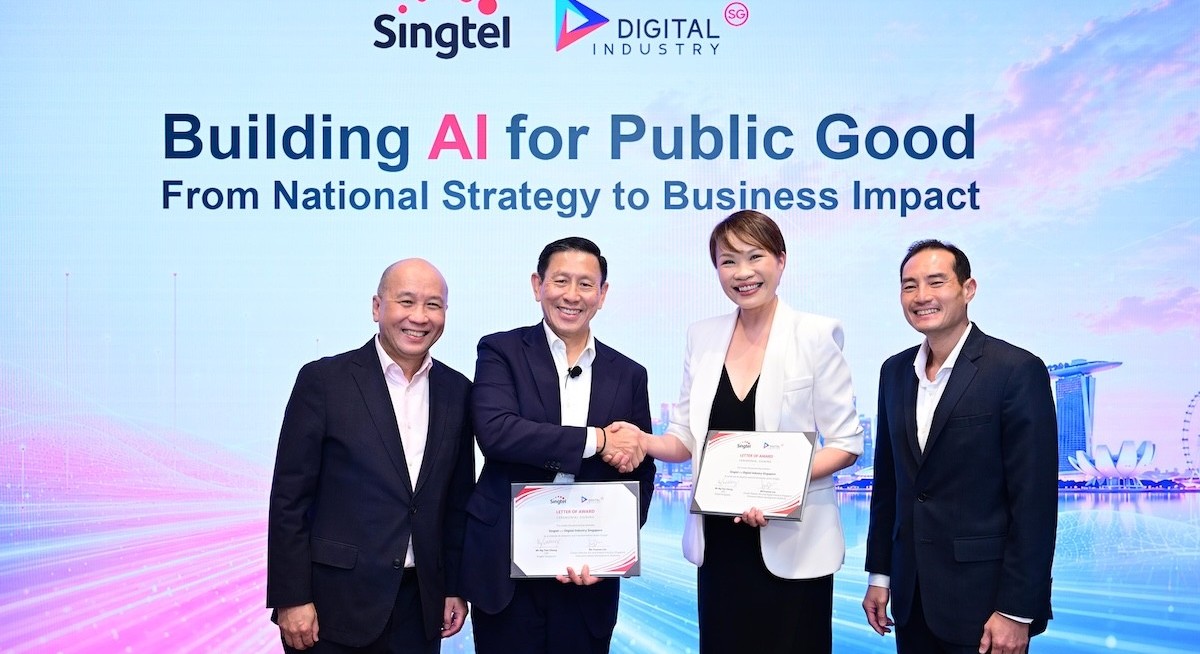


Singtel Singapore will receive funding from Digital Industry Singapore (DISG) to support its multi-year artificial intelligence (AI) transformation programme.
The support is for the first phase of the programme, which Singtel expects to run for about three years. It will cover AI talent, governance, technology architecture, implementation work and workforce redesign.
This puts Singtel in the centre of Singapore's push to make AI work at scale inside companies, rather than leave it in small trials. For the telco, the task is more direct. It has to show AI can improve service, cut manual work and make networks more reliable.
"Our goal is to become the world's most intelligent connectivity company, where AI is powering every customer interaction, every network decision that we make, and all of our employee experiences," says Ng Tian Chong, CEO of Singtel Singapore.
AI beyond trials
Singtel is moving away from an earlier phase in which departments tried AI separately. It has set up an AI, data and analytics (AIDA) centre of excellence to run governance, technology architecture, talent development and use cases from the centre.
See also: Keppel signs definitive 25-year agreement with Telstra for Bifrost cable system
Yuen Kuan Moon, Singtel Group's CEO, says AI has become part of how the company runs. "AI is not something we experiment with on the side. It is integral to how we run our business, how we serve our customers, how we operate our networks, how we foster new growth."
The company has picked eight areas for AI work. They include consumer personalisation, AI customer-care agents, enterprise sales support, procurement, risk management, software engineering, field-force planning and autonomous networks.
Some work has already moved into daily operations. Singtel says customers who call its service centre may already be speaking to a voice bot. AI is also being used to improve field-force scheduling.
See also: Li Ka-shing eyes more telco sales in ‘cash is king’ strategy — Bloomberg
Moreover, its CUBΣ enterprise platform is being built with AI-enabled orchestration to help enterprises manage performance, connectivity and security more dynamically.
The wider business case is harder. Telcos risk being treated as pipes in the AI economy, while cloud and software firms keep more of the value. Singtel is trying to use AI inside its own business, sell AI products through NCS and provide data centres, GPUs and cloud platforms through Nxera and RE:AI.
"As an adopter, Singtel, as a telco, uses AI to transform its operations from customer engagement to network operations. As a provider, NCS develops AI solutions for enterprises. As an enabler, our Digital InfraCo arm provides AI-ready data centres and our sovereign AI platform RE:AI runs sovereign AI workloads. We're not just using AI, we're helping others to use AI as well," says Moon.
Ng adds that Singtel Singapore also plans to share playbooks and implementation experience with other businesses, including SMEs, as part of its broader role in Singapore’s AI ecosystem.
The network test
Network is one of the hardest parts of the AI transformation programme.
Singtel wants to move towards Level 4 autonomous networks, where networks can detect, diagnose and recover from faults with limited human intervention. Its networks are now between Levels 2 and 3, depending on the infrastructure, shares Tay Yeow Lian, chief technology officer of Singtel Singapore. Alarms are already turned automatically into support tickets, and about half can be resolved without an engineer.
To stay ahead of the latest tech trends, click here for DigitalEdge Section
The next step is more difficult. A fibre cut may hit a base station, broadband service and core network at the same time. Engineers still need to trace the fault across systems. Singtel also runs equipment from Western stack (such as Ericsson and Nokia) and Eastern stack (including Huawei and ZTE), which makes a single AI layer harder to build.
Tay has set an internal target he calls "1-5-60", which is one minute to detect a fault, five minutes to identify the root cause, and 60 minutes or less to restore service. Over time, Singtel wants to cut that further. "The main goal is that I want to [deliver] uninterrupted connectivity to all my consumer and enterprise customers," he says.
Singtel's network supports parts of Singapore's automated economy. Ng cites port operations, airport automation, healthcare connectivity and smart manufacturing as areas that need low-latency connections and faster recovery when systems fail. For instance, PSA Singapore already has more than 300 autonomous guided vehicles operating in one terminal, running through the night without lighting.
Singtel is also preparing for more robots, drones and industrial devices. It is working on Internet of Things (IoT) SIM capabilities for machines that need lower latency, stronger uplink capacity and more precise location services. The network is ready, while the commercial product is still being developed with customers, states Ng.
Besides that, the company is building a sovereign AI platform for sensitive enterprise workloads, using the RE:AI cloud service, which provides AI and GPU capacity under local control.
Geet Bhanawat, Singtel Singapore's chief AI officer, shares that the company needs a single platform because AI agents are expected to spread across customer and network operations.
"In a few years, if not within a year, we will have hundreds of agents, or thousands of agents working with our customers, with our network," he says, adding that those AI agents will need a common place to draw intelligence, knowledge, tools and context.
Alongside its own infrastructure, Singtel is working with external AI partners including OpenAI, Mistral, Microsoft and Sierra AI. Sierra is working with Singtel on customer care, sales and personalisation, including chat and voice agents that can handle requests such as roaming and broadband queries.
Supporting Singapore's National AI Strategy 2.0, especially on talent
The workforce plan may prove as difficult as the technology.
Singtel has trained about 13,000 employees across its group in Singapore in basic AI fluency. Within Singtel Singapore, the company aims to further train 3,000 employees to become AI practitioners and another 300 to become AI specialists.
Job redesign is the bigger task. Customer service agents, enterprise sales teams, and network engineers are among the roles expected to change as AI takes on more routine work. Ng says Singtel Singapore is working with HR and unions as it redesigns workflows to enable staff to work side by side with AI.
Moon was direct about the labour risk. "People who are prepared to embrace, learn, and use AI will displace people who resist."
The Singtel-DISG partnership is also in line with Singapore's National AI Strategy 2.0 by helping to grow a vibrant AI ecosystem, develop AI talent, and strengthen sovereign digital capabilities.
On AI talent development, Moon says: "Singtel is known to be an exporter of talent. As much as we want to keep all our talent, there is healthy attrition. People will learn here and move on. In the past, we were the exporter of telco talent, not just within Singapore, but also outside of it. But now, if we're able to become an AI-led telco, we will be an exporter of AI talent because our workforce can not only deploy AI in our field but can also be useful for the rest [of the industries]."
Updated at 8.33 pm on June 5 to add links to Singapore's National AI Strategy 2.0, Moon's full quote on talent, and remove funding figures (the latter as requested by Singtel).




