


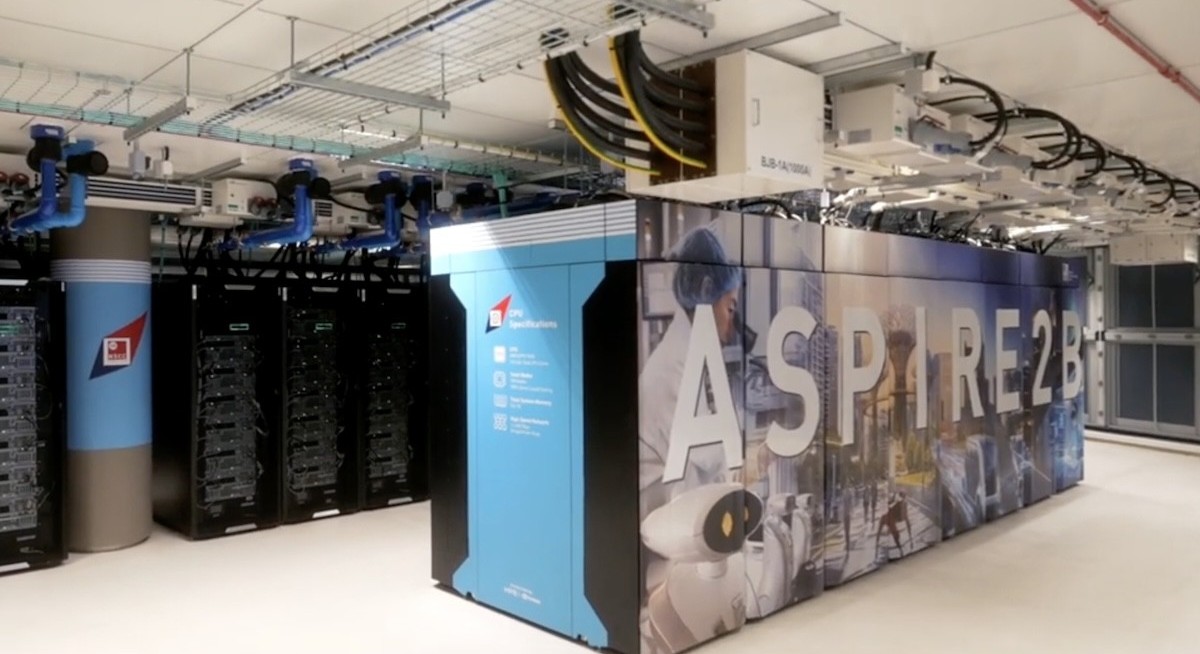


Singapore has launched a new national research supercomputer to expand the computing power available to researchers and public-sector users.
Called ASPIRE 2B, the next-generation national research supercomputer can deliver up to 115 petaFLOPS of compute power, or more than 100 quadrillion calculations per second. That is close to four times the combined capacity of Singapore’s existing national research systems, ASPIRE 2A and ASPIRE 2A+.
The launch puts a bigger national asset behind Singapore’s AI plans. Advanced artificial intelligence (AI) work now needs large amounts of processing power to train models, test them and apply them to real-world data.
The machine is part of a $270 million national investment announced by the National Research Foundation in 2024 to strengthen Singapore’s supercomputing infrastructure and capabilities. Its launch comes as the National Supercomputing Centre Singapore (NSCC), which runs the country’s national high-performance computing resources, marks its 10th anniversary.
Bigger compute for AI and science
ASPIRE 2B has 1,536 NVIDIA H200 GPUs, making it Singapore’s largest NVIDIA GPU cluster dedicated to research and public-sector use. GPUs are the chips commonly used in modern AI because they can perform many calculations simultaneously. The system also has 184,320 AMD EPYC CPU cores, more than 1,000 terabytes of memory and 63.5 petabytes of storage.
See also: Amazon inks US$17.5 bil loan as AI borrowing frenzy grows
The mix of chips matters because many new AI applications cannot run on chatbots alone. Healthcare models need clinical records. Weather models need climate data. Robotics systems need simulation and testing. Public services need AI that can understand local speech, languages and operating constraints. ASPIRE 2B is designed to let researchers combine those workloads on one platform.
One area of work is agentic AI, where systems help carry out a sequence of tasks instead of only producing an answer. In research, that could mean helping move an idea through design, testing and lab validation. Such work needs AI training and inference. Inference is the stage where a trained model uses new data to make a prediction or produce a response.
ASPIRE 2B is also being prepared for hybrid quantum-classical computing. The system is expected to be linked with Quantinuum’s Helios quantum computer, which is targeted for installation in Singapore near the end of this year. The link would allow researchers test algorithms that use both conventional supercomputing and quantum computing for problems that may be hard for either system to handle alone.
See also: TSMC’s monthly sales up 30% on sustained AI chip demand
Climate, healthcare and local AI
Climate research will be one of the early uses. NSCC’s systems have supported the National Environment Agency’s Third National Climate Change Study, led by the Centre for Climate Research Singapore (CCRS). That work produced high-resolution climate projections to support coastal adaptation, climate resilience and regional food security.
With ASPIRE 2B, CCRS plans to work on Singapore’s Future Climate Modelling Study V4. The study will use AI-driven, physics-based and hybrid modelling for rainfall nowcasting, local weather prediction and regional climate projections.
In practical terms, researchers will be able to run more detailed simulations of weather and climate risks while using AI to improve forecasting and produce more local climate projections. The work is expected to support planning for coastal protection, heat resilience, biodiversity, flood management and maritime operations.
Healthcare is another major use case. The Singapore Medical Foundation AI Model, or SIMFONI, was launched in 2025 to develop and deploy foundation models for healthcare. With ASPIRE 2B, SIMFONI will be able to train and fine-tune models on larger, more varied clinical datasets, including structured records and unstructured health notes.
Those capabilities could support AI tools for diagnostics, clinical workflow support, treatment planning and patient record analysis. Over time, the programme aims to support more personalised and preventive care by analysing patient data over longer periods and identifying risk signals earlier.
“Advancing healthcare AI requires the ability to work with large and complex clinical datasets at scale. ASPIRE 2B provides the compute foundation needed to support more advanced AI models for applications such as clinical decision support and patient record analysis, contributing to more data-driven and preventive healthcare," says Prof Robert Morris, Executive Director of SIMFONI.
To stay ahead of the latest tech trends, click here for DigitalEdge Section
ASPIRE 2B will also support Singapore’s efforts to build AI systems that better understand Southeast Asia. NSCC systems have powered the Multimodal Empathetic Reasoning and Learning in One Network (MERaLiON) project, developed by A*STAR’s Institute for Infocomm Research.
MERaLiON is a multilingual and multimodal large language model initiative focused on Singapore and Southeast Asia. Its AudioLLM v3 model can transcribe, translate, summarise and answer questions while interpreting regional accents, dialects, colloquialisms and code-switching. The series also includes text-to-speech capability for local Hokkien.
That matters in sectors such as healthcare, finance and public services, where AI systems need to work across local languages and speech patterns. One example cited is MERaLiON’s work with Axiom and Lion Befrienders, a social service agency supporting seniors, where the model helps automate routine check-in calls and improve outreach operations.
The MERaLiON team has released 12 models and two datasets on Hugging Face, with close to 1 million downloads. It has also formed an 18-member consortium to drive applications across healthcare, banking, mobility, media and homeland security.
With ASPIRE 2B, the team will be able to train larger multimodal models, cover more underserved languages and develop richer audio-visual and emotion-aware capabilities. The aim is to build sovereign AI systems designed for Singapore and Southeast Asia, instead of relying only on models built for other markets.
Access and execution
NSCC is also changing how researchers gain access to national computing resources. It will adjust its resource-provisioning framework to prioritise national Research, Innovation and Enterprise (RIE) programmes while giving institutions and emerging research teams greater flexibility.
A new Institutional Resource Allocation Framework will give Singapore’s institutes of higher learning a clearer route to national supercomputing resources beyond traditional RIE-funded programmes. The aim is to better coordinate demand and reduce the need for institutions to duplicate expensive infrastructure.
NSCC also plans to provide more hands-on support for researchers, including workflow optimisation, technical partnerships, and advice on how to design algorithms for specific hardware. It will expand training through structured onboarding and curriculum work with universities and industry partners.
“ASPIRE 2B reflects Singapore’s ambition to strengthen its position in trusted AI and advanced computing. It provides researchers with the compute capabilities needed to tackle larger and more complex challenges in areas critical to Singapore’s future, including healthcare, sustainability and urban resilience," says Dr Terence Hung, chief executive of NSCC Singapore.




