


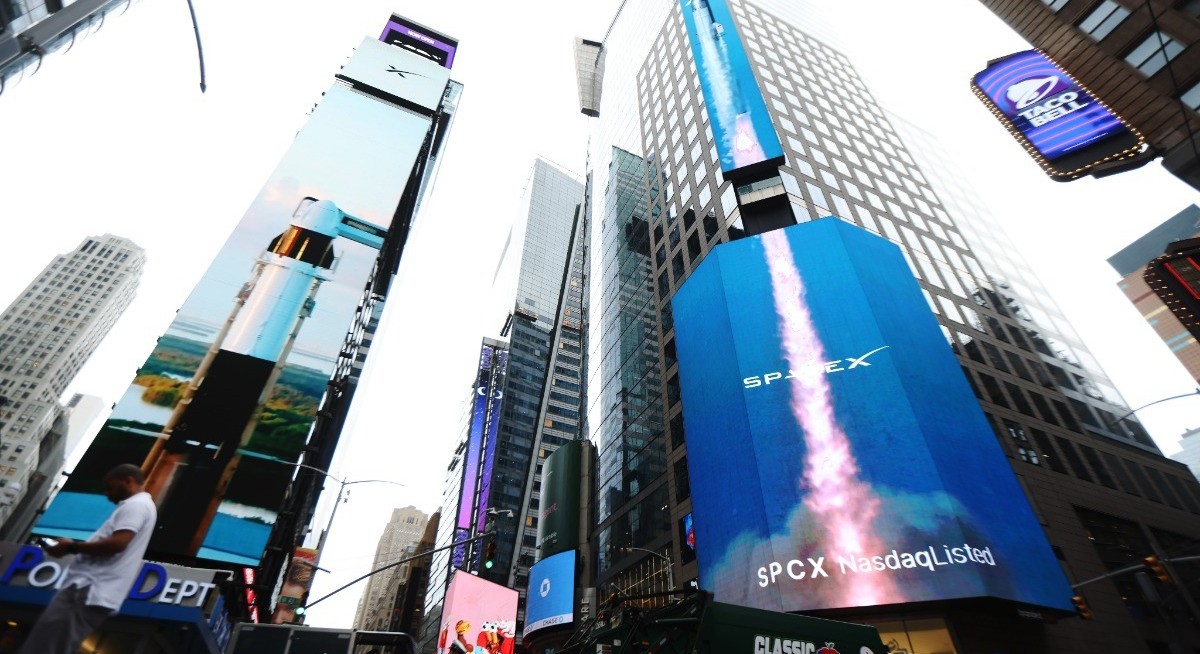


(June 13): SpaceX’s first day on the stock market transformed the startup into one of the world’s most-valuable public companies, handed buyers of the initial public offering (IPO) a 19% return and turned its founder Elon Musk into the world’s first trillionaire.
Yet the record-breaking US$75 billion ($96.33 billion) offering also accomplished something else: It allowed for a sigh of relief, not only for backers of Musk’s company but for an entire stock market that has been driven higher this year on optimism about the growth potential for artificial intelligence (AI).
SpaceX’s embrace of AI with the acquisition of Musk’s xAI in February made the listing somewhat of a referendum on the current leadership of the market as well as the IPO prospects of competitors Anthropic PBC and OpenAI, both of which plan to go public as soon as this year.
“It bodes well for the market and for these other IPOs that are coming that are going to be quite sizeable as well,” said Robert Gruendyke, senior portfolio manager for the growth equity team at Allspring Global Investments. “They clearly priced it right, at least for one day. It should just make you optimistic for the markets, especially for growth stocks.”
The shares jumped as much as 31% above their US$135 offering price, before closing up 19% at US$160.95. That left the company’s market capitalisation at US$2.2 trillion, meaning it ended its first day on the stock market as the sixth-highest valued public company in the world.
There was a long list of sceptics when it came to Musk’s grandiose ambitions and whether they’d lead to a monumental day like this for the company.
See also: S&P 500 climbs as SpaceX gains, hopes build for Iran peace deal
Among them, surprisingly, was Musk himself.
“It is certainly hard to believe that little company that started in a warehouse in El Segundo is now going public with the largest IPO ever,” Musk said in a livestream on Friday morning on X, the former Twitter that is now part of SpaceX. “If people had told me this was going to happen, I was like, man you must be smoking some really good crack, because I think this company is going to fail.”
SpaceX president Gwynne Shotwell, chief financial officer Bret Johnsen and Musk’s mother Maye waded through the crowds of paparazzi, police and onlookers to make it inside the Nasdaq MarketSite in New York’s Times Square for the stock’s debut. Musk himself remained behind at the company’s headquarters in Starbase, Texas, where he rang the exchange’s opening bell remotely. Many of his employees had other business to attend to: SpaceX launched 29 of its Starlink satellites into orbit on its Falcon 9 rocket from Cape Canaveral, Florida, about an hour before US stock markets opened.
See also: US SEC proposes eliminating equities trade-through rule
The IPO drew more than US$350 billion in demand from institutions and retail investors, according to people familiar with the matter. Among the firms that placed orders, close to one-third of them didn’t receive any stock, some of the people said.
Retail traders delivered more than US$100 billion of demand, Bloomberg News reported, the majority of which wasn’t met since the group received about US$15 billion in stock.
Despite all the enthusiasm for the listing, many investors remain sceptical that a company that has yet to turn a profit deserves such a hefty valuation.
“On the fundamentals, investors have got ahead of themselves,” said Amanda Lyons, head of research at Energy Group Capital, adding that she believes a sum-of-its-parts valuation would be about US$600 billion, roughly one third of its IPO market capitalisation. “But ‘expensive’ has never been a catalyst with Elon Musk, and betting against his premium has been a losing trade for a decade.”
And not everyone is convinced the stock’s debut should be interpreted as a positive signal for the broader market.
“Historically, without a doubt in the 20th and 21st centuries, any time you have seen massive IPOs and secondaries relative to the size of the market or the economy, investors generally have been advised to be a little more cautious or reduce their risk,” Jim Chanos, the veteran short-seller and president and founder of Chanos & Co, told Bloomberg Television.
Meanwhile, Musk’s newly minted trillionaire status also prompted calls from Democratic lawmakers including Massachusetts Senator Elizabeth Warren and California Representative Ro Khanna for a wealth tax on the richest Americans.
To stay ahead of Singapore and the region’s corporate and economic trends, click here for Latest Section
For the hordes of small-time investors among Musk’s fanbase, however, there was reason to celebrate — and trade.
SpaceX was the most bought stock by retail investors on Friday, according to a preliminary assessment by Vanda Research Ltd, with net purchases running at more than 3.5 times that of second-place Nvidia Corp.
The day wasn’t entirely without glitches for amateur stock pickers. Customers of Robinhood Markets Inc faced issues during the first minutes of trading, with the website Downdetector reporting roughly 5,000 outages shortly before noon in New York amid record-breaking traffic.
Yet the stock’s debut will likely be remembered for its orderly trading, and a jump in price that was relatively routine for a hot new listing.
“The initial bump is within the range of normality for a technology stock,” said Dec Mullarkey, managing director at SLC Management. “It’s what I would expect as I think the investor base has a range from those who believe Musk has the Midas touch to others that are technical traders. They somewhat keep each other in check.”
Still, a jump in price on the first day following a large IPO is no guarantee of future share gains. Even some firms that soar after their IPOs fail to maintain the momentum. SpaceX will still need the market’s ongoing validation of its ambition to dominate AI and carry humans to the moon and Mars, as well as the company’s controversial governance regime that promises Musk near-total control.
For US IPOs raising at least US$1 billion, the record for the biggest day-one gain belongs to design software maker Figma Inc, which rose 250% in its 2025 debut, data compiled by Bloomberg show. It gave up the increase and is now about 45% below its IPO price.
Companies with negative net income tend to lag by more than 10% over the first 18 months after their listing compared with profitable peers, according to a Trivariate Research report last year. SpaceX had a net loss of US$4.28 billion in the first quarter of 2026.
Goldman Sachs Group Inc, Morgan Stanley, Bank of America Corp, Citigroup Inc and JPMorgan Chase & Co led the deal with 18 other banks participating. The company is formally known as Space Exploration Technologies Corp.
With Wall Street already lining up to give SpaceX price targets as high as US$190, the debate over Musk’s dream of making humans a multiplanetary species has only just begun.
Uploaded by Chng Shear Lane




