


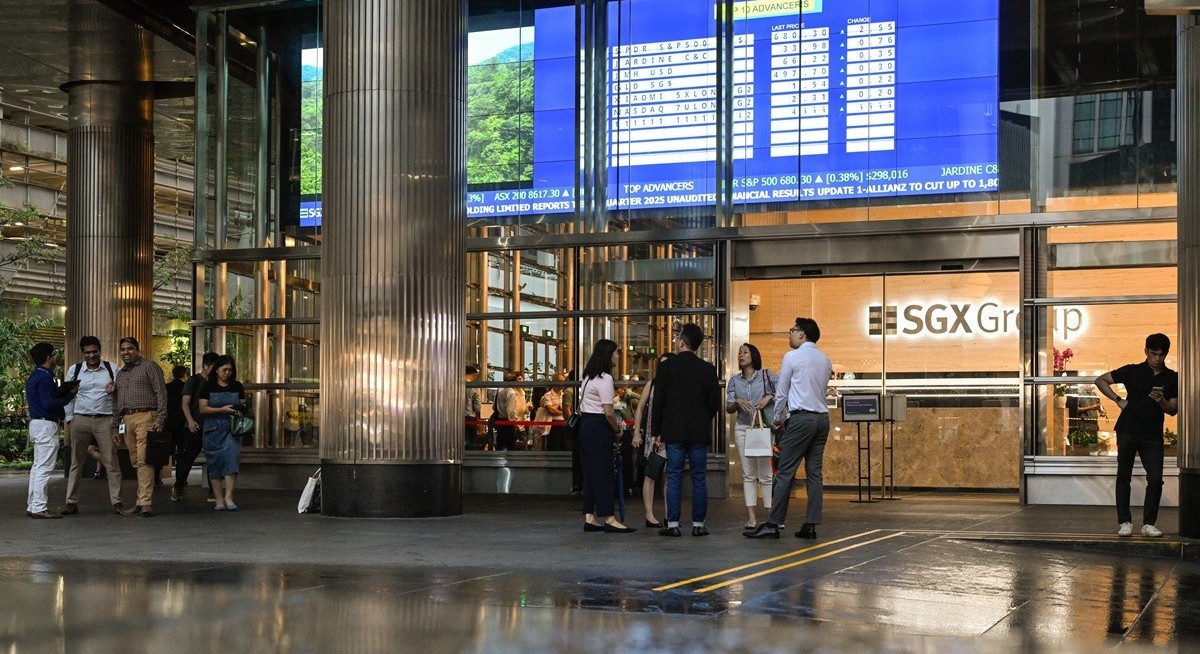


Why is there a need to update the custody system? Retail investors of listed companies on the SGX mostly hold their local securities in direct accounts with the Central Depository (CDP) while holding overseas securities in broker custody accounts. This arrangement differs from other major markets, where investors typically hold all their securities through brokers in omnibus accounts. The adoption of custody accounts is designed to align the market with international standards and encourage greater participation by internationally active asset managers, potentially enhancing the country’s competitiveness as a trading and investment hub and, in turn, providing an additional boost to Singapore equities.
Growth of broker custody accounts
Several brokerages say broker custody accounts are gaining in popularity. “There is a clear and accelerating shift toward the use of custody accounts for trading SGX-listed stocks,” says Tiger Brokers Singapore CEO Ian Leong. “In 2024, Singapore stock trading volume on our platform grew about 50% y-o-y, with the fourth quarter posting [an] 81% increase compared with the same period a year earlier. The momentum continued into 2025, where second-quarter orders increased 50% y-o-y and 21% q-o-q, while total trade value surged 133% y-o-y and 46% q-o-q.”
In a similar vein, iFast Singapore CEO Vincent Tong says that “custody accounts are indeed much more popular than CDP accounts” on its platform. “More than 90% of our SGX trades and volume are via custody accounts, and the proportion is still growing,” he adds.
See also: DBS likes 'pick-and-shovel' firms as AI and energy drive new global capex supercycle
According to Phillip Securities managing director Luke Lim, the brokerage has observed that more custody accounts are being opened on its trading platform, Poems. Lim says that this is “driven largely by demand from clients who trade across multiple markets and find the lower commission structure attractive”.
Broker custody accounts come with lower commission rates in general, offering a more economical option to cost-conscious investors in Singapore. Yujun Lin, CEO of Interactive Brokers Singapore, says that these types of accounts are “much cheaper and more efficient to operate”. He adds: “This is the standard operating model in most of the 160 markets we serve, and we pass these operational savings to the end-client.”
The lower costs also make them “attractive to younger investors and those trading in smaller sizes,” says Moomoo Singapore country head Echo Zhao. Although Moomoo began offering CDP linkage in October, Zhao adds: “The clear trend is that most Moomoo clients still favour the custody structure when trading Singapore equities, and that preference has remained consistent even after CDP linkage became available.”
See also: Clear cut case of no rate cut, no shortcut to lower US debt: Yellen
Besides lower costs, broker custody accounts also offer convenience to investors, including consolidating all investments under one platform and providing access to markets in Singapore and beyond.
“Clients can view SGX shares together with other products such as unit trusts, foreign equities, and bonds, all within a single account,” says Tong, who also leads the B2B arm of iFast. “This also reduces the risk of accidental short-selling, because all holdings are visible and sit in one place.”
Broker custody accounts also allow investors to start their investment journey sooner. As there is no need to link or set up a CDP account, investors can start investing once the trading account is open.
Flexibility in managing capital is another possible benefit, notes Moomoo. “When clients buy SG stocks under custody, those positions count towards their margin — providing greater flexibility in portfolio management and allowing them to optimise their capital,” says Zhao. “CDP-held shares, by contrast, cannot be used as margin collateral.”
Brokerages themselves could also possibly benefit from the custody model, as it provides brokerages with more insight into clients’ holdings, potentially allowing them to better serve their clients, notes Tiger Brokers. “Such a structure enables brokers to deliver more value-added services, including portfolio analytics, personalised insights and financing solutions that rely on real-time visibility of client positions,” says Leong.
Similarly, iFast notes that custody accounts have the potential to uplift brokerages. “The wealth management industry is shifting from ‘buy shares from a broker’ to ‘buy portfolios, diversification, regular savings plans and fractional share trading’,” adds Tong. “The move to a broker custody account model will greatly reduce the operational challenges for brokers to offer fractional shares and portfolio trading.”
He adds that nominee accounts provide an additional layer of privacy to investors. As shares are registered in the broker’s name on behalf of their clients, their holdings are not reflected in CDP, which provides an “additional layer of confidentiality”.
To stay ahead of Singapore and the region’s corporate and economic trends, click here for Latest Section
The additional secrecy does come at a cost. For instance, a CDP account user is eligible to attend AGMs as the shares are held in their name. In contrast, as the shares are not in their names, broker custody account users are unable to attend AGMs, unless appointed as a proxy.
According to Section 181 of the Companies Act, a person may attend, speak and vote at company AGMs only if they are appointed as proxies by a relevant intermediary member, which may be a brokerage that holds a capital markets services licence to provide custodial services under the Securities and Futures Act 2001 and holds shares in that capacity. Each proxy must be appointed to exercise the rights attached to a different share or shares held by the member.
iFast provided some insight into the number of custody broker users who want to attend AGMs, sharing that they receive “a few thousand requests each year” and that the number is growing. “In 2025, we saw a 30% y-o-y increase,” says Tong. “Almost all these requests were facilitated successfully.”
The deadline for custody account users to submit their requests for attending AGMs varies between brokers but is typically a few days before the registrar’s cut-off. According to most brokerages, the process for this group of clients to exercise their shareholder rights is relatively straightforward, with most brokers offering in-app notification and digital submission of requests.
Are CDP accounts still relevant?
While broker custody accounts have risen in popularity, there are still proponents of the CDP system.
Firstly, as shares are held directly under an investor’s name in CDP, the shares are portable across brokerages. This means that investors may shop around for the best rates and/or service and are not trapped in an ecosystem that they are unhappy with.
Some Singaporean investors remain comfortable with the CDP model, notes Phillip Securities. “Some clients prefer CDP accounts as their Singapore-listed shares are held directly with CDP, which provides a sense of security and allows them to consolidate all SGX holdings in a single depository,” says Lim. “Over the past two years, both custody and CDP accounts have seen increased trading volumes on SG stocks, supported by the broader market trend as the STI has been on an upward trajectory.”
However, digital brokers such as Interactive Brokers believe that regulations have kept up with the times and made broker custody accounts just as secure as CDP. “Regulatory requirements on brokers for capital, system resiliency, and record keeping have been strengthened over the years, so in modern times, there is no discernible difference in the sanctity of the share ledger between a broker and the central or national depository,” says Lin.
Future-proofing the stock market
As announced, to align with international practice and enable retail investors to manage all their holdings on a single account, the review group endorsed SGX’s proposals to promote wider investor adoption of broker custody accounts, including enabling omnibus accounts for SGX securities for Singapore investors.
Digital brokers voiced their support for the proposal. Interactive Brokers says that it supports the “modernisation” of the custody model. “The broker custody model could allow Interactive Brokers to operate at higher efficiency and automate more of the securities clearing and settlement process,” says Lin.
Moomoo says that the move aligns closely with the trading habits of a new generation of investors. “As the industry continues to embrace custody structures, we believe this will further strengthen the ecosystem for digital brokers and enhance the overall experience for investors,” adds Zhao.
Leong says that Tiger Brokers welcomes SGX’s initiative. “This direction is aligned with global market practices and supports a more efficient and investor-centric ecosystem, where trading, custody, corporate actions and portfolio management can be integrated within a single platform,” he adds.
For iFast, it sees the initiative as part of broader measures to revitalise the liquidity of Singapore’s equity market. “By shifting to a broker custody account model, SGX will align with global norms and reduce entry friction, possibly attracting more retail trading and foreign participation,” says Tong.
The broader measures announced by MAS include the dual listing bridge between SGX and Nasdaq, the second tranche of the equity market development programme (EQDP), the Value Unlock programme and smaller board lot sizes.
Several transition measures will be implemented to support the adoption of broker custody accounts by retail investors. These include paving the way for investors to better exercise their shareholder rights from a broker custody account, as well as rolling out public education initiatives on this account type. The CDP accounts will also remain available as a custody option for retail investors, to ensure a gradual transition for brokers and investors.
On the transition measures to facilitate shareholders to exercise their rights from broker custody accounts, an SGX spokesperson says: “The processes and timelines may, however, vary from one broker to another. SGX RegCo will consult in due course on measures such as setting a baseline for these processes to ensure investors are well-served and will work closely with brokers along the way.”
The planned SGX consultation with stakeholders will take place in 1Q2026.




