


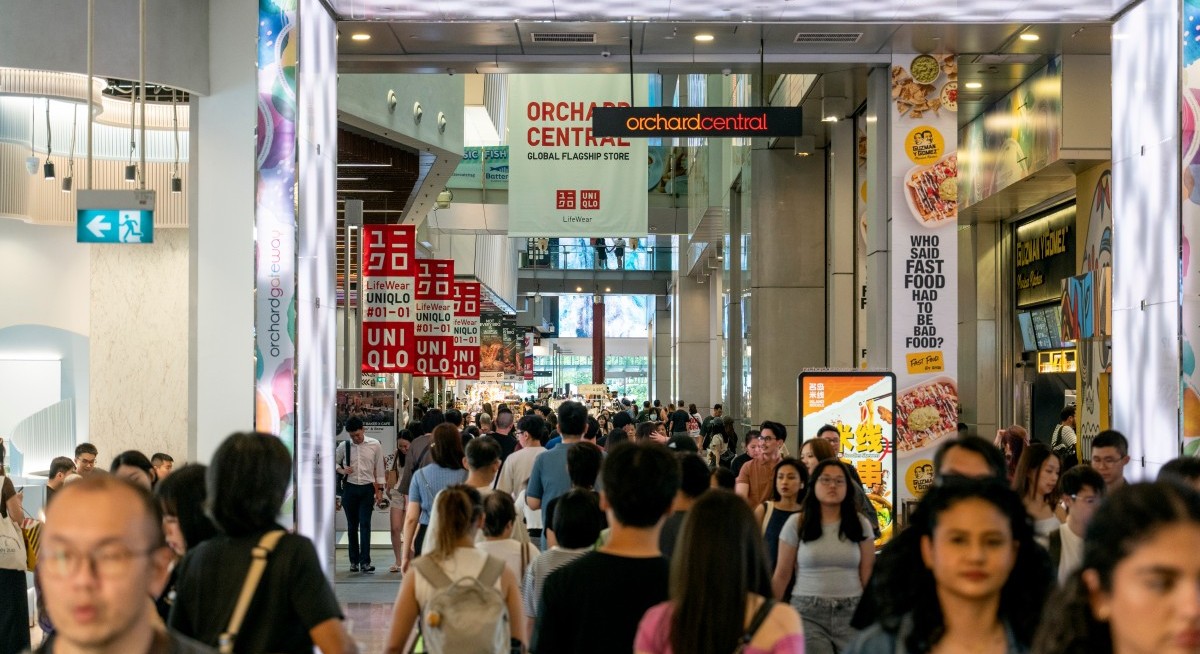


According to Liu, the best case scenario is the RTS causing a short-term 3% to 4% leakage in retail spend to Johor which is still “manageable”. However, she believes that the RTS is likely to be a net positive for retail in the long-term.
In fact, Liu sees increased labour inflow to Singapore, which will help to alleviate, or even tackle persistent labour shortage here, especially in the labour-intensive service and F&B sectors.
For REITS such as Frasers Centrepoint Trust, which has a significant portion of its malls in the northern region, Liu remains “cautiously optimistic”. She believes footfall will be “softened” in the near-term, but in the long-term, these mall owners will benefit from lower tenant operating costs and a more “predictable” consumption pattern of an increasing population density driven by the possible labour influx.
Meanwhile, Liu sees “net positives” such as higher footfall and stable rental reversions for CBD malls to impact Suntec REIT, Lendlease Global Commercial Trust (L-REIT) and CapitaLand Integrated Commercial Trust (CICT).
See also: ESR-REIT to buy five Melbourne logistics assets from Frasers Property for A$276.8 mil
For Suntec REIT, Liu notes that more than 70% of its income is generated from the Singapore retail and office sectors. With interest rates forecasted to drop further this year, the REIT is expected to generate more cash from FY2026 and grow its distribution per unit (DPU) by 3.3%.
As Suntec REIT’s recent divestment of some properties at 20% above valuation has shown, this implies a “very unjustified valuation” with its unit price trading at a 40% discount to its NAV per share. Liu’s target price for Suntec REIT is $1.41 with a “buy” rating.
Another pick by Liu is Lendlease Global Commercial REIT, which has used proceeds from the recent divestment of the office portion of JEM to reduce its gearing to around 35%. Lifted by lower financing costs, the analyst believes that this REIT’s DPU has bottomed out and will stabilise in the coming FY2027, with some support from the recent acquisition of a 70% stake in Paya Lebar Quarter mall, which is 2.5% accretive.
See also: Elite UK REIT divests four properties in Wales for GBP6 mil
Liu, who has a “buy” call and 69 cents target price, believes Lendlease REIT’s current valuation of 0.7 times price to net tangible asset (NTA) to be “very attractive”.
Fortress balance sheet
Hashim Osman of Phillip Securities points out in contrast to the 11.6% decline in 2024, the S-REIT index saw a “dramatic” rebound in 2025, with a 10.6% increase, thanks to “strong” retail and office performance, as well as “solid” occupancy and rental reversions.
Hashim justifies his optimism for the local REITs sector from a macro perspective. He observes that S-REITS tend to rally when the US dollar weakens against the Sing dollar. When this happens, not only do acquisitions become cheaper for REITS in Sing dollar terms, foreign capital would also tend to flow into S-REITS because of their relatively attractive yields. Also, when rates go down, REITs go up as financing costs will be lower. “So due to the Trump put effect, where he's cutting interest rates, we are observing a rally back to the S-REITs,” says the analyst.
Describing the drop in the three-month SORA by 180 basis points to the current 1.2% as “massive”, with more rate cuts expected, Hashim expects S-REITS to maintain “good momentum” and grow their net asset values and also DPU at an average of 1%.
He estimates that more than 70% of the REITs has benefitted from lower rates. For example, CDL Hospitality Trusts and OUE REIT have seen “significant” y-o-y declines in debt cost while Stoneweg Europe Stapled Trust (SERT) and Prime US REIT will likely refinance their debt to lower rates presumably in the near future.
SERT, according to Hashim, has a “fortress balance sheet” as it has no debt maturities until 2030 and it has been lowering debt. In addition, it has a “resilient” portfolio with occupancy in the 93% to 95% range, translating into consistent earnings and DPU growth. Lastly, he expects the REIT’s investment into data centres to yield handsome returns. Based on the above reasons, Phillip Securities has a “buy” rating for SERT with a target price of EUR1.86.
For more stories about where money flows, click here for Capital Section
Hashim likes Prime US REIT as well, and expects recovery in its unit price, which is down by over 70% in the past five years to the point that it is now trading at a discount of around 60% to its NAV even as portfolio occupancy holds at around 80%.
Right now, only 70% of the portfolio is contributing cash due to rent-free periods as part of long-term lease agreements. This means once these rent-free periods expire and tenants start paying rent, DPU will naturally increase.
Previously, Prime US REIT had held its distribution at just 10% of the distributable income. This is set to increase with the REIT committing to raise payouts to 50% of distributable income. The payout will also be augmented by new lease signings, which is estimated to push the REIT’s occupancy rate to 90% later this year, says Hisham, who has a “buy” call and 30 US cents target price.




