


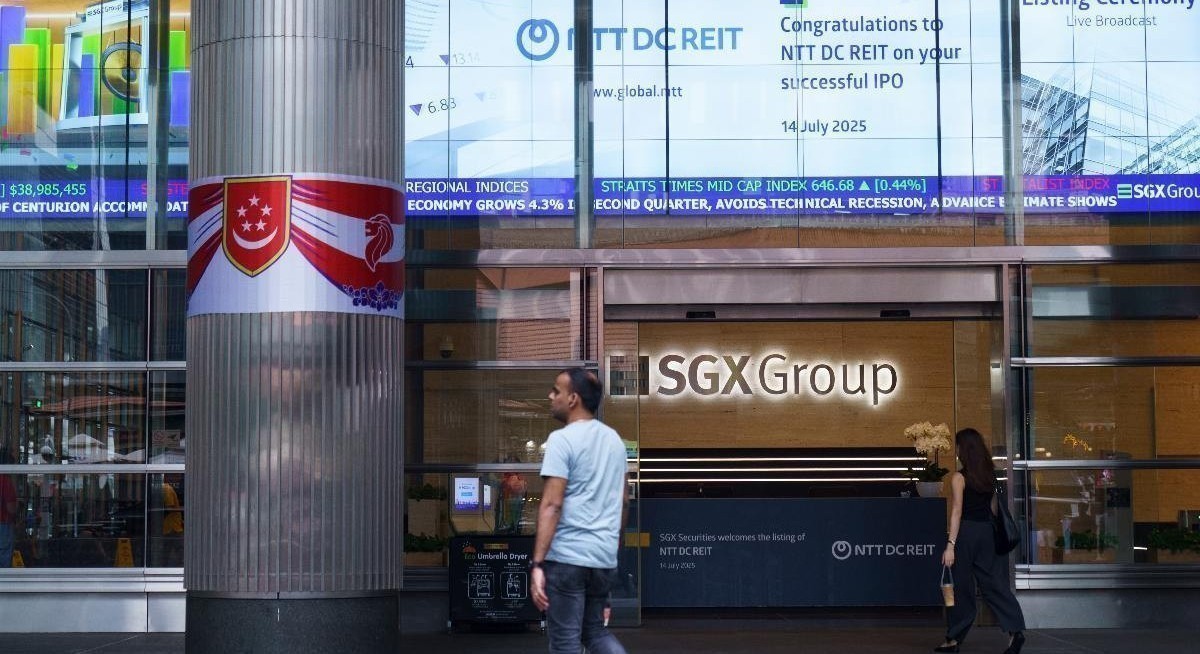


To Maybank Securities analyst Thilan Wickramasinghe, SGX’s 1HFY2026’s core profits were in line with his estimates and ahead of the consensus’ estimate. “Its fixed income, currencies and commodities segment (FICC) business demonstrated strong positioning as a risk management venue amidst significant supply chain uncertainty,” he writes.
Wickramasinghe adds that revenue stemming from equities – cash grew 16% y-o-y in the period, led by average daily value traded (ADV) increasing 19.5% y-o-y to $1.51 billion. On the broadening in ADV, he writes: “In our view, this growth is largely independent of equity market reforms as related implementation has yet to kick-off i.e. EQDP (Equity Market Development Programme) is only just starting to be deployed.”
The analyst expects momentum in equities and cash to “accelerate” in the second half once market reforms start to be implemented, which he thinks “should drive higher volumes and a better fee mix”.
The deployment of the $5 billion EQDP fund, coupled with continued safe-haven flows to Singapore, should provide upside risks to market velocity, notes Wickramagsinghe.
See also: Info-Tech to benefit from 'structural shift' in government's AI-related push: RHB
SGX’s management has claimed that nearly a sixth of all listings have shown interest in value unlock via market reforms, to which Wickramagsinghe sees could “become an additional layer of liquidity and momentum” in the 2HFY2026.
He adds: “Similarly, management claims there are over 30 initial public offerings (IPO) in the pipeline and the Nasdaq-SGX dual listing bridge is drawing strong enquiries.”
The 1.8% y-o-y rise in clearing fees he notes also highlights a shift in mix towards full-fee paying retail and institutional clients. “Combined, these developments should broaden and deepen SGX’s equity-cash proposition. We raise FY2027 to FY2028 equities revenues by 2% each,” he notes.
See also: Mittal of DBS maintains 'buy' on Singtel on sale of Gulf Development stake
In the 1HFY2026, FICC volumes jumped by 20.8% y-o-y, driven by iron ore and foreign exchange (forex) futures. On this, Wickramasinghe sees that significant forex and supply chain uncertainty globally is “likely to persist” in the medium-term, which should drive demand for the segment. With this, he raises FICC FY2026 to FY2028 revenues by 1% to 2%.
“Equities – derivative volumes were relatively sluggish, at a 0.4% [decline] y-o-y, with this segment continuing to provide a stable base for longer-term revenue diversification,” he writes.
Following forecast adjustments, particularly to FICC and equities — cash, Wickramasinge sees SGX’s FY2026 to FY2028 earnings per share (EPS) rising between 1% to 4%. With this, the Maybank analyst is keeping his “buy” call on the group with a raised target price of $20.37 from $18.81.
He writes: “SGX remains the most direct proxy to upsides from Singapore market reforms, while also offering a play on revenue opportunities stemming from managing forex, commodities and supply-chain volatility.”
Upside factors noted by him include increased geopolitical uncertainty, central bank policy changes which could drive higher derivative risk management volumes, value-accretive mergers and acquisitions (M&A) that may complement existing business segments, positive structural policy changes aimed at attracting IPOs and raising secondary market securities daily average value (SDAV).
On the other hand, downside risks include disruptions to SGX technology infrastructure leading to halts in trading which can result in material impact on earnings and market confidence, increased competition from regional exchanges- especially in introducing similar derivative products and the advent of disruptive financial technology and off-exchange trading solutions.
DBS Group Research’s Lim Rui Wen has a similar take on the group’s performance with her “buy” call and lifted target price of $19.20.
For more stories about where money flows, click here for Capital Section
Lim writes: “We believe the current volatility and Singapore dollar safe-haven inflows are structural in nature, and anticipate continued flows into Singapore, particularly for yield stocks, post-Liberation Day, given the diminished trust in the US dollar amid ongoing de-dollarisation trends and re-evaluation of US credit and policy credibility.”
On the EQDP she writes: “We believe there are further legs to the market as we look towards deployment of a second EQDP tranche.”
Analyst Tay Wee Kuang of CGS International (CGSI) is also keeping his “add” on the group with an unchanged target price of $19.10.
Tay’s target price is pegged to FY2027 price-to-earnings ratio (P/E) of 28 times, two significant deviation (s.d.) above its 15-year mean as he believes SGX can achieve sustained growth from FY2026 to FY2028 due to the equity market review.
The group’s management in August 2025 announced that it would remain committed to a 0.25 cents quarterly step up in dividend per share (DPS) to 13.5 cents by the 4QFY2028, between the FY2025 and FY2028. This would translate to a yield of about 2.5% to 3.0% for the FY2026 to FY2028.
“Other re-rating catalysts include new initiatives to enhance shareholders return through dividends as well as bolt-on acquisitions that would further diversify SGX’s suites of products,” writes Tay. Conversely, downside risks noted by him include stagnating trading volumes and steep declines to treasury income as a result of declining interest rates.
Andy Wong of OCBC Investment Research has kept his “hold” call on the group at a raised fair value of $18.17 from $16.15 after the group’s net profit after tax of $357.1 million beat expectations, forming 54.1% of his initial FY2026 forecast.
On SGX’s commitment to quarterly increase in DPS, he notes that this would be subject to earnings growth and supported by broad-based strength across the group’s multi-asset business model, which includes scaling up its forex business, broadening and deepening its derivatives franchise and accelerating its stock exchange business.
Notably, in 1HFY2026, SGX’s forex achieved an all-time high ADV of US$180 billion ($229.4 billion), while securities SDAV jumped 19.5% y-o-y to $1.51 billion, which Wong notes was “the highest” since early 2021.
Like his fellow analysts, Wong has lifted his target P/E multiple peg from 26.2 times to 27.0 times on account of “encouraging signals” from SGX’s initiatives.
He points out product development and alliances with other bourses which increase trading flows and bottom line, tighter cost controls as well as higher-than-expected declared dividends and trading velocity as potential catalysts.
As for investment risks, he lists cost inflation, fee pressures, faster-than-anticipated market share loss, M&A risk as well as higher compliance or regulatory-related costs and operating expenses.
“We view derivatives as the main long-term driver of revenue and earnings growth for the exchange, not cash equities. Derivatives revenue has increased structurally as a share of trading revenue, occasionally offset by a pickup in cash equities, as we're seeing now,” writes Morningstar Equity Research analyst Roy Van Keulen.
Van Keulen has a three-star rating on the group, which according to Morningstar “indicates our belief that investors are likely to receive a fair risk-adjusted return.”
In-line with this, the analyst has lowered his annual cost growth estimates from high-single digits to mid-single digits for his explicit forecast period. He writes “As a result, our fair value estimate for wide-moat SGX increases by 6% to $16 per share. Shares screen as slightly overvalued.”
On the EQDP, Van Kuelen calls “such tailwinds” as “temporary”. He writes: “We believe this has driven the outsize importance of the exchange and has allowed it to become the dominant venue for some of the most liquid and widely traded derivatives products for various regional markets, including China and India.”
“As a result, we expect the injection of new funds into local equities to eventually simply free up capital elsewhere for overseas investment,” he adds.
Citi Research’s Tan Yong Han is the only analyst to have a “sell” call among his peers.
He notes: “SGX reported 1HFY2026 profit of $342.7 million was 11% higher h-o-h and 1% higher y-o-y, which was a headline 3% miss; underlying profit of $357.1 million was slightly ahead. Reported profits were weaker due to a $15 million goodwill impairment of Scientific Beta.”
“Revenue growth with sustained cost discipline drove better operating leverage. Despite [the] November 2025 announcement to award a further $2.9 billion of EQDP funds, share price traded sideways, likely reflecting a spike in SDAV well anticipated by the market,” adds Tan.
His target price for the group is $14.90, based on a dividend discount model given SGX's “cyclical profit profile”, thus leading the analyst to focus on sustainable dividends to provide a core valuation for the stock.
As SGX “enjoys” one of the highest transaction fee structures globally due to a near-domestic monopoly, Tan sees that new entrants or changes to pricing structure and business mix could impact this.
Should this have a greater downside impact than he anticipates, the group’s share price will “likely have difficulty” attaining his target price. Conversely, should the impact of this upside be greater than he anticipates, the stock could materially exceed his target price.
Shares in SGX closed 7 cents lower or 0.40% down at $17.57 on Feb 6.




