


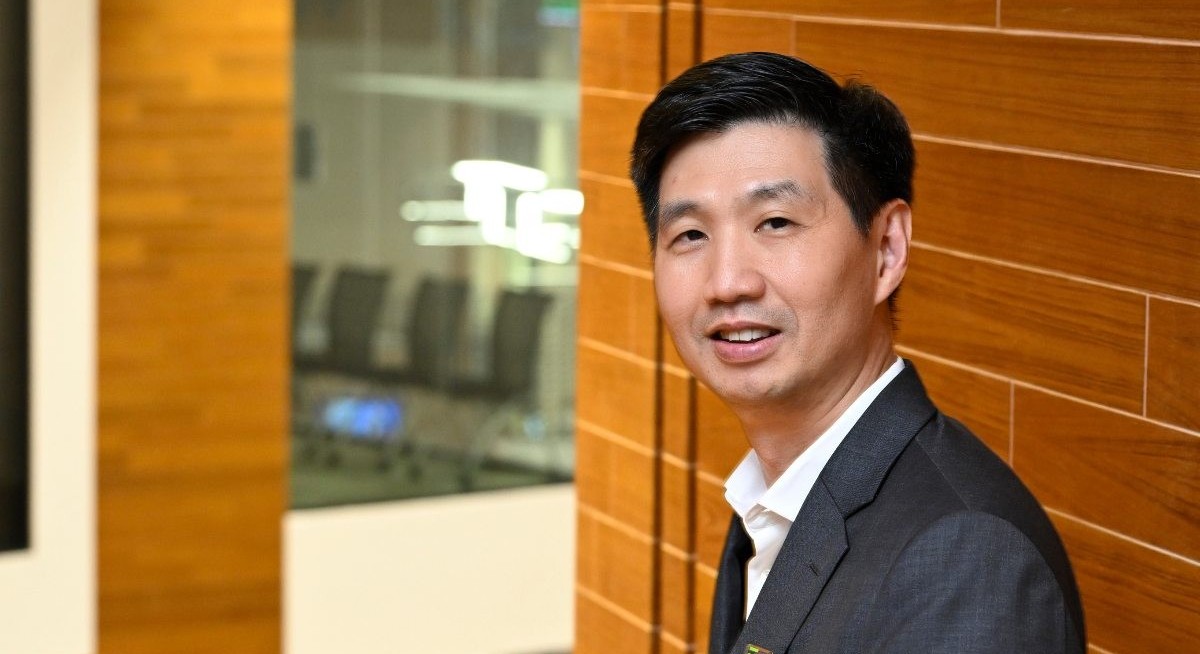


Yet, while the numbers have brought the party mood back to many, Ng Yao Loong, SGX’s head of equities, has bigger concerns. “We need to be relevant; the economic paradigm has shifted, assumptions have shifted,” he says. He adds that the bourse should focus on how it supports its companies. “[It] can’t just be firms taking risks. They need the help of capital providers. They need the help of the government in some way, shape or form.”
For Ng, relevance is measured by how the bourse serves its 606 listed companies as of December 2025. “Relevance is not about being [the] biggest or largest in this region,” he says. It is also not about higher trading volumes, although that would be nice in terms of league tables and peer comparisons.
SGX had “struggled as a market”, particularly amid feedback that the exchange was losing relevance. The equity market review group was introduced in August 2024, at a time when many market watchers questioned whether SGX had lost its shine, with investors preferring more dynamic markets such as the US. At the time, the Singapore market was described as “listless”, “boring”, and “undervalued”, in contrast to regional exchanges gaining momentum.
Ng, however, remains pragmatic. “Most Singaporeans invest anywhere in the world, but they care about how the [Singapore] stock market does,” he says. “We always believe that we are part of the Singapore market infrastructure, and by virtue of being a market infrastructure, we need to serve a certain segment of the companies or the population.”
See also: Clear cut case of no rate cut, no shortcut to lower US debt: Yellen
SGX has not always been the first choice for local issuers, with examples such as Nasdaq-listed Grab or NYSE-listed Sea. “Issuers can list overseas,” Ng says. “There may [be] certain issues, especially for the smaller ones, but they do care that the Singapore stock market is here and it’s functioning.”
“[Take for instance, our] universities — our best students, I think, continue to go overseas, but we still need to serve the vast majority of the domestic constituents,” says Ng, who holds an MBA from Northwestern University, and a Bachelor of Arts from the University of Cambridge.
Breaking the vicious cycle
See also: May is another active month for SGX with volumes reaching new highs
The challenge SGX faced was not just sentiment — it was structural. For years, the bourse was caught in what Ng describes as a vicious cycle.
“Many institutional investors look at SGX and say, ‘Because of your liquidity profile, I can only size certain positions accordingly,” Ng explains. “They need to think about how — if and when they exit — how do they do it? And because the market was slower in trading volumes, they would then size it at a lower number. That’s just very normal financial management.”
SGX was also perceived as a yield-focused market dominated by REITs and dividend-paying stocks — a perception that became reality as it became about the best “plus” point for the market then. “We needed to, in a way, break that perception. Last year, there were a couple of listings that were helpful, but clearly there’s still room to do more.”
Breaking that perception does not mean abandoning dividend-paying stocks for growth companies. Diversity is possible, Ng notes. “If you look at the US market, they have a diversity of companies, including those who decide they’ll do monthly payouts because it appeals to a certain segment,” he says. “I don’t think it’s a mutually exclusive situation.”
He adds that markets, like portfolios, should accommodate a range of company types, and even so, their nature and growth profile could change over time, taking on the varying definitions of “exciting”. For example, data centre REITs are not necessarily the boring stable yield type of investments. They can be capital-intensive growth plays too.
“The data centre companies right now are undertaking massive amounts of investments, and whatever cash flows they do generate are used to build new ones at quite an unprecedented pace,” Ng says. “So you would say, look, that is a growth profile. It’s not a dividend-paying company.”
“In the new drivers of economic performance, whether you talk about artificial intelligence or the application of AI, the infrastructure layers, who would have thought that the capex requirements of data centre providers are so huge?” he muses, adding that the market needs to accommodate both data centre REITs and operators, just as the real estate sector has both REITs and developers.
To stay ahead of Singapore and the region’s corporate and economic trends, click here for Latest Section
Sustainable participation
If there is one key takeaway from recent market momentum, it is the breadth of participation.
“We could have gotten the same numbers, but with just a few companies with the same group of investors,” Ng says. “But that is clearly not the case. It is a broader number of companies, a broader set of investors — more retail and institutional — that are involved in our market, because that makes it more sustainable.”
In its Jan 9 release, SGX said retail participation in cash equities grew to a four-year high, while institutions net purchased $415 million of small- and mid-cap stocks in 2025.
Though the benchmark Straits Times Index (STI) is at an all-time-high and just a whisker away from 5,000 points, Ng notes that there should be more room to run. Factors include the return of retail investors after “years on the sidelines”, global allocation tailwinds, the valuation gap between Singapore’s economic growth and its market value, normalising risk premiums, structural under-ownership, and late-cycle timing masking an equity cycle that still has room to grow.
The $5 billion Equity Market Development Programme (EQDP), announced in February 2025 as part of the broader market revitalisation package, is also a key factor, although Ng notes that the actual firepower should be higher when private capital is crowded in.
Beyond liquidity, SGX is creating initiatives to attract different types of companies. The Global Listing Board (GLB), a partnership with Nasdaq launching by mid-2026, targets high-growth, new economy companies with an Asian nexus.
“I think it is an attractive feature and we want this to be able to help us accelerate growth of certain types of companies,” Ng says. “But ultimately, SGX must be able to serve the vast majority of the domestic and regional companies out there.”
Even so, when compared to the US, which is, by far, the deepest and broadest market with over 4,000 listed companies, Ng hopes that an SGX listing via the GLB makes sense. “In the past, that gap was too wide for [companies] to say… ‘I like Singapore, but that discount was too large and I can’t digest it.’ But I think that gap has grown smaller.”
“We want SGX to be one of the preferred listing venues [companies] think about,” he adds. “In the logical sequence of events, hopefully SGX can serve their purpose without them having to take a very big step to go overseas. They can do it eventually, but I’d love for SGX to be able to play that meaningful role in supporting their growth.”
As it is, companies here will receive more support via the Value Unlock programme, another one of the measures suggested by the review group. “SGX is very involved in the day-to-day [when] working with these companies to try and put the different parts of the ecosystem [together],” says Ng.
Implementation ongoing
While the full package of market revitalisation measures has been announced, implementation is far from complete. An Equities Market Implementation Committee, set to be announced in the coming weeks, will oversee the multi-year rollout, co-chaired by Monetary Authority of Singapore managing director Chia Der Jiun and SGX CEO Loh Boon Chye.
“Clearly, some of the projects are multi-year,” Ng says. “As usual, it’ll be useful to get feedback along the way. The work has not been completed yet.”
Ultimately, Ng sees the transformation as bigger than the exchange itself. “We all have an interest for the stock market to [become] more vibrant, more relevant,” he says. “Not just to SGX, but to the various stakeholders.”
Those stakeholders include listed companies, retail and institutional investors, as well as the broader Singapore economy. The stock market plays a role in capital formation, price discovery, and even retirement planning for some segments of the population.
“Our role is capital formation, price discovery; and I’d like to think that we have a role in planning for retirement for at least some segments of the population,” Ng says.
Whether the vision translates into sustained transformation remains to be seen. The measures are in place, the pipeline is being built, and market momentum is positive. But as Ng emphasises, the ultimate measure is not STI levels or trading volumes — it is whether SGX remains relevant to the companies, investors, and economy it serves.
For a market infrastructure, relevance is not a luxury, it is the point. In Singapore’s new economic paradigm, which demands more risk-taking and growth capital, staying relevant means evolving beyond the old playbook.
“How does SGX remain relevant when more risk-taking is required?” Ng asks. It’s a question the exchange is actively answering.
When asked about his thoughts on the post-listing performance of the recent IPOs, some of which went underwater while others enjoyed a nice pop, Ng says that key is to have a balance. “We want [an IPO] to leave a good after-taste, [which] ideally [means it] settled to a level where investors say, ‘I’m glad I was a part of this IPO and I’d like to remain a shareholder of the company.’ That’s what issuers want.”
In all, Ng is “glad” for the combination of factors ranging from the internal reforms to the exogenous factors that have led to the run-up in the STI today. “As our minister [Chee Hong Tat] said, we do have agency, and if we are able to ride the wave smartly and navigate the situation, there’s no reason why the stock market cannot be a better version of what it was two years ago.”




