


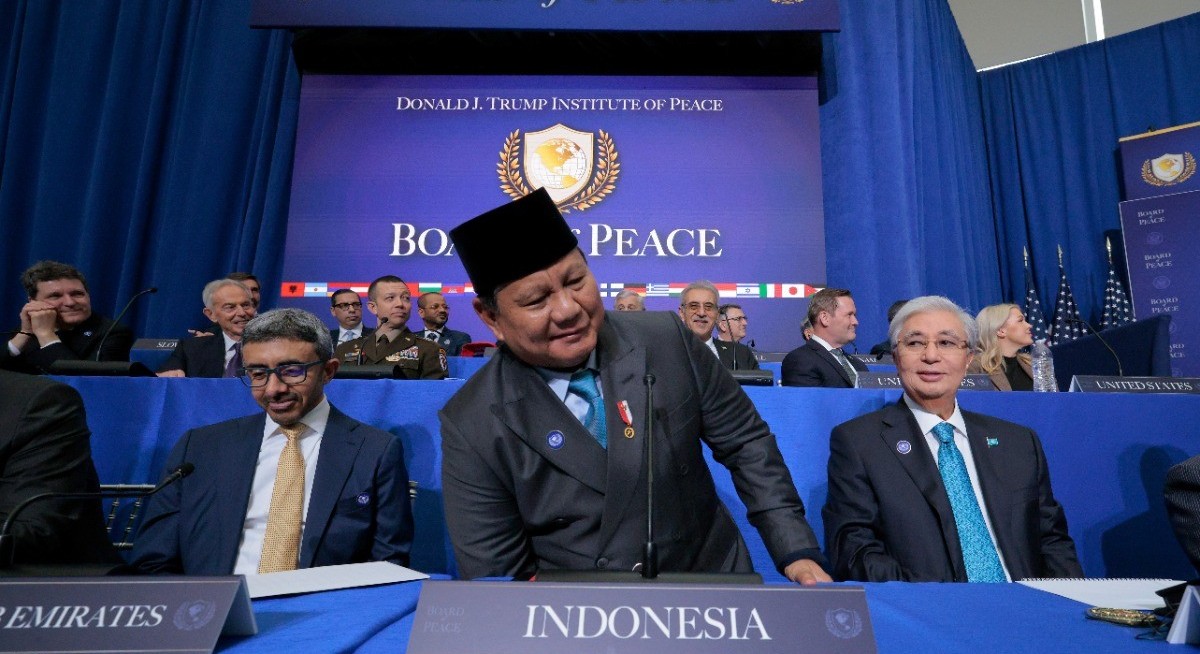


(Feb 20): US President Donald Trump and Indonesian President Prabowo Subianto finalised a trade agreement on Thursday, ending months of uncertainty with an accord that’s expected to lower US tariffs and see Jakarta facilitate the purchase of an estimated US$33 billion ($42 billion) in American goods.
The leaders “confirmed their strong commitment to implementing” the deal and instructed their teams to “take further steps for a new golden age of the ever-growing US-Indonesian Alliance” as they met on the sidelines of the Board of Peace’s inaugural meeting in Washington, according to a White House statement.
Under the deal, Indonesia — a Group of 20 nation that counts the US as its second-biggest export destination — will avoid the threatened 32% tariffs and instead face a 19% rate for most goods.
The agreement also eliminates heightened duties on some of Indonesia’s exports, including palm oil, spices, and pharmaceuticals. It creates a mechanism for certain textiles and apparel to earn tariff exemptions — boosting a key Indonesian industry.
For the US, the pact aims to expand access to a fast-growing consumer market of more than 280 million people and bring Indonesian companies to source more from the US.
Indonesia will eliminate levies on more than 99% of US goods and remove non-tariff barriers, while Indonesian businesses are expected to buy more US energy, agricultural products and other goods — steps meant to narrow Indonesia’s roughly US$16 billion trade surplus with the US.
See also: ECB’s Lagarde renews call for cooperation to save global order
Those deals include the import of US$15 billion in US energy, including US$3.5 billion of liquefied petroleum gas, US$4.5 billion of crude oil and US$7 billion of refined gasoline. Indonesia is also expected to procure US$13.5 billion in commercial aircraft, in what should be a boon for Boeing Co. And Jakarta has agreed to import US$4.5 billion in US agricultural commodities — including cotton, soybeans, wheat, beef, rice and corn — as part of the agreement.
Indonesia will also reform its pre-shipment inspection processes to address concerns raised by US exporters and eliminate tariffs and fees on digital services. And Indonesia has said it would “endeavour to facilitate” US$10 billion of outbound direct investment to the US, including engineering and construction projects as well as energy initiatives including the development of blue ammonia.
“President Trump is unlocking Indonesia’s market of over 285 million people to create commercially meaningful opportunities for American farmers and manufacturers,” said US Trade Representative Jamieson Greer in a statement. “This landmark agreement breaks down trade barriers while advancing the economic and national security interests of the American people.”
See also: Takaichi to tout plans aimed at stoking private spending
Indonesia and the US will form a council to address any disputes and perceived imbalances in their bilateral trade, Coordinating Economic Minister Airlangga Hartarto said in a briefing. Both countries have room to amend their agreement and lower tariffs as needed, he added.
“The aim and vision of the agreement is to realise economic prosperity with a strong supply chain and respect for the sovereignty of each country,” Hartarto said.
Unlike the tariff deals signed with other countries, the US agreed to revoke articles that do not address economic cooperation, including nuclear reactor development, the South China Sea, and defense and border security, he said.
The pact also commits Indonesia to align with US export controls and sanctions on sensitive technologies — including restricting dealings with blacklisted entities — and prevent its companies from helping others circumvent those measures.
If Indonesia enters a new bilateral trade deal that jeopardises essential US interests, the US may terminate this reciprocal tariff agreement and reimpose higher levies.
Beyond tariffs, Indonesia pledged to exempt the US from key economic regulations, including halal certification, local content requirements and a one-year onshore lock-up of dollar earnings.
The agreement also touches on critical minerals, as the US seeks to reduce supply-chain dependence on China and secure inputs for electric vehicles, defence, and manufacturing. Indonesia said it would allow US companies to extract critical minerals on terms similar to those for domestic investors.
To stay ahead of Singapore and the region’s corporate and economic trends, click here for Latest Section
Indonesia will also scrap foreign ownership restrictions for US investors in sectors like mining, broadcasting and financial services. That move could prove complicated, if not controversial. Other countries and companies have pushed back against these rules for years, but have had no choice but to comply with them to tap Indonesia’s market.
Washington promised to consider offering investment financing through the Export-Import Bank and US International Development Finance Corporation.
Trade-offs
The nations reached a framework last July, under which Indonesia agreed to eliminate tariffs on more than 99% of American goods and remove non-tariff barriers while the US slashed duties on Indonesian products to 19% from the threatened 32% rate.
The deal helps preserve trade relations between the two countries whose annual bilateral trade totals more than US$40 billion.
“With the current geopolitical configuration and the state of trade and investment cooperation — particularly with the US — the outcome can never be a 100% win. There is always a trade-off,” said David Sumual, the chief economist of PT Bank Central Asia in Jakarta.
For the US, the agreement lowers barriers to selling into the world’s fourth-most populous nation and could give American companies a more level playing field in a market that is trying to attract manufacturing and other investment from firms considering diversifying China-focused supply chains.
Trump said in July that he had reached a deal with Indonesia, but a signing stalled in late 2025, with US officials saying Indonesia was backpedalling on some commitments. Indonesian officials attributed the delays to the US government shutdown and said talks were proceeding smoothly.
For Indonesia, the deal also comes as the country is facing market headwinds after MSCI Inc warned about the stock market’s attractiveness and Moody’s lowered its sovereign credit outlook, citing policy uncertainty and weak governance under Prabowo’s administration. Questions about a possible government takeover of one of the country’s largest gold mines have added to investor concerns.
Lower duties could help support foreign-exchange inflows at a time when the rupiah is trading near an all-time low against the dollar and economic growth remains tepid.
The signing comes during Prabowo’s third visit to Washington since assuming power in October 2024. Prabowo also attended the Board of Peace gathering, a body organised to help rebuild and stabilise Gaza. Indonesia, the world’s largest Muslim-majority nation, has said it is preparing up to 8,000 troops for a possible peacekeeping mission to the territory.
Prabowo, who speaking at the inaugural meeting of the Board of Peace, said the country is fully committed to supporting the Gaza ceasefire and broader peace efforts, reaffirming Jakarta’s pledge to contribute troops to an international stabilization force. An advance contingent could be deployed within one to two months, adding that Indonesia has been asked to serve as deputy commander of the International Stabilization Force (ISF), he told reporters. The ISF commander earlier has confirmed that Indonesia has formally received the offer to assume the deputy commander role.
Uploaded by Tham Yek Lee




