


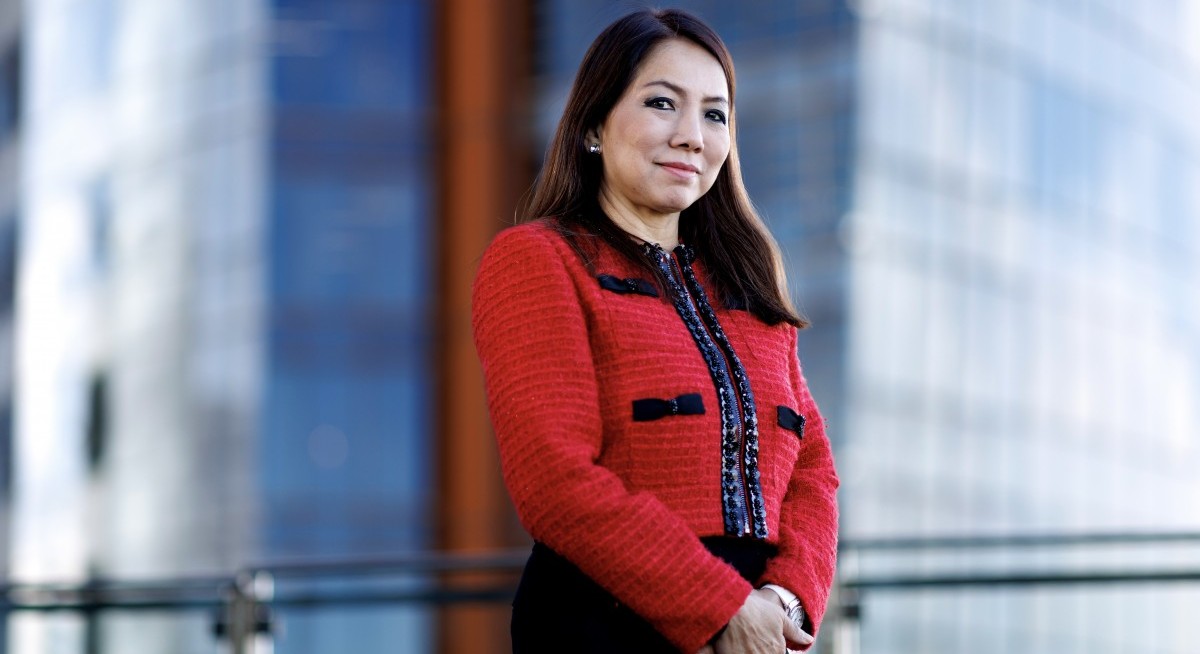


“I think the biggest and best thing we can do to celebrate Piyush’s legacy is to continue the path that he has led us on, which is one of transformation, innovation and growth,” Tan said in a briefing on Aug 7, 2024, when she was named Gupta’s successor. “Our styles may be different, but some things will not change going forward.”
FY2025 marks Tan’s first year at the helm of DBS. Besides building on the foundations left by Gupta, Tan could tap DBS’s growing wealth management business, a segment she personally helped build. Investors were bullish on DBS’s prospects under Tan, with the stock opening at a record high of $60 on Jan 29.
DBS misses FY2025 estimates
That was until Feb 9, when DBS announced 4QFY2025 and FY2025 earnings of $2.358 billion and $11.033 billion, respectively, that missed estimates. According to Bloomberg’s estimates, DBS was expected to report a quarterly net profit of $2.6 billion and a full-year net profit of $11.375 billion. DBS shares closed at $57.50 on Feb 11, easing from a record close of $59.79 on Jan 29.
See also: Sats’ rally to above pre-war levels prompts divergent views
It is worth noting that the missed earnings might have masked the strength of DBS’s wealth push under Tan. The bank’s net fee and commission income for 4QFY2025 grew by 14% y-o-y to nearly $1.1 billion, led by its wealth management business. DBS’s wealth management fees for the quarter grew by 24% y-o-y to $645 million. In addition, assets under management (AUM) and net new money for the bank’s wealth segment hit new highs of $488 billion and $12 billion, respectively.
Tan warns at the results briefing on Feb 9 that 2026 is set to be another unpredictable year, with Venezuela, Greenland, cryptocurrencies and significant dollar movements hogging headlines in the first month of the year. “I tell clients to buckle up — it will be a volatile year. It feels like a year condensed into a month.”
Volatility, however, may help rather than hamper DBS. Customers will be more inclined to “look for stability, resilience and reliability” in times of uncertainty. “We believe DBS can be a beneficiary of this volatility by standing out as a safe, dependable and future-forward bank,” Tan adds.
See also: SGX enjoys higher target prices again with volume surge
Specifically for 4QFY2025, what had ended up pulling down DBS’s earnings came from impairments following its “prudent downgrade of a previously watchlisted real estate exposure”. While Tan declined to name the exposure, CFO Chng Sok Hui says it was on DBS’s watchlist for two years and that the borrower is not currently in default.
DBS’s total allowance reserves stood at $6.281 billion as at the end of December. Out of the total $6.281 billion, $3.859 billion was allocated under general provisions (GP) while $2.422 billion was allocated under specific provisions (SP). This is a slight decrease from last quarter, when total reserves stood at $6.425 billion, with GP reserves at $4.071 billion and SP reserves at $2.354 billion.
According to Chng, GP is reclassified as SP once a loan is placed on the watchlist. The GP set aside will be released if the loan is later classified as non-performing. “General allowance reserves remain prudent, with the GP overlay at $2.4 billion. The GP overlay of $2.4 billion is in addition to baseline GP and takes into account stress scenarios such as heightened geopolitical and macroeconomic risk.”
Some analysts weren’t too concerned about the write-down. Fitch analysts Tania Gold and Willie Tanoto say they “do not expect broad-based stress” to emerge from DBS’s commercial real-estate exposures in Hong Kong. As they see it, DBS has conservative coverage ratios, coupled with a $2.4 billion management overlay that exceeds what macroeconomic variable (MEV) models require banks to provision for.
DBS currently has $10 billion in property exposure in Mainland China. This includes $4 billion in exposure to state-owned enterprises, $4 billion to international developers and $1 billion to privately owned enterprises with conservative loan-to-value ratios.
The bulls, bears and the in-between
Analysts have mixed reactions to the results, given that they have adjusted their target prices to a broad range of $48.67 to $70.
For more stories about where money flows, click here for Capital Section
Goldman Sachs’ Melissa Kuang and Olivia Shi expect DBS’s credit costs for FY2026 to reach 19 basis points (bps). “Despite minor softness in market trading income and an uptick in HK non-performing loans [NPLs], the bank demonstrated robust wealth management growth and continued strong deposit inflows, reinforcing its profitability outlook and conservative risk management,” state Kuang and Shi, who have kept their “buy” call but with a slightly trimmed target price of $69.40 from $69.90.
CGS International’s Tay Wee Kuang and Lim Siew Khee have lowered their target price to $60 from $60.50, citing uncertainty weighing on DBS’s FY2026 results and near-term pressure on the bank’s earnings. “Despite achieving resilient underlying operating metrics in FY2025, DBS kept its guidance for slightly weaker FY2026 earnings during its analyst briefing,” the analysts write.
Macquarie’s Jayden Vantarakis has lowered his target price to $48.67 from $50, citing “little margin for error” for DBS. Based on the bank’s guidance, Vantarakis is expecting a “volatile” FY2026 ahead. He has also lowered his earnings per share (EPS) estimate by 2% to 4% for FY2026 and FY2027.
Citi’s Tan Yong Hong, who has kept his “buy” call and $61.10 target price, likes the bank’s position as a “deposits beneficiary”. The 4QFY2025 blip in its trading income is likely temporary, while the pre-emptive downgrade of its loans could reduce future uncertainty around its real estate exposure in Greater China, he adds.
Morningstar’s Kathy Chan has a “two-star” rating on the bank, which she deems as “slightly overvalued”. Per her estimates, Chan’s FY2026 P/B ratio is 2.4 times above DBS’s 10-year historical average of 1.4 times. However, her FY2026 dividend forecast of $3.24 per share continues to imply an “attractive” yield of 5.6%, which could continue to support the bank’s share price. Chan has raised her fair value estimate by 4% to $50. “We raise our Stage II growth rate to 4.5% from 4.0% as we now expect DBS’s wealth franchise to support stronger long-term growth”.
Other analysts have become more bullish. PhillipCapital’s Glenn Thum upgraded his call to “accumulate” from “neutral”, along with a higher target price of $60 from $58, citing a pivot towards fee income that has offset the drag from net interest income (NII).
“Fee income effectively cushioned the NII drag, led by a 24% surge in wealth management fees,” says Thum. “AUM rose to $488 billion (15% higher y-o-y) from net new money inflows of $12 billion for 4QFY2025, showing demand for investment products as depositors pivot from fixed deposits to wealth products.”
That said, Thum lowered his FY2026 earnings estimate by 5% to $11.1 billion on the back of weaker NII estimates. “We expect non-interest income to be the main growth driver, as heightened volatility will benefit trading income and continued wealth management growth will stem from shifts in investor sentiment and AUM inflows.”
Among the three banks, Thum maintains his preference for DBS, citing its clear capital return plan of 15 cents per share per quarter through FY2027, which offers “greater stability” compared with the others, which use a floating payout ratio tied to earnings.
Maybank’s Thilan Wickramasinghe has maintained his “buy” call, raising the target price to $65.31 from $62.79. “Scale, balance sheet and macro tailwinds favour DBS,” he says, noting that the bank is “well placed” to benefit from the continued liquidity flows to Singapore and Hong Kong, which should mitigate any downside risks to interest income and drive upside to fees, especially in wealth management and capital markets.
Despite the jump in specific provision, Wickramasinghe believes DBS’s NPLs remain “benign”. There is also $2.4 billion in management overlays and there is potential for further write-backs as NPLs improve by 1% versus FY2024’s 1.1%, which should “keep credit charges in check”.
AI deployments in DBS’s know-your-customer (KYC) processes, credit memo writing, chatbots, procedure consulting, and response generation should also enhance overall productivity, he adds.
On DBS’s capital returns, the analyst notes that there is potential for a special dividend if the bank does not fulfil its mandate by FY2027. So far, only 12% of its $3 billion share buyback mandate is completed, he notes.
Even without this, the bank is offering a yield of over 5.5% in the medium term. Wickramasinghe’s new assumptions have lifted his FY2026 EPS estimate by 3%.
RHB Bank Singapore has also maintained its “buy” call, with a higher target price of $63.50, up from $59. On top of DBS’s “in-the-bag” dividend in FY2026, there could be room for management to boost dividends next year. “At this stage, DBS prefers to keep its options open for the under-utilised share buyback portion. We do not discount its return in dividend form.”
OCBC Investment Research’s Carmen Lee has kept her “hold” call but raised the fair value estimate to $59.43 from $55 previously. Despite challenging market conditions, Lee believes the bank’s strong balance sheet should position it “well”.
With growing AUM, Lee believes that DBS’s wealth income can hold above the $5 billion mark. She recommends that investors accumulate on any price weakness caused by unexpected external factors.
The loudest DBS bull — JPMorgan’s Harsh Modi and Daniel Tan, with their street-topping target price of $70 — has maintained their stance. DBS remains their top pick among the banks.
To them, the dip in DBS’s shares presents a “good entry point”. They also believe CEO Tan’s assumptions of “slightly lower y-o-y NII”, which assumes Sora of 1.25%, two US Fed cuts (compared to JP Morgan’s expectations of zero cuts) and a strong Singapore dollar (SGD), are “a touch conservative”, which should lead to the consensus lowering expectations.
Modi and Tan expect a six-cent increase in DBS’s regular dividend for 4QFY2026, given that its fully phased-in CET-1 remains fairly stable at 15% this year. “Basically, despite a sharp pick-up in payout, the capital levels are almost 150 bps to 250 bps above the optimum range, even before the potential release of capital from the reversal of the MAS penalty [of around] 40 bps.”
“This level of stock and flow of capital underscores the likelihood of sharply higher DPS [or dividends per share] (and buybacks) in the course of the next few years for DBS,” they note. “We look forward to management plans regarding streamlining the buyback process, or guidance for the use of that capital in the form of dividends.”




