


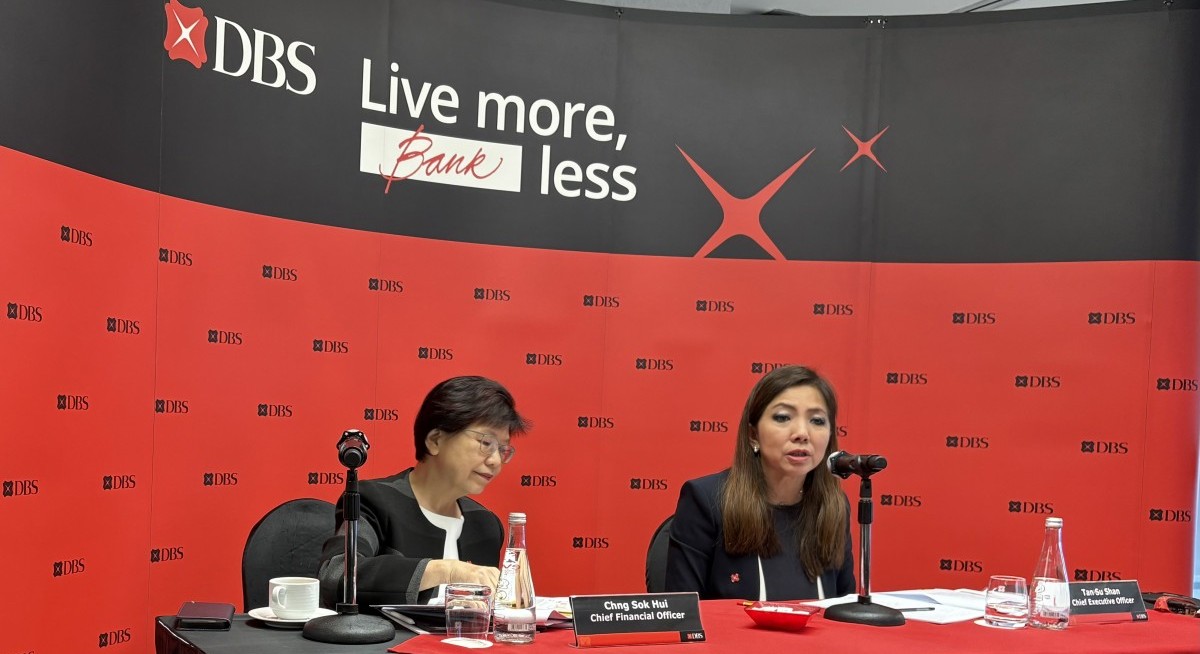


For 2026, DBS expects total income to hover at around 2025 levels. This is in spite of rate headwinds and volatility in the markets. Specifically, DBS is assuming a Singapore Overnight Rate Average (Sora) of 1.25%. It is also forecasting two rate cuts by the US Federal Reserve and for the Singapore dollar to maintain its strength.
“For net profit, we are looking at slightly below 2025 levels. But as I said, we will maintain our cost discipline. We will maintain our credit discipline. We will maintain our operational discipline,” says DBS group CEO Tan Su Shan at the bank’s media briefing on the same day.
In fact, Tan believes that volatility is not in itself a bad thing. “The good thing about volatility is you have risk but you also have opportunities. When markets are very volatile, you can trade. You can be nimble. You can also lock in, hopefully, some good rates during the market falls. So, we want to continue to capture this volatility that will give us hedging opportunities.”
2025 marks Tan’s first year at the helm of DBS. Tan took over the reins in April 2025 following longtime CEO Piyush Gupta’s retirement in March 2025. Gupta joined DBS in 2009. His 15 year tenure as group CEO saw DBS delivering total shareholder returns of almost 600%.
See also: Banks' rally pushes market cap of DBS just whisker off $200 bil mark
DBS’s commercial book total income and markets trading income increased by 1% and 49% y-o-y respectively. What ended up being a drag on earnings came from the bank’s “prudent downgrade of a previously watchlisted real estate exposure” to its non-performing loans in 4QFY2025. DBS says the downgrade resulted in specific allowances for the year rising to 19 basis points of loans though they were partially offset by a release of general allowances. Tan declined to name the real estate exposure when asked about it at the bank’s media briefing.
“We reduced our GP (general provisions) to increase our SP (specific provisions), so we were already prudent in the past. So this shouldn’t be [of] any surprise to anyone,” says Tan.
As at the end of December, DBS’s total allowance reserves stood at $6.281 billion. Out of the reserves, $3.859 billion were allocated under GP while $2.422 billion was allocated under SP. This is a slight decrease from last quarter when total reserves stood at $6.425 billion, with GP reserves at $4.071 billion and SP reserves at $2.354 billion.
See also: MAS proposing regulatory changes for quicker approvals of new fund types
According to DBS CFO Chng Sok Hui, the slight decline in GP reserves stemmed from the release of the general allowance previously set aside for the downgraded real estate exposure. “The exposure has been on our watchlist for two years. The borrower is currently not in default status.”
General allowances are reclassified as specific allowances once a loan is placed on the watchlist. If the loan is later classified as a non-performing loan (NPL), the general allowance set aside will be released, says Chng.
“General allowance reserves remain prudent with the GP overlay at $2.4 billion out of the total $3.86 billion,” Chng told reporters on Feb 9. “So to recap, the GP overlay of $2.4 billion is in addition to baseline GP generated by the model, and it takes into account stress scenarios such as heightened geopolitical and macroeconomic risk.”
Deposit growth outpaced loan growth
Notably, FY2025 saw DBS’s deposit growth outpacing its loan growth. DBS’s deposits went up by 12% or $64 billion, which the bank says is the largest absolute increase in its history. On the other hand, DBS’s loans grew by 6% or $24 billion. Deposit growth mainly came from Casa (current account and savings account) inflows while loan growth was driven by corporate and wealth management-related loans. DBS says its surplus deposits were parked in high quality liquid assets (HQLA), which will add to the bank’s net interest income and return on equity.
“It’s not that we are not seeing loan growth. We are. It is just that deposit growth was so high, it is higher than loan growth,” says Tan. “Loan growth has been quite steady. It keeps growing but deposit growth has been stronger and that is why there is a delta.”
Chng says deploying the surplus deposits into HQLA is a good move because the ROE is very high. “We only put [them] into mainly sovereigns, so it is not that you are taking big risks running any HQLA portfolio.”
For more stories about where money flows, click here for Capital Section
DBS’s growth in deposits reflects a good mix between Singapore dollars ($28 billion) and foreign currencies ($19 billion.) “Sensitivity actually has increased for Sing dollars, because as more and more deposits come in, there’s more sensitivity to the Sora, which is a good thing. If rates go up, you benefit more,” Chng says, noting that DBS does not take any FX exposure on its foreign currency deposits due to hedging.
Indonesia downgrade not a concern
The past week has seen Indonesia struggling with a $101 billion market rout after global index provider MSCI raised concerns about the limited transparency of its markets. Ratings agency Moody’s downgraded Indonesia’s credit rating outlook to negative from stable on Feb 5, citing concerns over the stability of Indonesia’s policymaking and governance.
“Our books in Indonesia are pretty focused around the large quality blue chip names. We’ve looked at it over and over again. I don’t really have too much concerns about the credit quality there,” says Tan.
Han Kwee Juan, DBS’s group head of institutional banking, told reporters, on Feb 9, that the bank is less concerned with the volatility raging in Indonesia’s markets. “What you see in terms of the market volatility leads to the market, whereas we lend to the operating company generating the cash flows so that they do not affect the market. That’s the differentiation.”
Indonesia’s market chaos has drawn the attention of its regulators who are now rushing to deliver market reforms such as doubling the Indonesian stock market’s free float rate to 15%.
“I think this will be good in the long term for Indonesia,” says Tan. “Short term, there is some market volatility and some market pain, but I think the long-term implications for increased transparency, governance, increased free float and all that is a good thing. The swift action taken by the authorities is quite commendable.”




