


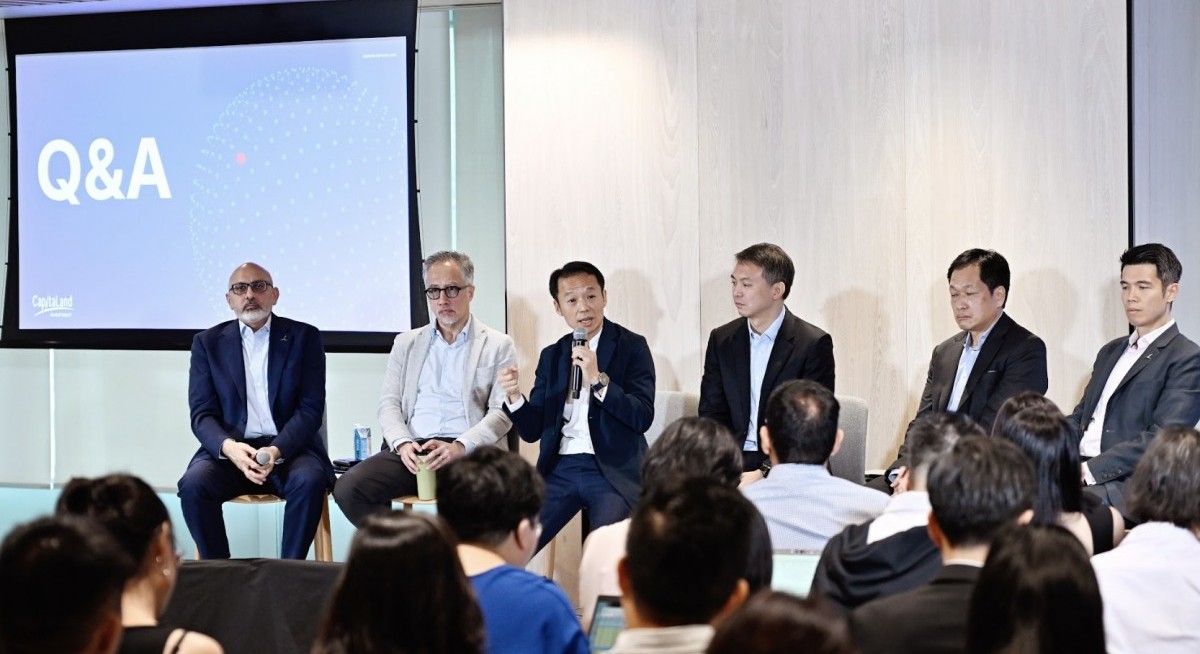


“We will look at deals that make sense. It must make strategic sense culturally, you need to pay a fair price that makes sense to all investors.”
As Lee sees it, if “there’s a meeting of minds, the pricing is suitable, everything is good, then, of course, everything can happen”. “It’s like dating. Sometimes you get married in the next month, sometimes it takes a few years, and sometimes you’re almost going to get married, then you decide you cannot. It’s like dating a girl,” Lee says, conjuring up images of himself and Hiew Yoon Khong, group CEO of Mapletree Investments, going off into the sunset together.
Most of the results briefing was about business as usual (BAU). CLI announced that it had a revaluation loss of $439 million, attributed mainly to China, causing net patmi to plummet. Operating patmi in FY2025, however, rose 6% y-o-y to $539 million.
In FY2025, the dividends of 12 cents translated into a payout of $599 million, which is more than the operating patmi of $539 million but lower than the operating cash flow. Net asset value fell by 20 cents y-o-y to $2.52 as of end-December 2025.
See also: Fewer GCB deals in 1H2026, but larger quantums lift average psf near record: PropNex
Concerns about the dividend payout ratio were brushed aside. Paul Tham, group CFO, says that the group prefers to track operating cash flow in terms of making sure CLI has the funds to pay dividends.
“We have a very strong fee income business that consistently generates income, and then we have all the REIT dividends that come in. We look at the operating free cash flow as the more critical measure for our own internal capital management and then we look at the operating profits as a guide to what we think is about the right level to return to shareholders,” Tham explains.
As CLI moves increasingly towards a fee-related revenue (FRR) business, with less reliance on its on-balance sheet assets, P/NAV becomes less of a key measure. “In the longer run, we won’t need such a wide capital base as a fund manager. Our NAV is very large compared to most other global fund managers,” Tham points out.
See also: ‘Breathe life’ into precincts by investing in commercial property: Steward Asia
CLI’s FRR rose by 6% to $1.234 billion in FY2025. The largest contributor was commercial management, followed by lodging, listed funds management and private funds management FRR, in that order.
JP Morgan’s view is that core patmi was above its expectations, with 2H2025 core operating patmi (excluding disposal and revaluation gains) up 30% y-o-y to $279 million. The FY2025 operating patmi of $539m exceeded JP Morgan’s own forecast of $508 million. However, because of revaluation losses, total patmi fell to $145 million which was way below the consensus estimate of $708 million.
“While disappointing, we believe this provides an easier path to monetise its China assets over time,” JP Morgan says. On the other hand, funds under management (FUM) grew to $125 billion, up from $117 billion a year ago. The record number of signings in FY2025 of 19,000 units in CLI’s lodging pipeline was also a positive development.
Citigroup says the positive development, the increased colour and The Ascott’s improved performance could assist investors to better understand the business unit. The Ascott’s FY2025 fee income of $350 million on 100,000 units is expected to grow to $500 million. “At some point in time, CLI may look to put The Ascott as a standalone business,” Citigroup says.
CLI’s first and final dividend of 12 cents, unchanged y-o-y, was a disappointment to JP Morgan who had anticipated a payout of 18 cents.
The surprise came in the form of CLI filing for a second C-REIT. In September last year, CLI, along with CapitaLand China Trust (CLCT), had successfully listed CapitaLand Commercial C-REIT (CLCR).
CLCR’s IPO price was RMB5.718 ($1.04) and it is now trading around RMB6.90. Yuhuating Mall, which was formerly an asset in CLCT, was divested into CLCR at above its book value.
Sink your teeth into in-depth insights from our contributors, and dive into financial and economic trends
Puah Tze Shyang, CEO of CapitaLand China, says one of the assets earmarked for CLI’s second C-REIT is Raffles City Shenzhen. The new C-REIT is likely to take just six months to bring to market compared with the two years required for its first IPO. “The regulators are picking up the pace and allowing for a more expedited process,” he says.
In addition, the mandate has opened up and sponsors do not need to reinvest the proceeds of the C-REIT back into China.
Based on the old CapitaLand’s 2019 annual report, 56% of Raffles City Shenzhen’s 121,814 sqm of GFA is retail, 27% is office, and 17% is lodging. The asset’s last known publicly available value was RMB5.5 billion as at end-2019, with CapitaLand’s stake at that time recorded as 30.4%. As at end-December 2025, CLI’s stake is 57.4%.
The last major transaction involving CapitaLand’s Raffles City portfolio in China was in 2021, when CapitaLand sold partial stakes in six Raffles City developments (Shanghai, Beijing, Ningbo, Chengdu, Changning, and Hangzhou) to Ping An Life Insurance. That deal valued the portfolio at about RMB46.7 billion. Post-transaction, CapitaLand kept effective stakes of 12.6% to 30% in each development.
On the data centre front, Kishore Moorjani, CEO of Alternatives at CLI, says he is looking at CLI developing an operating platform. “We are now looking across the universe as data centres themselves have evolved from the niche real estate asset class to a deep operating capability asset class. We’re looking at that [platform] with customers and with investors. In the next few months, you’ll see us form [our data centre business] into an operating construct and focus on very specific markets.”




