


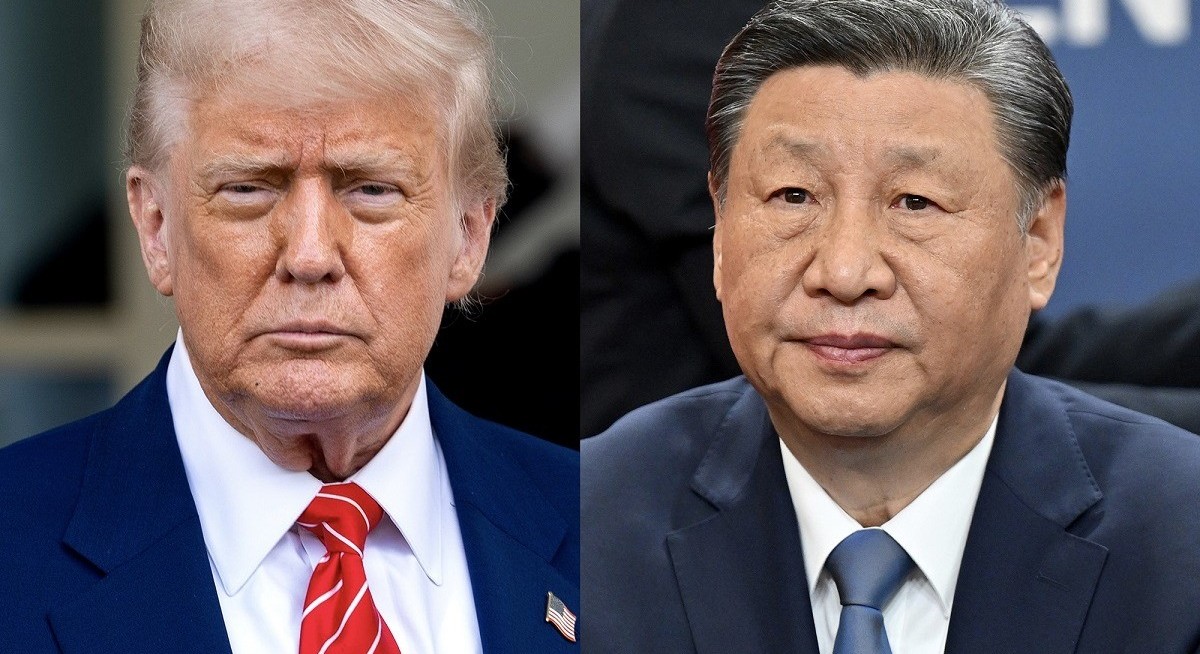


(May 12): Donald Trump is expecting economic deals and a “wild” welcome this week in China. In reality, he’ll arrive facing an emboldened Xi Jinping, just as his own hand is constrained by the conflict in Iran.
When the US president touches down in Beijing on Wednesday evening for a 36-hour summit, it’ll mark his first overseas trip since waging war in the Middle East. Over talks at the Great Hall of the People and a state dinner, followed by morning tea, the leaders will discuss trade, tariffs and the self-ruled island of Taiwan. Another agenda item, of course, is Iran.
As the war extends into its third month, China appears to hold unique sway as the biggest buyer of the Islamic Republic’s oil and a strategic partner of Tehran. US Treasury Secretary Scott Bessent acknowledged that last week when he called on Beijing to help reopen the Strait of Hormuz, the closure of which has unleashed the biggest oil supply shock in modern history.
The US has targeted Chinese oil refiners and firms providing satellite imagery to Iran in the meeting’s lead-up, as Trump ramps up his campaign to pressure Tehran into a deal. Washington must balance such actions against Beijing’s ace card: Rare earths, the “golden screws” of global manufacturing, which China used last year to stare down US tariffs.

“Xi is coming into the summit feeling confident he has solved Trump,” said Jeremy Chan, a senior analyst at Eurasia Group and a former US diplomat, citing China’s critical minerals advantage. The November midterm elections, in which higher fuel prices threaten Republican control of Congress, also mean the US leader is chasing voter-friendly wins on agricultural purchases.
See also: Canada eyes free trade pacts with Philippines, Asean this year
“Trump needs more from this summit than Xi does,” Chan added. “And Xi knows it.”
The unresolved Middle Eastern conflict could turn the meeting into a test of China’s willingness to help on Iran instead of an in-depth session on trade and economic differences.
“Iran could overshadow” the gathering, said Craig Singleton, a former US diplomat and senior fellow at the Foundation for Defense of Democracies. “It complicates the optics, it raises the stakes.”
See also: Worst start to wildfire season raises alarm as El Niño threatens
Trump has repeatedly said he sees himself as having the upper hand in negotiations with US adversaries and allies, and his team has insisted the president is entering talks from a position of strength. As the world’s largest oil importer, China faces economic risks from a prolonged closure of the strait, especially if it affects global demand for its export machine.

Ahead of the meeting, Bessent is stopping in Japan and South Korea, sending a public message that the US has allies in the region. He’s also sitting down with his Chinese counterpart, He Lifeng. For its part, China is expected to welcome Russian President Vladimir Putin in Beijing later this month, as Xi balances his own diplomatic relationships.
Both the US and China want stability, despite their differences. The Chinese yuan marked its longest winning streak in nearly 11 weeks on Tuesday, a move the US could take as an olive branch. China also said Monday it had dismantled a cross-border drug trafficking network with the US — progress on a key issue Trump last year imposed tariffs on Beijing over.
The two sides are likely to discuss an extension of their trade truce, Chinese purchases of US agricultural products and planes and follow up on fentanyl shipments. US officials on Sunday told reporters the leaders would review proposals to form a board of trade, which would govern commerce in non-sensitive products, and a board of investment.
But while Trump is bringing an entourage of executives spanning major financial, technology, aerospace and agricultural firms, expectations are low for major breakthroughs.
“Don’t expect too many deals,” said Wang Yiwei, a former Chinese diplomat and director of Renmin University’s Institute of International Affairs. “Trump coming is in itself a success and will lay a foundation for Xi’s visit to the US later this year.”
To stay ahead of Singapore and the region’s corporate and economic trends, click here for Latest Section

For Xi, multiple Chinese analysts said the priority will be Taiwan, a democratic island the Communist Party considers its own despite never having ruled it. Xi warned Trump to proceed with care on arms sales earlier this year, after the US unveiled a record US$11 billion ($14 billion) weapons package. Officials in Beijing have in recent weeks used unorthodox ways to further isolate the island’s leader.
“China will push for Trump to shift policy on Taiwan, including but not just the arms sale,” said Zhu Feng, executive dean of Nanjing University’s School of International Studies, adding the issue is “the most sensitive and core of China’s interests.”
Beijing has tools to retaliate — including more sophisticated military maneuvers and sanctions — if the US pushes on Taiwan, said Zhou Bo, a retired People’s Liberation Army senior colonel. Underscoring the risks to American commerce, Sanjay Mehrotra, the chief executive officer of Micron Technology Inc, is expected to travel with Trump this week — his company was hit by Chinese sanctions in 2023.
Trump has said he’ll discuss US arms sales to Taiwan with Xi, while Secretary of State Marco Rubio — who has twice been sanctioned by China — made clear “our policy remains unchanged” on the issue. Still, some former US officials expressed concern that Trump could soften Washington’s position on island during the talks.
“Watch the ‘three Bs’ — that is, China’s purchases of US soybeans, beef, and Boeing aircraft. Together, they account for about 12% of US exports to China — and Trump likely wants China to buy more. Along with China’s rare earth export controls, that’s a powerful lever for Xi,” said Bloomberg Economics.
It’s a pivotal moment for Trump, who has spent the past decade accusing China of taking advantage of the US and vowing to get even. Now, there’s a growing sense he will have a harder time reordering the relationship, given Beijing’s increased willingness to push back.
Xi has dusted off two dormant trade tools in the past month. First, Beijing cancelled Meta Platforms Inc’s US$2 billion acquisition of AI start-up Manus, in an unprecedented use of a regulatory weapon created in 2020 by the National Development and Reform Commission. Days later, China for the first time ordered its firms to defy American sanctions against companies dealing with Iranian oil.
Meta’s Dina Powell McCormick will be in Trump’s delegation, suggesting that saga could be part of discussions.
“The belated order to unwind Meta’s acquisition of Manus shows the degree to which Beijing is feeling like the ball is in its court,” said Dexter Roberts, a nonresident senior fellow at the Atlantic Council’s Global China Hub.
Roberts expects China to make a more explicit link between access to US chips and rare earths, where Beijing has economic leverage worth US$1.2 trillion, according to Bloomberg Economics.
When Xi and Trump last met six months ago in South Korea to strike a one-year trade truce, tariffs were a top concern. Since then, Trump has seen his ability to use such levies as a cudgel undermined by a US Supreme Court ruling, and his message of economic prowess undercut by higher fuel prices.
China, meanwhile, faces its own set of economic problems and remains hamstrung by American curbs on access to the advanced chips required to compete in the AI age. How much leverage Beijing has over Iran to end the war is also an open question.
What will be clear as Trump and Xi shake hands in Beijing is the balance of power between the two superpowers is shifting.
“We are getting a new normal,” said Henry Wang Huiyao, founder of the Center for China and Globalization research group in Beijing. “That means both the US and China recognise China is different than some 10 years ago during Trump’s first visit.”
Uploaded by Magessan Varatharaja




