


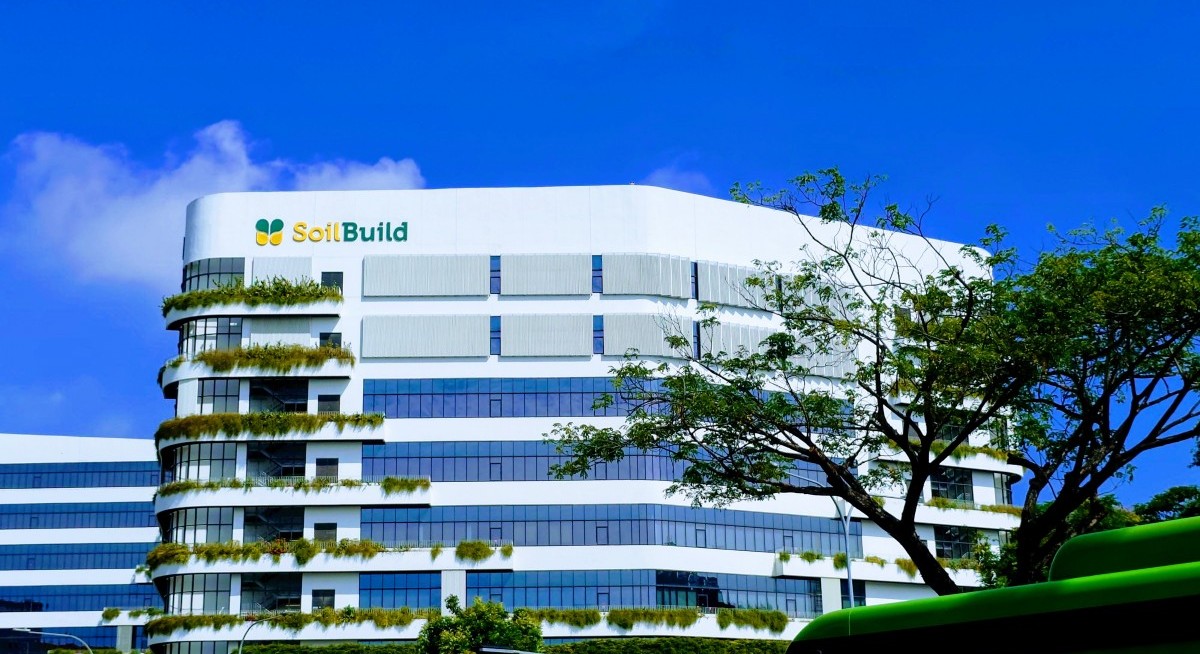


On Oct 21, 2025, Soilbuild Construction Group, the remaining listed entity, announced that it is exploring a possible spin-off listing of its precast and prefabrication business on the Mainboard. The precast and prefabrication business, which provides a full range of prefabrication products and services across the entire construction value chain, is one of two businesses within the construction arm.
According to CEO Lim Han Ren, about 15% of Soilbuild’s $1.2 billion order book comprises precast projects. Of these, 70% to 80% are projects linked to the public sector, mostly for HDB works, while the remainder are industrial.
When asked, Lim declined to share further details about the potential listing, other than that it is a work in progress and that, should this exercise proceed, Soilbuild will retain a majority stake. In addition, Lim points out that via the spin-off, Soilbuild will be able to unlock value if this part of the business is listed as well. If so, this is additional cheerful news for investors of this stock. In 2024, Soilbuild was one of the top-performing Singapore-listed stocks, gaining about 173%. It repeated this feat in 2025, with a gain of another 334%, bringing its market value to $569.2 million.
Following the steady run-up over the past two years, the share price is now perceived as potentially “too high” for investors to trade comfortably. The company proposed a one-for-four share split, which increased the total number of shares to 496.4 million. The split, which took effect on Jan 14, would make each share and board lot more affordable, thereby encouraging greater trading participation. Lim adds that the split was also designed to bring the share price closer to the $1 psychological level, which traders reportedly find more comfortable with. The ratio also helped minimise odd-lot trading while making the stock more attractive to both retail and institutional investors.
“We do believe that the market right now is quite hot, especially with the Equity Market Development Programme (EQDP). We’re seeing that funds are paying a bit more attention to the SGX. So this would be a good time for any potential corporate action,” says Lim in an interview with The Edge Singapore on Jan 7.
In an unrated note dated Oct 14, 2025, DBS Group Research noted that the company’s construction and precast and prefabrication segment will continue to see “strong visibility” on the back of Singapore’s infrastructure and building work.
CGS International’s Lim Siew Khee also likes Soilbuild thanks to favourable construction tailwinds and precast growth in Singapore, which is seen as a “key growth engine”. In an initiation report dated Oct 7, she has indicated an “add” call and target price of $4.21. This should translate to $1.05 after Soilbuild’s one-for-four share split.
See also: Singapore’s built environment must build a collaboration advantage
PhillipCapital’s Yik Ban Chong, who has a “buy” call and a target price of $3.41, or a post-share split target of 85 cents, sees upside potential from the precast segment as well. In the most recent 1HFY2025 ended June 2025, revenue for this segment increased 77% y-o-y, and operating margins increased 4.5 percentage points y-o-y. The analyst expects precast operating margins for FY2025 to increase by 2 percentage points y-o-y to 10.9%, as scale and efficiencies improve.

Soilbuild's revenue breakdown / Photo: Soilbuild Construction Group
“If you look at our earnings in 1HFY2025, you’ll notice that [the precast business] is quite positive … We see it’s an opportune time,” says Soilbuild’s Lim. Over the six-month period, the precast and prefabrication division contributed approximately $59.4 million to total revenue, driven by higher product sales.
Given the specific nature of the precast business, the CEO believes its valuations will be higher than those of a traditional construction business.
He remains tight-lipped on expansion plans, except to say that business remains robust. Soilbuild’s plant in Pontian, Johor, maintains a utilisation rate of about 70%, while its two plants in Singapore are running at full capacity.
The first plant, its Integrated Construction and Prefabrication Hub (ICPH), built in 2015, is a “highly automated” facility that produces large panel slabs and hollow-core slabs. Another plant in Seletar North produces additional components, including prefabricated bathroom units (PBUs) and facades. The 134,000 sq m (1.4 million sq ft) plant in Pontian produces the remaining larger components such as T-slabs, double T-slabs and prefabricated prefinished volumetric construction (PPVC), among others.
Explaining the difference in utilisation rates, Lim says the Pontian plant occupies much larger land and has many more production lines than Singapore’s plant.
To stay ahead of Singapore and the region’s corporate and economic trends, click here for Latest Section
This precast business is in response to the Singapore government’s push to make the construction industry more efficient. The government has mandated that 25%–50% of precast components be produced locally to prevent supply chain interruptions, which has contributed to the high utilisation rate at the Singapore plant. This policy was introduced after border shutdowns stemming from the Covid-19 pandemic delayed various HDB projects, as most precast components were produced in Johor, Lim adds.
Share consolidation and Tuas contract
Alongside its operational growth and precast expansion, Soilbuild has also actively adjusted its share structure to improve market perception and investor accessibility. In September 2024, the company proposed a 10-for-one share consolidation, reducing its 1.65 billion shares to 165.5 million. Shareholders holding fewer than 10 shares at the time were not entitled to any consolidated shares and were removed from the register.
The company says that the consolidation was necessary because shares traded between 2.9 cents and 11.8 cents and were “more prone to speculation and market manipulation, which may result in excessive share price volatility”. The low price also gave the impression of a penny stock, which carried a stigma and discouraged long-term retail and institutional investors. “With penny stocks … people are less inclined to trade,” Lim said. “We wanted to move away from that perception and reduce volatility in our share price movements.” The consolidation was completed in December 2024.
Around the same time, Soilbuild was undergoing a share consolidation; its mega $647.5 million contract to build the Tuas container port caught investors’ attention. Since then, it has won a series of other contracts, including the latest last July to build a 10-storey multi-user industrial development at Lok Yang Way. According to the company, this contract, along with orders for additional precast parts, totals $178.6 million.
With the overall pick up in construction stocks, plus the consolidation, Soilbuild’s shares rose steadily, climbing from 77 cents to over $3 by November 2025. Lim noted, “The market started to notice us more, and coupled with the results we have had over the last two years, we started to see the share price run quite a bit.”
Embracing technology, digitalisation and sustainability
Managing market perception is essential, but certain fundamentals remain key. Construction is traditionally seen as conservative and staid. However, Soilbuild has actively introduced new technologies and processes to stay abreast of industry changes. For example, to better engage potential clients, the company will produce fly-through videos to visualise the projects.
“At the project execution level, we use our models on a weekly basis to run through the project with our clients, even to the extent that we model the dimensions so that they are able to plan their production space and layout even before the project is completed. So this gives them a head start even before the project is actually completed,” says Lim.
ISOTeam, which specialises in painting contracts, has made a show of deploying robots. Soilbuild is also using robots for painting and wall installations to increase worker productivity.
“We are also exploring the further use of AI to deal with safety. Currently, we have our safety monitoring devices, which are using AI CCTV analytics to highlight safety infringements to us, and are automatically sent to a Telegram chat for safety officers for each project,” adds Lim.

Embracing AI and modelling / Photo: Soilbuild Construction Group
Soilbuild is also placing greater emphasis on sustainability in recent times. “We saw that clients out there are increasingly looking for builders who are more sustainable in the way they operate. Some of them actually instituted certain sustainability targets for us when we were building the projects for them,” says Lim.
“This led us to the implementation of battery energy storage systems, which allows us to reduce our carbon footprint by about 50%, and we added the use of solar panels to our site offices to further reduce our diesel consumption,” adds Lim.
Lim admits that the focus on sustainability is becoming a niche, which helps the company to win a series of projects. “During the tendering process of the PSA project at Tuas, they also seem to focus a bit more on some of these initiatives. So, I think some of these initiatives help us a lot,” adds Lim.

Emphasis on sustainability / Photo: Soilbuild Construction Group
Short-term projects preferred; competitive advantage in tendering
Some contractors may have built a reputation for certain types of projects, such as public housing contracts, which they deem manageable because they are typically in the hundreds of millions. For Lim, industrial projects are preferred because they have shorter construction timelines.
“Typically, industrial projects range from 18 to 24 months and that translates to faster cash flow for us. Within the industrial space, you have the general industries and specialised industries with higher specification, such as cleanroom requirements and automated storage and retrieval system (ASRS) requirements,” states Lim.
Lim says that the higher-value projects are mainly from the specialised industries space, where the company has a strong track record, and he hopes to target more of these projects in the long term.
“Whenever we tender for these projects, we implement digitalisation initiatives to differentiate ourselves from our bidders. With our building information modelling (BIM), we are able to create fly-through videos of the project for our clients, so that they can visualise how their building looks once completed,” he shares.
“Right now, what you typically have is an architect who gives you an artist’s impression of your building, but often the completed building looks nothing like the artist’s impression. Therefore, our model accurately depicts their project and shows how it should look. This allowed us to better engage with our clients and customers and therefore create this competitive advantage,” he adds.
2026 looks to be a positive year
Maybank economists expect the Singapore construction industry to grow at more than 6% this year and maintain at above 5% per year until 2030, thanks to a pipeline of big projects ranging from the airport’s Terminal 5, further parts of the Tuas Megaport, HDB housing, the two integrated resorts and more, with a combined contract value of more than $100 billion.
Lim shares the optimism. In addition to the mega projects, there are “a lot more” industrial projects up for tender. “The trend will last at least for the next two to three years. I don’t think [2026] will be a bad year for the construction industry,” states Lim.
Soilbuild, having built its reputation undertaking industrial projects, fully intends to maintain its position in this space. “Right now, on hand, we know of a couple of bigger and larger-sized projects that are up for tender,” adds Lim.
Meanwhile, to better manage costs, the company is using technology to enhance efficiency and strengthen its supplier network. “Whenever we win a project, as much as possible, we try to sub out the work to our subcontractors and try to lock in the prices with them. This will allow us to know ahead of time our fixed margin upon completion of the respective project, and any further expansion of margins from there is really about effectively managing our resources onsite to complete the project on time or even ahead of schedule,” says Lim.
‘Not opposed’ to another REIT listing
Over the years, the Lims have demonstrated their willingness to tap into markets and secure capital partners to trade their property assets. When Soilbuild’s property development business was first formed, cash flow was more lumpy, and the listing of Soilbuild Business Space REIT in 2013 was intended to help address this.
When the pandemic hit and affected property values, Soilbuild decided to privatise the REIT, which it did in April 2021 with the help of Blackstone. Just over three years later, the portfolio of assets with a total gross floor area of 4.5 million sq ft was sold to Lendlease and Warburg Pincus for $1.6 billion.
Today, Soilbuild holds three investment properties: Tai Seng Exchange, Trion and B-Central. The Lim family office is separately managing a portfolio of purpose-built student accommodation (PBSA) in the UK, comprising three to four developments.
If Soilbuild is willing to consider a spin-off of its precast business, would it be open to another REIT? Lim is “not opposed” to this idea, but he maintains that the portfolio size ought to be sizeable.
Lessons from his father
Lim, a second-generation leader of the business, credits much of his operational understanding to hands-on learning from his father, Soilbuild’s executive chairman Lim Chap Huat. The younger Lim is the youngest of three sons. The brothers are managing different parts of the business, ranging from property development to the family office, which has invested in start-ups such as property investment platform RealVantage.

Lim Han Ren credits much of his operational understanding of Soilbuild to hands-on learning from his father, executive chairman Lim Chap Huat / Photo: Albert Chua / The Edge Singapore
“One key thing he has taught me so far is that construction is very logical,” Lim notes. “You follow a sequence of steps to build something and you can’t skip a step. There are only certain things that can happen on site and if you follow a certain set of procedures, [things] won’t go wrong.”
Lim recalls walking the sites with his father as one of the most memorable lessons. “He has a vast knowledge of construction processes and a very keen eye for productivity. He’s able to see certain issues before they even happen, and he’s able to warn the team to watch out for certain things.”
The younger Lim, who studied business at university, began his career in equity investments at Dymon Asia Capital in Singapore. While that experience provided him with insight into business operations, the family construction business was something he had to learn from scratch as he is not an engineer by training.
He also emphasises the importance of site visits, a practice he learned from his father since childhood. “On weekends, we have family meals and after which, we will take a drive to our different construction sites to look at the process. [This] is something that is actually very important … [and] something we still practice to date.”




