


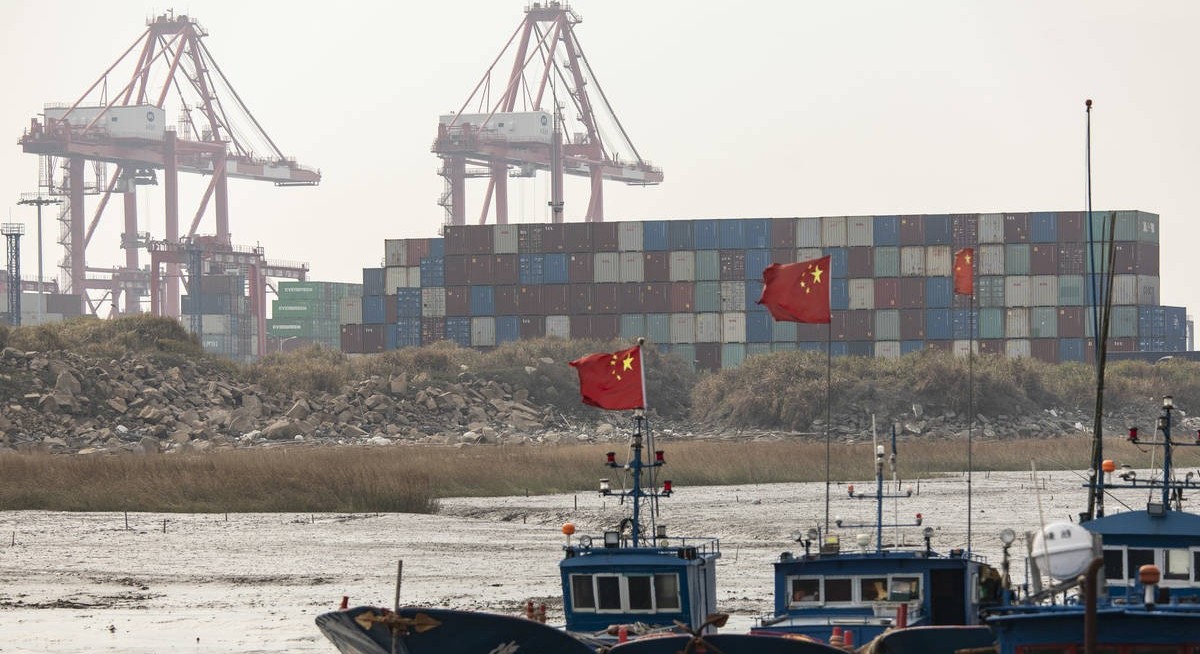


(March 25): An investment boom in artificial intelligence (AI) has kept China’s trade volumes on a path to exceed last year’s record levels, offsetting disruptions from higher oil prices in the weeks after war broke out in Iran.
Nearly 20 million containers moved through Chinese ports in the first three weeks of March, an increase of more than 6% from the same period a year ago, according to data released on Monday by the Ministry of Transport.
While moderating from the 12% gain seen in the first nine weeks of the year, the pace of increase indicates that aftershocks from the conflict in the Middle East have yet to become a serious drag on Chinese trade. The country’s export performance stands out as global merchandise trade risks a deeper slowdown this year if the war keeps energy prices high for a sustained period.
Strong global demand driven by investments in data centres and power equipment is likely helping ward off external threats for Chinese companies. As evidence, economists point to a strong correlation between China’s outbound shipments and its imports from South Korea because of the deep integration between the two countries’ supply chains.

South Korea’s exports to China recorded a 69% jump in the first 20 days of March, with its overall semiconductor sales abroad surging 164%. The pickup means China’s overseas shipments probably also continued to climb after rapid growth seen in January and February.
See also: Meituan, Alibaba shares jump as Beijing vows to end price wars
“This strength in regional tech exports provides a constructive signal for China’s external trade outlook,” Australia and New Zealand Banking Group Ltd (ANZ) economists including Vicky Xiao Zhou said in a report on Tuesday. “The AI-driven upcycle remains intact despite the current energy disruption.”
The outlook for trade is key to assessing the state of the world’s second-largest economy.
China relied on net exports for almost a third of its economic expansion last year, the highest level since 1997. As the Iran war sent global oil prices soaring and almost closed off the Strait of Hormuz, China could be vulnerable to spillovers from foreign shocks in case of a slowdown in global growth.
See also: Pop Mart shares sink 22% on doubts firm can grow past Labubu

The fallout from the hostilities has already shown signs of spreading across the world economy, with multiple purchasing manager indices compiled by S&P Global for March registering declines.
Before the US and Israel attacked Iran on Feb 28, Chinese exporters were off to a spectacular start to the year.
Overseas shipments soared 22% in the first two months of 2026 from a year ago, blowing past the consensus forecasts of economists. AI-related demand was already in play, as chips exports spiked 73%.
ANZ estimates that China’s AI-related exports accounted for almost 19% of the total in 2025. They mostly consisted of intermediate goods such as semiconductors, with China increasingly integrated into the global AI supply chain, ANZ analysts said in the report.
Some economists expected seasonal factors to hold back China’s export growth in March. A later-than-usual Lunar New Year likely resulted in more working days in February while having the opposite effect this month. Official Chinese trade data for March will be released on April 14.
China is by no means in the clear yet, with few signs of letup in the conflict and the possibility of longer disruptions to energy production and supply chains.
To stay ahead of Singapore and the region’s corporate and economic trends, click here for Latest Section
Many Chinese factories that rely on crude or oil-derived products as raw materials are already struggling with soaring costs.
The risk is that manufacturers’ profits could get squeezed if they fail to pass on higher costs to customers, at a time when their margins are already under pressure from slower economic growth at home. That could result in weaker production and investment down the road.
But AI-related products, along with green technologies, will probably continue providing support to China’s exports, according to Barclays plc. Economists at the British bank estimate China accounts for more than 30% of global export value in critical AI-linked goods, far above South Korea’s share of around 6%.
“The country is a key supplier of AI manufactured components,” Barclays economists including Jian Chang said in a note. “With a 4.5%–5% growth target and no sign of large-scale fiscal or monetary stimulus, we expect exports to remain a critical growth driver.”
Uploaded by Tham Yek Lee




