


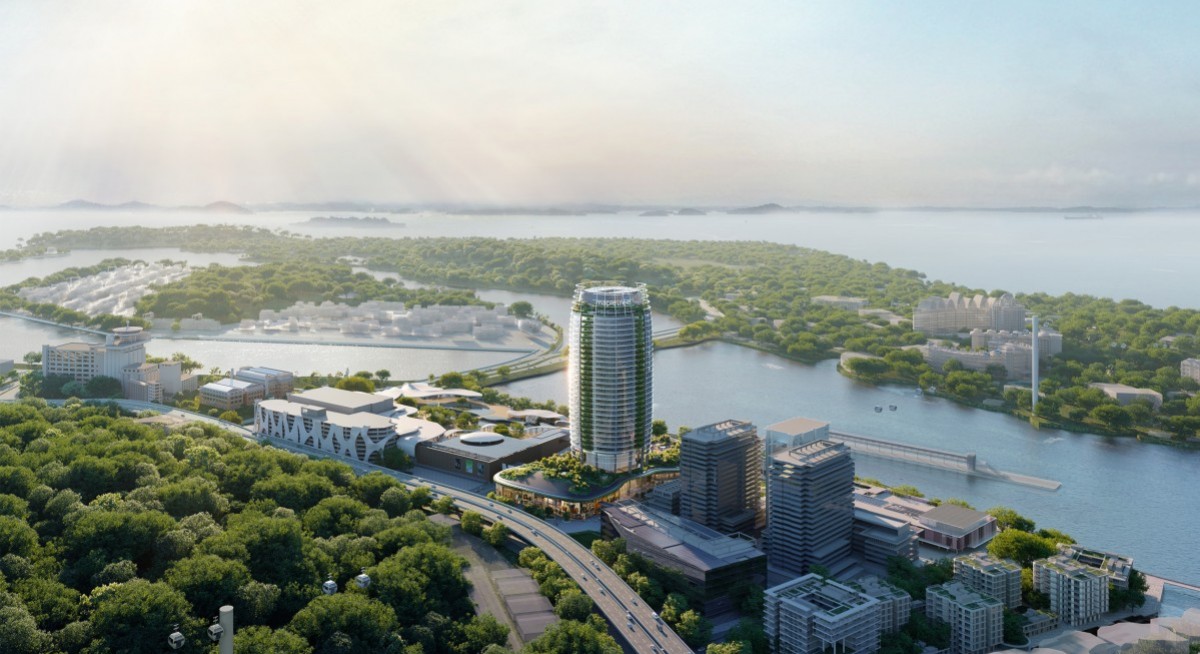


Instead of each building running its own chiller, buildings tap into a shared system that aggregates cooling demand, achieving economies of scale and improving cooling efficiency, says Mapletree in a Jan 20 announcement. “This reduces operating costs and carbon emissions, while freeing up valuable space previously used for individual cooling plants for operational or commercial use.”
The DDC network will be implemented over two phases, starting in 2027 and targeted to be fully operational by 2031.
With an installed cooling capacity of 17,150 refrigeration tonnes, the DDC system is projected to achieve more than 5% savings in cooling-related expenses annually through improved operational efficiency and economies of scale.
Upon full implementation, the system is expected to be 8% more energy-efficient than the National Environment Agency’s Minimum Energy Efficiency Standards for water-cooled chilled water systems in industrial facilities.
See also: Fifth desalination plant, Tampines district cooling announced
According to Mapletree, the DDC system will also reduce carbon emissions by about 13,700 tonnes over a 20-year operating period, which works out to some 685 tonnes of carbon emissions per year. This is comparable to the emissions from powering 550 three-room HDB households a year.
This marks Singapore’s second brownfield DDC deployment, following SP’s successful implementation at Tampines Central in March 2025.
The seven buildings connected to the Tampines Central network are Century Square, CPF Tampines Building, Income at Tampines Junction, OCBC Tampines Centre 2, Our Tampines Hub, Tampines Mall and Tampines 1.
See also: The city that knows itself
According to SP Group’s March 2025 announcement, the Tampines Central network will help the town centre cut its carbon emissions by 1,000 tonnes a year. The shift to DDC also freed up some 25,000 sq ft of space, which was previously occupied by several chiller plants.
Mapletree did not state how much space cooling plants currently occupy in the four existing HarbourFront Precinct buildings.
With more than 80% of Singapore’s landscape being brownfield, expanding DDC in mature districts can significantly cut energy use and carbon emissions, supporting Singapore’s climate goals, says Mapletree.
Mapletree and SP have previously collaborated on other sustainability initiatives. SP’s Utilities Management System has been deployed across the Mapletree Group, with over 2,000 smart meters enabling real-time tracking of utilities consumption for carbon reporting and energy efficiency improvements. SP has also provided electric vehicle charging solutions to support Mapletree’s commitment to green mobility.




