


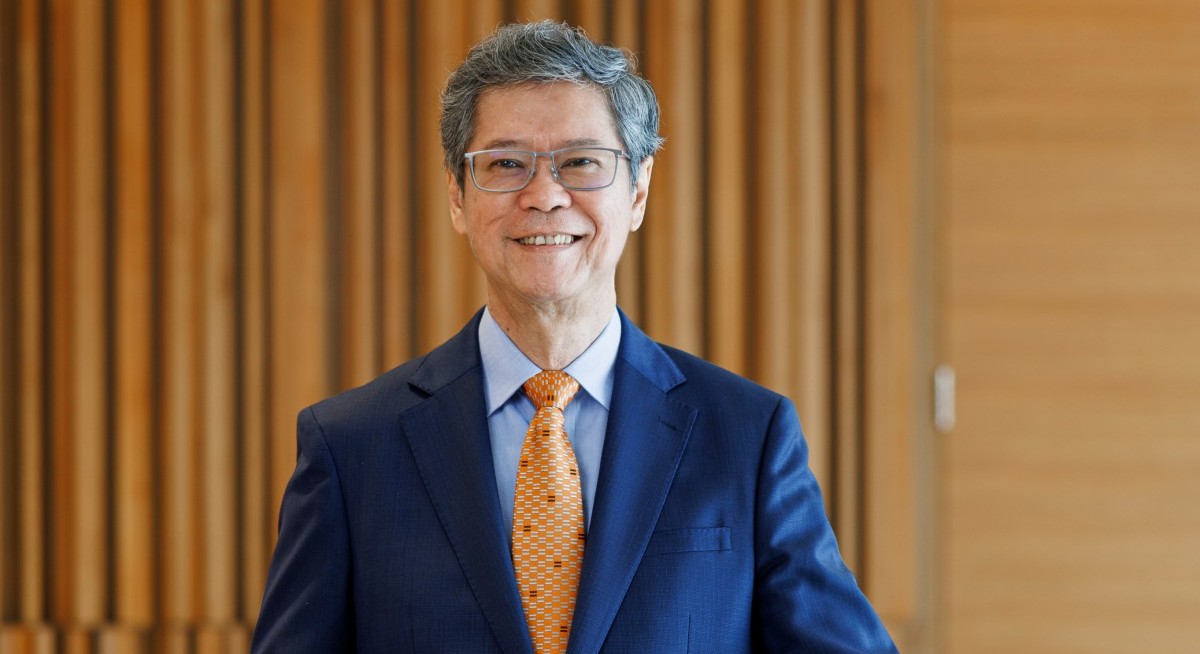


Both of the Temasek portfolio companies have understandably declined to comment on the speculation — and so has Hiew Yoon Khong, group CEO of Mapletree Investments.
Hiew, 64, has perhaps the most history with both entities. He helped launch Singapore’s first REIT — CapitaLand Mall Trust — in mid-2002. Formerly CEO of CapitaLand Financial (now part of CapitaLand Investment), Hiew joined Mapletree as CEO in August 2003 and is one of the longest-serving CEOs of a major Singapore government-linked company (GLC) — which he has denied. Granted, there may be lesser-known veterans at other unlisted firms.

Mapletree was established in December 2000 to hold the non-portfolio properties that were transferred from PSA Corp to Temasek. A quarter of a century later, Temasek is now evaluating options to grow its businesses into larger, stronger global entities — if the Wall Street Journal report is to be believed — and the wholly owned Mapletree is in its sights.
See also: Fewer GCB deals in 1H2026, but larger quantums lift average psf near record: PropNex
This is something new for investors to chew on, after years of wondering why CapitaLand Investment chose to list on the Singapore Exchange (SGX) while Mapletree remains privately held by Temasek. Both entities sponsor a handful of REITs on the SGX — CapitaLand has five, while Mapletree has three.
Hiew told The Edge Singapore back in 2023 that supporting REITs and private funds is more effectively done as an unlisted company. If Mapletree Investments were to be listed, its role would have to change “very significantly”, said Hiew for our cover story in Issue 1100. “So, the quick answer is that we never have plans to list.”
From 2023: Mapletree Investments reimagines its business model
See also: ‘Breathe life’ into precincts by investing in commercial property: Steward Asia
It seems that it has not changed in recent years. “Our structure has allowed us to make long-term decisions in the best interests of our investors, and that has been a clear advantage for us over the past 25 years,” says Hiew to City & Country today.
Mapletree Investments, like CapitaLand Investment, pays dividends to Temasek each year. “We look at the payout ratio alongside operating cash flows, reinvestment needs and balance sheet strength to ensure distributions are well supported,” says Hiew. “It is pertinent to note that over the past 25 years, we have not had additional equity infusion from our shareholders to support our growth.”
Up to $120 bil AUM goal
Hiew is the first cover profile in The Edge Singapore’s relaunched City & Country property section, but the industry veteran is no stranger to longtime readers. Some 20 years ago, for the issue dated July 25, 2005, City & Country placed Hiew and then-CEO of Mapletree Logistics Trust (MLT) Chua Tiow Chye on the cover.
Titled “First-mover advantage”, the story then was about MLT’s imminent listing as the sixth REIT on the SGX and the first regional logistics REIT. Mapletree has grown tremendously since then, and Chua has risen from leading MLT to becoming deputy CEO of the group.

When Hiew joined as CEO in 2003, Mapletree managed $2.3 billion in assets. This figure has grown to $80.3 billion as at March 31, 2025.
Hiew says the group’s track record has been “consistent and steady”. “Over 20 years, our average returns on invested equity (ROIE) is around 10.2%. Also, we have grown our recurring fee income from $8 million in FY2005/2006 to $458 million in FY2024/2025. That recurring income is important to our business model, and its long-term value is not yet fully appreciated by the market.”
Hiew says he has always prioritised sustainable growth over chasing numbers. “When I joined back in 2003, my team and I made sure we had the right mindset and frameworks for investment and operations in place. If you get those fundamentals right, results and scale will follow.”
The group is in the second year of its fourth five-year plan, which runs from FY2024/2025 to FY2028/2029. Mapletree aims to reach between $100 billion and $120 billion in assets under management (AUM) by the end of FY2028/2029.
“Going forward, the principle remains the same,” adds Hiew. “If it takes us to $100 billion and beyond, it should come naturally from the work we are doing, not from pursuing a number for its own sake or a target we set out to chase; that is, we do not chase AUM for its own sake.”
A fourth REIT?
Mapletree remains “very light” on hospitality, as Hiew put it two years ago, and the sector has not fared as well as compared to industrial assets. Back in February 2017, Mapletree acquired serviced apartment operator Oakwood Worldwide, before letting it go to CapitaLand in July 2022, which has a more expansive and ambitious lodging business.
“We are focused on areas where we see more substantial and resilient returns,” says Hiew today. The group’s “closest adjacency” to hospitality right now is in the living space, particularly the student accommodation sector, he adds.
There was talk as early as 2019 about Mapletree listing a student accommodation REIT. Among the group’s nine private real estate funds today is the Mapletree Global Student Accommodation Private Trust (MGSA), a closed-end student accommodation-focused fund with UK and US assets, a 2017 vintage and an inception AUM of some US$1.3 billion ($1.6 billion).
According to Hiew, student housing continues to draw strong institutional interest because of its resilient and counter-cyclical nature. “The fundamentals are strong, and Mapletree continues to see growing opportunities in key regions such as the UK, Europe and Australia… In many countries, there is a structural undersupply of quality student accommodation, while demand for higher education and student mobility continues to rise. That imbalance creates favourable demand fundamentals and makes the sector highly scalable.”
Shorter annual lease cycles also allow owners to adjust rental rates more frequently, he adds, positioning the sector as a natural hedge against inflation.
The group is launching the syndication of the Mapletree Student Castle Accommodation UK Fund (MCASTLE) in early 2026. The fund is seeded with GBP500 million ($864 million) of seven high-quality UK student housing assets across top UK university cities that are managed by Mapletree’s in-house operational team.
These assets were part of a GBP1 billion strategic acquisition announced in April 2024, where Mapletree bought 31 assets in the UK and Germany, as well as the Student Castle operating platform, from Cuscaden Peak Investments.
Last August, Mapletree announced the acquisition of a site in Perth to be developed into a student housing asset. This development, according to the Australian Financial Review, is worth around A$300 million ($259 million) when completed.
“In the near future, Mapletree plans to continue expanding its student housing footprint in developed student housing markets like the US, continental Europe and to expand selectively in Asia,” he says.
But Hiew is not ruling out a student accommodation REIT yet. “We will continue to monitor market conditions and explore various investment vehicles, including a student accommodation REIT, when the environment is more favourable to ensure sustainable returns for investors.”

Four core sectors
Aside from student housing, the group’s expansion efforts are concentrated on three other core sectors: logistics, data centre and office.
In logistics, Mapletree sees Malaysia, Vietnam and India as bright spots in 2026. “Strong domestic consumption, a growing population and the rapid rise of digital commerce are driving demand,” says Hiew.
At the same time, the US continues to show enduring strength, with e-commerce and supply chain reshoring creating sustained growth potential, he adds. “To enhance value and create better-designed facilities for the market, we are also adopting a more development-oriented approach to our investments in the sector globally.”
The office sector in some of the “weaker” markets in Europe and the US is showing some signs of bottoming out and recovery, with leasing demand picking up and vacancy rates easing, notes Hiew. “We are cautiously optimistic but selective, as we direct our capital into key Asian gateway markets like India, Singapore and Vietnam, where demand for quality office space is strongest, and the fundamentals align with our long-term strategy.”
Finally, Mapletree is positioning to expand into data centre assets. “In 2025, we laid the groundwork by strengthening internal capabilities. That foundation positions us well to expand globally through both mature and emerging markets in Europe and various parts of Asia,” adds Hiew.
These four core sectors have long-term tailwinds that underpin defensive yield profiles and sustained growth, adds Hiew. “The way we underwrite these transactions must be something we can confidently stand behind, as we bring more like-minded investors onto our capital management platforms.”

The new HarbourFront Centre
In its early years, Mapletree set out to revamp the World Trade Centre, which was completed in 1978. The property reopened as HarbourFront Centre in February 2003.
Last year, Mapletree unveiled plans to redevelop HarbourFront Centre, now more than 40 years old. The reimagined 33-storey HarbourFront Centre will span 123,000 sqm in gross floor area in the core part of HarbourFront Precinct come 1H2031. It will be directly connected to the HarbourFront MRT Station and adjoining VivoCity, HarbourFront Towers One and Two, and a newly constructed two-storey cruise and ferry terminal. The terminal will commence its operations at the new premises around 2H2026.

Among Mapletree’s plans is a 26-storey Grade A office tower with a 16m-high lobby, atop five floors of retail space. “The retail podium will offer shoppers curated fresh concepts alongside interactive brand experiences and will complement the offerings currently available in VivoCity,” says Hiew.
In the same way, Mapletree Business City (MBC) and mTower are directly linked to the Labrador Park MRT Station in the Alexandra Precinct. “Together, these two clusters around the HarbourFront and Alexandra Precincts are core commercial nodes within the larger Greater Southern Waterfront master plan,” adds Hiew.
VivoCity, MBC and mTower are owned by Mapletree Pan Asia Commercial Trust (MPACT). “These Mapletree assets within the HarbourFront and Alexandra Precincts will redefine working outside the CBD as they are built for global companies that value accessibility, scale and full amenities — all in one place,” Hiew adds.
M25
Looking back at the past year, the group commemorated its 25th anniversary with a “cosy, intimate event” at its MBC headquarters in August 2025, says Hiew. “During the event, we presented long-service awards and unveiled a special commemorative tumbler for all staff. It was a way to honour our people while marking this important chapter in Mapletree’s journey.”
In total, 35 staff received long-service awards — 31 of them marked 15 years, one at 20 years, two at 25 years and one at an extraordinary milestone of 50 years, notes Hiew. “The employee joined PSA back in November 1974 and was later seconded to Mapletree.”

Mapletree’s longest-serving employee, Azizah Dollah, scored a special autograph from group CEO Hiew
“This celebration is about honouring our long-serving colleagues, recognising their dedication and celebrating how much we have achieved over the past 25 years. It also reflects our proven resilience in seizing opportunities and emerging stronger from every market cycle.”
Photos: Mapletree Investments
For more property profiles and breaking news, visit City & Country’s microsite at theedgesingapore.com/cityandcountry




