




While the politicians are trading barbs over the progress of the project, rail industry officials say both the state and federal governments play important roles in ensuring its smooth implementation.
“The [federal] government will have to decide whether the line will be 57km or 30km long. If you want a 57km-long line, that will take at least five years,” one official tells The Edge.
The project is a public-private partnership (PPP) between the federal government under the Public Private Partnership Unit (UKAS) and a consortium led by DOM Industries (M).
The state government also has a role to play in alignment finalisation, the official highlights, as the project cannot start without its green light on alignment, as well as land identification, alienation and acquisitions.
The e-ART project is estimated to cost RM10 billion ($3.1 billion), although this has not been finalised as it depends on the alignment as well as the length of the system. It is safe to estimate, however, that the cost is around RM350 million per km, excluding land costs.
A bit of background
A rapid transit system called Iskandar Malaysia Bus Rapid Transit (IMBRT) was first proposed in 2016, with an estimated cost of slightly above RM2.5 billion at that time.
See also: Beachfront Port Dickson land on the market for about RM15 mil
The project was, however, delayed for several years due partly to the change in the federal government in May 2018, and the subsequent Covid-19 pandemic.
A pilot programme was launched in April 2021 to test the system but it was shelved indefinitely, coinciding with the change in government at both federal and state level in 2022.
Datuk Onn Hafiz Ghazi became the menteri besar in March 2022, following BN’s landslide win in the state election.
The project was then replaced by the e-ART proposal in 2024, as the IMBRT system was deemed insufficient to tackle traffic congestion in Johor Bahru because it does not have a dedicated right of way and would have to share lanes with other modes of transport.
In March 2025, UKAS issued a request for proposal (RFP) for an e-ART system in the Iskandar Malaysia region.
It was a three-horse race among the DOM Industries-led consortium — which includes Nylex (Malaysia), MMC Engineering and BTS Group Holdings — and two other consortia led by WCT Holdings and YTL Corp.
Nylex is 42.2% owned by Ancom Nylex, while MMC Engineering is a wholly-owned indirect subsidiary of MMC Corp.
After more than a year, the proposal by the DOM Industries consortium was selected. However, this is just the first step before the project can take off, another rail company official tells The Edge.
“The letter of intent has been issued. Now, the winning consortium will have to talk to the state government and other relevant agencies to finalise the contract.
“They [the consortium] will have to resubmit a revised proposal on the alignment, stations and system. It has to be reviewed and approved by UKAS and the Ministry of Finance. To do this, they must first finalise the alignment and location of depots with the state,” the official says.
He adds that the state and federal governments should, as an interim measure, consider implementing a shorter 10km line, which could be completed within two years, rather than proceeding with the entire 57km line at one go.
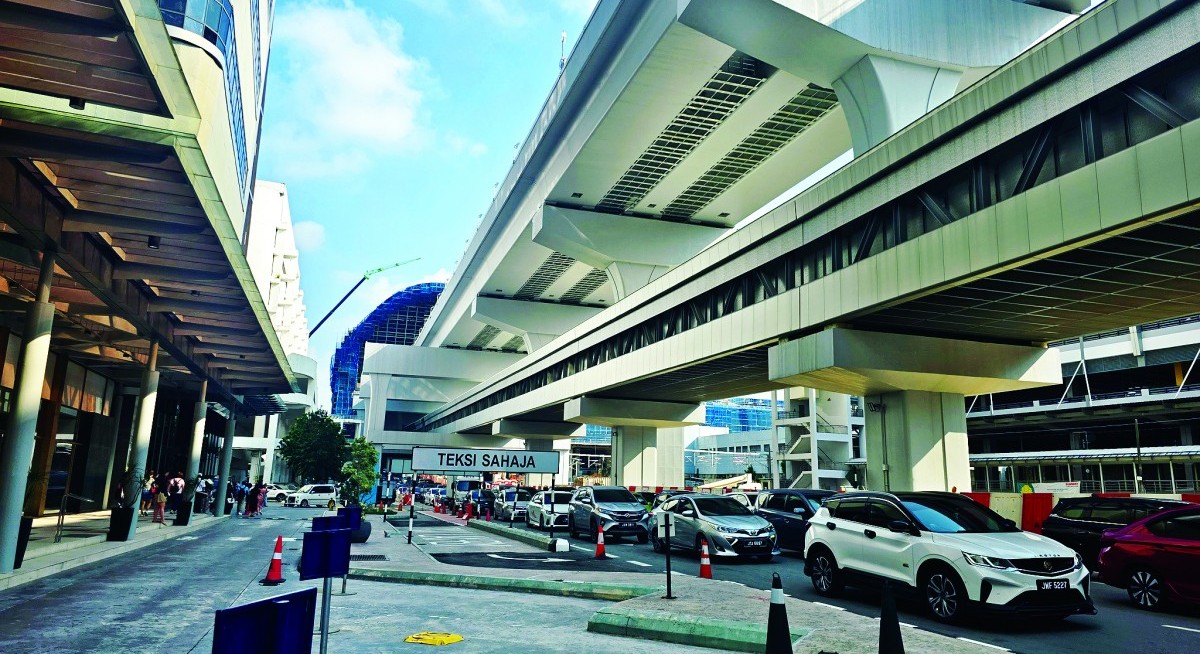
The state government wants the project to be completed quickly, as the JB-Singapore RTS is expected to start in January 2027. The cross-border transit between Malaysia and Singapore has the capacity to carry a maximum of 10,000 passengers per hour per direction, which would require an efficient public transport system to be dispersed throughout the city and the Johor Bahru metropolitan area. Without an efficient public transport system, the city centre, especially near the Bukit Chagar station and customs, immigration and quarantine complex, would be choked with traffic.
To induce pedestrianisation, the state’s authority is implementing several short- and medium-term solutions, including expanding park-and-ride facilities, implementing smart traffic management systems and reorganising the movement of buses, taxis and e-hailing vehicles.
But these aren’t expected to solve the congestion issue in Johor Bahru. Menteri Besar Onn Hafiz stresses that the e-ART is the “most critical long-term solution” to absorb an expected surge in passenger movement once the RTS starts operating.
“The state wants the project to be done quickly, in order to alleviate congestion in Johor Bahru and disperse traffic from the RTS. But the state also wants certain changes made to the alignments,” a government official who is privy to the negotiations between the DOM Industries consortium and the state government tells The Edge.
He says alignment changes are being proposed, including stations in certain areas that were not part of the original alignment proposal, such as in Larkin Sentral.
To be fair to the state government, it makes sense to have a station in Larkin Sentral considering that it is a public transport hub in the northern part of Johor Bahru.
The government official confirms that the consortium and the state have agreed on the general alignment of the line, with more than half of the stations’ exact locations having been determined.
When asked by The Edge, a representative of Ancom Nylex declined to comment on the status of the project due to the confidentiality of the proposal.
Questions on PPP business model
Johor Bahru’s location as the southern gateway to Singapore presents both challenges and opportunities for the city and the state.
The e-ART would be the first rapid transit project in Malaysia to be developed under a PPP model. By comparison, the Ampang and Sri Petaling LRT lines in the Klang Valley originally employed private finance models, before being taken over by Prasarana Malaysia in September 2002, as part of a government bailout.
A key challenge of the PPP model is balancing commercial viability with public policy objectives.
Private-sector partners would naturally seek a reasonable return on their investments, potentially requiring fares to be charged at commercial rates. This may clash with the government’s intention to keep fares low in order to boost ridership.
There is already a debate over whether Singaporeans using the system should be charged a higher fare. One argument is that if Malaysians have to pay, say RM2 per direction, Singaporeans should pay the equivalent of $2 for the same trip.
“But it is up to the federal government how much they want to subsidise the fares,” says another rail industry official.
“The state government can also provide special subsidies for Johoreans if it wants to make the fares cheaper for the locals.”
In Southeast Asia, Thailand has adopted the PPP model for its rapid transit systems in Bangkok. BTS, which is part of the DOM Industries consortium, has co-invested in the Bangkok SkyTrain’s Green Line.
While the PPP model in Bangkok is generally regarded as a success, recent expansion of the system has increasingly relied on public funding, with the Thai authorities awarding BTS operation and maintenance contracts.
This suggests that even in Bangkok, where the PPP model has delivered positive outcomes, large-scale network expansion ultimately requires public funding given the substantial capital investments.
Nevertheless, BTS, as the operator of the city’s Green, Gold, Pink and Yellow Lines, as well as its bus rapid transit system, is a successful company that does not really depend on the Thai government for funding.
BTS has a fairly high proportion of non-fare revenue, which makes up more than 60% of its total revenue. The group is often described as a “media, property and services company built on rail ridership”.
Besides operating and maintaining the lines, BTS also manages the retail spaces, advertising, as well as the automated payment system through its Rabbit card — equivalent to Touch ‘n Go in Malaysia.
It owns a 33.51% stake in VGI, an offline-to-online marketing solutions provider spanning advertising, payment and distribution. Through its 46.5% investment in Rabbit Holdings, BTS operates insurance as well as property development businesses.
In addition, it operates Thana City Golf and Sports Club, a restaurant management business through Turtle 23 Co, as well as an ICT solutions business through ROCTEC Global.
BTS has a presence in the airport business via its 40% share in U-Tapao International Airport in Rayong province, which serves the burgeoning Eastern Economic Corridor.
Through a joint venture, the group has also secured two concessions for intercity motorway projects — Bang Pa In-Nakhon Ratchasima (196km) and Bang Yai-Kanchanaburi (96km).
This is believed to be the model that the DOM Industries consortium is seeking to emulate for the e-ART project. However, it remains to be seen whether it can be replicated successfully given the potential for conflicting interests to arise.
The consortium might also seek to monetise the land surrounding the stations through transit-oriented development. However, it is unclear at this juncture whether it will own the land under the PPP model.
No matter what business model the consortium undertakes, one thing is for sure — Johor Bahru’s congestion issues are unlikely to be solved at least for the next two to five years without an efficient public transport system.
This story first appeared in the June 22 issue of The Edge Malaysia




