


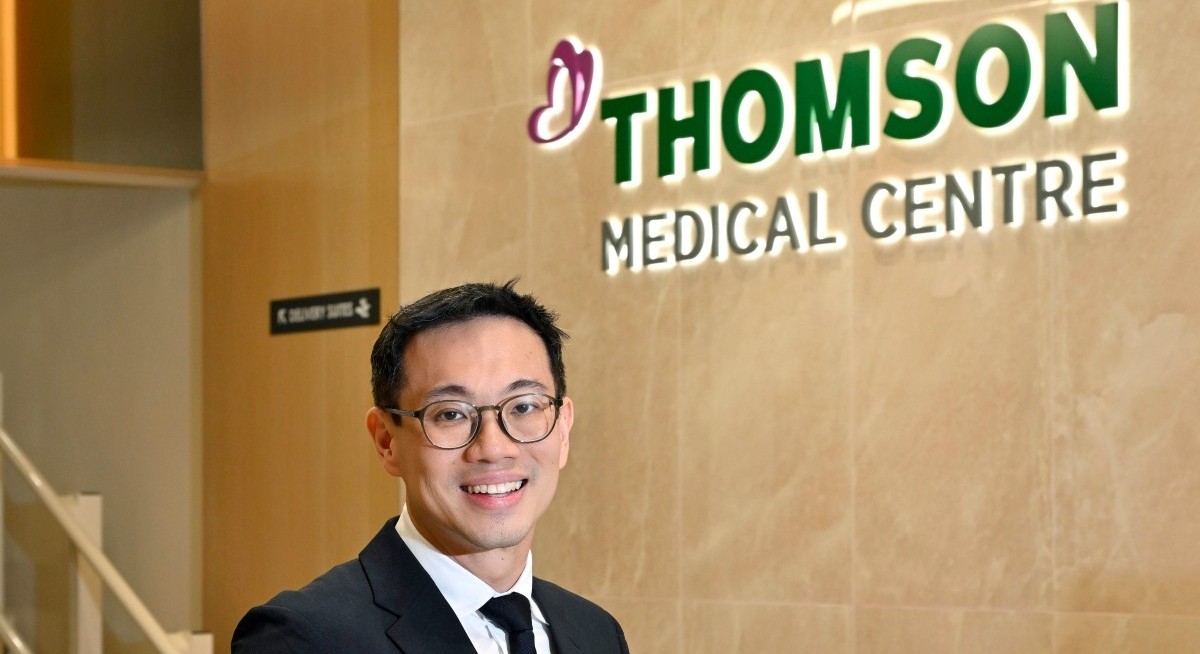


From the discussions, the group agreed that it wanted to build more clinical specialities. “The idea was not just so that we can have a bigger catchment of patients or surface area for patients to come to, but we realised that we created so much value,” he says, noting that many of the families he meets are Thomson babies. “So they have this endearment towards the brand, and we kind of let them down by not being able to stretch.”
Naturally, when the group looked to expand, it focused on areas aligned with its existing strengths, including complex gynaecology, oncology, fertility preservation and children’s surgery. “There was so much we felt that we could go deeper than palm them off to some other provider.”
One of Heng’s priorities was Thomson Medical Centre itself, a building that had not been renovated since it was completed 47 years ago. Under his watch, the ground floor was gutted and rebuilt with a new lobby, relocated pharmacy, blood bank and, most notably, an MRI machine. The idea had been mooted many times but rejected for several reasons, including floor load and the risk that its magnetic field could cause disruption. There was also concern about interference from external traffic, Heng notes. “But we did it, and it’s functioning. And that’s why we feel there’s so much more that we could put into our hardware to support this aspiration of really empowering patients’ journeys.”
The partnership playbook
See also: MetaOptics stays focused on unicorn ambition with new CEO
Beyond hardware, Heng is exploring ways to expand the group’s capabilities through strategic partnerships, rather than buying specialist groups outright. “We felt that when you buy something, the doctors have cashed out. They don’t have any more alignment,” he says. “We felt that it was better to keep them aligned to their practice, but collaborate with them in a way, with a commercial structure that incentivises both parties to work for the success of the facility.”
The model isn’t new, given that there are private equity models that have taken on a similar direction, but this model is something that the group has “unlocked… pretty well in different countries”.
One example is the group’s 2024 partnership with OncoCare Medical, a portfolio company backed by Temasek’s 65 Equity Partners and Hong Kong-based private equity firm Templewater. This collaboration aims specifically to elevate cancer care standards across Thomson’s network in Malaysia.
See also: E-commerce logistics hub gives SingPost flexibility to value up its floor space
The experience, says Heng, was “magical”, as the group had brought in “very, very incentivised doctors” who were business owners and were also at the top of their game in oncology care. The partnership gave these doctors an opportunity to have a place and a blank canvas to build their services.
Patients who come through such partnerships will then flow through the group’s ecosystem, using its diagnostic centres and labs and subsequently being referred to other specialists.
To Heng, these models are “very exciting” to work with because healthcare is, in his terms, a “team sport” in that so many stakeholders are involved. “Getting the alignment from stakeholders is key. Everyone needs to feel that they are taking something back.”
While he acknowledges that the group can do everything on its own and organically, the outcome of these partnerships is “greater than the sum of the individual parts.”
Besides its own clinics in Singapore, OncoCare set up the Thomson OncoCare Cancer Centre at Thomson Medical Centre last year. Given that OncoCare is part of the regional oncology network under Tamarind Health, Heng sees scope to replicate the structure across Thomson’s other geographies.
Expanding in Vietnam
Thomson may be smaller than peers like IHH Healthcare, but it has big ambitions in Southeast Asia, a region “we have decided to call our playground,” says Heng. Rather than being distracted by the “bright lights” of China, India and the Middle East, the company sees great opportunity in Southeast Asia as there are “a lot of needs and demands and patient requirements that are so unique that it makes sense for us to specialise in this area.”
To stay ahead of Singapore and the region’s corporate and economic trends, click here for Latest Section
Thomson Medical’s acquisition of FV Hospital in Vietnam was the first step towards the group’s regional ambitions. The group announced in July 2023 that it had agreed to acquire the Ho Chi Minh-based hospital for up to US$381.4 million. At the time, the move was the largest healthcare acquisition in Southeast Asia since 2020. The group completed the acquisition of FV Hospital in January 2024.
“The Southeast Asia mandate was there, and there was definitely a view to consider expanding and seeing where we could build up the group,” says Heng on the expansion. Recalling the situation then — with Covid-19 coming to an end and changing demands for medical services — the group definitely needed diversity. “Having another hospital in the fold was probably a good way for us to expand.”
Yet the group didn’t want just any hospital but something that “made sense”. “We looked at a lot of opportunities in Malaysia, Vietnam, Thailand and Indonesia, but we landed on Malaysia and Vietnam as good opportunities,” recalls Heng.
FV, a 250-bed, Joint Commission International (JCI)-accredited institution, was an “interesting target”. The hospital was established by a group of 15 French doctors in 2003. Today, it retains the rigour of a founder-led business and stands as one of the leading private hospitals in Vietnam. “I dare say that the reason why we thought that this was a good hospital to work with as well is that they were doing more than just treating simple cases. They were doing complex cases,” says Heng. “We were actually having foreign doctors from other countries do complex corneal transplants.”
FV Hospital’s location was also attractive. “Ho Chi Minh City is the largest city. The majority of Vietnam’s population lives between Ho Chi Minh and the Mekong Delta. That’s about 70 million people,” he says. “The catchment is good; the area itself has since [been] gentrified with very nice housing… so it was a good location.” He adds: “We even had two other private hospitals next to us. So it was a little bit like a healthcare cluster.”
Beyond FV Hospital, the group hopes to expand its presence; in late 2025, it received permission to expand its grounds by another 10,000 sqm. Heng envisions Centres of Excellence in oncology, IVF, gastroenterology and cardiology as part of the expansion. “We think we could make this one of the best hospitals in Vietnam, if not already.”
The big bet: Johor Bay
In line with its Southeast Asia playbook, Thomson Medical Group’s next ambition is an integrated project on a 26-acre site within the Johor-Singapore Special Economic Zone (JS-SEZ).
The site, located 1.2km from the upcoming Johor Bahru-Singapore rapid transit system (RTS) at Bukit Chagar and minutes from the Causeway and regional ferry terminals, has sat on Thomson’s books “for years”, says Heng. “The piece is well undervalued because on our books, it’s set at a much lower valuation than [its] potential.”
The group had long intended to develop the land, with earlier master plans that never quite got over the line. When Heng joined in 2022, the land was one of his priorities. The groundwork began alongside the acquisition process, with hospital plans dusted off and wireframes revisited. External validation followed, as momentum built around the RTS link and the unveiling of the JS-SEZ.
“It’s not that the SEZ came about and we started wanting to develop it,” Heng adds. “The SEZ has good and bad things. Hype is never great because hype is always built on sentiment. But if you look at the core principles of the location, the demographics of Johor, the rate of population growth, the initiatives to reduce the friction of human transport across the causeway, the arbitrage in terms of pricing for land, it does make sense for us just to develop a project.”
The project, which has a gross projected development value of $5.5 billion, will be built in phases. “It’s about three and a half times the size of MBFC (Marina Bay Financial Centre). It’s huge, unlike anything,” Heng says. At its centre will be a hospital of about 300-plus beds. Moving away from the hospital nucleus will be active ageing and assisted living facilities, residential towers, hospitality, and commercial space.
The plot also enjoys an attractive geographical location. “The hospital is in the middle of Johor Bahru city centre, with very few competitors around, with proximity to the RTS and to the causeway, and the freedom to paint around that canvas,” Heng says. The nearest competing hospitals are 20 to 25 minutes away. “We are going to be the closest hospital, really, to Singapore in terms of the Causeway.”
Asked about the funding process, he says the group is in advanced talks with prospective development partners. But Heng is in no rush to close. “Getting the right partner is more important than meeting the timelines. We’d rather do things properly and find the right piece and right partner, rather than rush and force something just so that we can meet certain timelines.”
One component still being worked through is the active ageing and assisted living product — what it should look like in a Southeast Asian market with distinct attitudes toward elder care and multigenerational living, including retirement villages in Thailand, Club Med-style concepts, retainer fee models in China, and approaches seen in France and Australia. Yet, Heng remains open to ideas. “I think with a partner, we will have to take a view on what type of product is going to work.”
Playing the long game
Thomson Medical’s ambitions extend beyond bricks and mortar. Heng is also focused on strengthening the group’s digital capabilities. Unlike many hospital groups that outsource this function, Thomson runs its own in-house development teams in Ho Chi Minh City, Hanoi and Shanghai. “The software of the hospital is really key, and the hardware wraps around this software,” he says. “Without good software, it’s really hard to do anything, even though you have the best equipment.”
The technology is beginning to reach the market in Singapore, with other geographies to follow once it has been proven. The aim is simple: to meet patients earlier in their journey, before they reach a clinic or ward. Increasingly, that journey begins online.
Human capital is equally critical. The group has invested heavily in leadership pipelines, mentorship programmes, and structured career pathways for healthcare administrators. Finding talent is hard enough; retaining it is even more challenging.
For Heng, both strands come back to the same point. “It’s the best way to get market research, because these are your users,” he says of his approach to shareholder and patient feedback. “I tell you that when I was a hospital CEO, the QR code that the patient had in the room to give feedback — every single room, I got an email. Why not? Because they are the end user.”
Nearly four years in, Heng’s conviction in what Thomson Medical can become has not wavered. “I hope [the shareholders] see the potential in the platform that I see,” he says. “I think… this group has a lot of potential, and being a Singapore-based healthcare company, I would love for them to really join us on the journey.”
On June 1, the group announced the appointment of Cassandra Loh as its acting CEO for its Singapore operations. Loh, the group’s Singapore chief commercial officer, will take over from outgoing Singapore CEO Lee Suen Ming on July 1. She will continue to oversee her responsibilities as chief commercial officer.
According to the group, the leadership change comes as it moves into the next phase of its transformation. “Suen Ming joined us at an important point in Thomson Medical Singapore’s transformation. On behalf of the group, I would like to thank him for his service, commitment and steady leadership over the past few years. He has helped to guide the Singapore business through a period of change, and we wish him the very best in his next chapter,” said Heng in the group’s June 1 statement.
“As we move forward on our next phase of growth, our focus is clear: to drive excellence, stay close to the ground and ensure our growth plans translate into better outcomes for patients, doctors, partners and our people. Cassandra brings a strong mix of commercial discipline, healthcare experience, partnerships, operations and growth. Having her step into the acting CEO role while continuing as chief commercial officer will bring our commercial strategy and day-to-day leadership closer together, which is what this next phase requires.”
Tong Kooi Ong, founder and chairman of The Edge Media Group, is also the new chairman of Thomson Medical Group’s board. This interview was arranged and held before his appointment




