




Mustafa had already expanded into Malaysia with Mustafa Jewellery in Melaka, which it opened in September 2023. For perspective, its Singapore flagship spans about 400,000 sq ft over six storeys in Little India. The 24-hour megastore offers a comprehensive range of products — from groceries to perfume, consumer electronics, jewellery, toys, fashion and cosmetics, as well as services such as money exchange, remittance and travel bookings.
Zerin Properties Research highlights several possible venues, including Komtar JBCC, a city-centre asset with recovering occupancy, high footfall and robust infrastructure linkages, and that is currently under active enhancement.
“Nevertheless, this would depend on negotiations with the owner and whether there is available space suitable for another anchor tenant or other concepts at suitable locations in the mall, in line with the mall’s evolving tenant mix and leasing strategy,” it says.
Another potential site is the former Skudai Parade, which Zerin says was recently sold and now awaits the new owner’s redevelopment plans, making it unsuitable for immediate occupation.
See also: Resorts World Sentosa suit: Malaysian court rules gambling debt not enforceable
Zerin also cites Holiday Plaza, which remains operational but is an ageing asset sustaining steady trade through gradual upgrades while retaining a mid-tier tenant mix. It adds that Holiday Plaza is one of the few underperforming, yet functional, malls that could be repositioned, although spatial constraints apply.
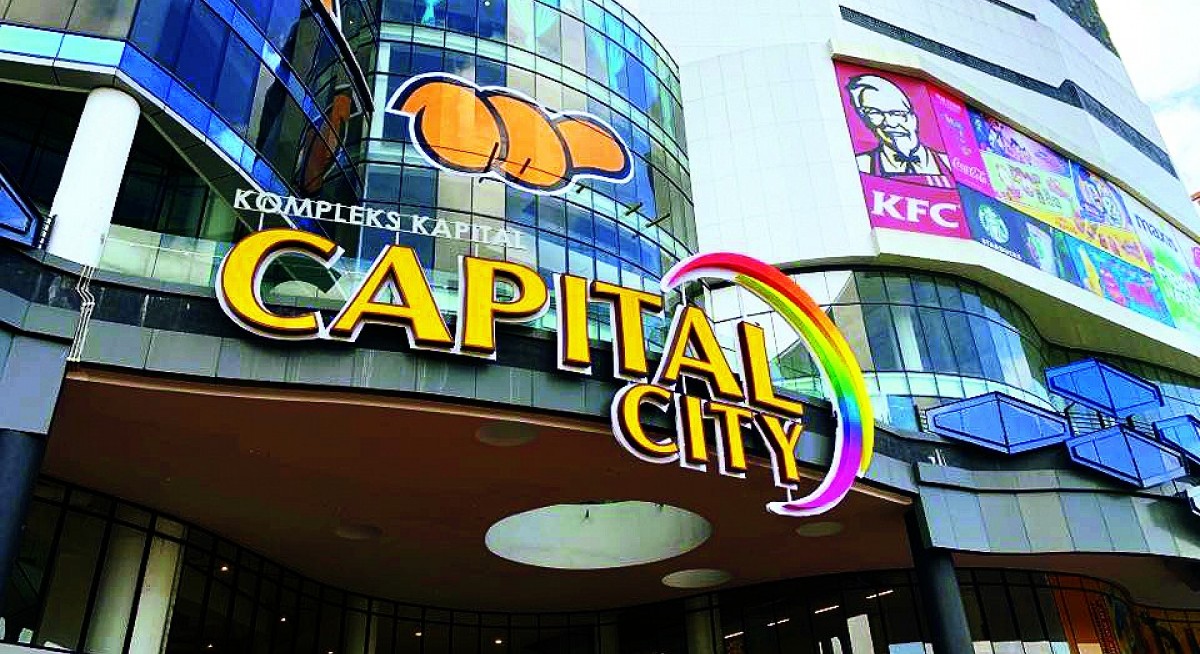
Capital City Mall’s journey has been anything but smooth. To recap, it opened in 2018 but closed two years later after Capital World ran into financial difficulties and sought court protection from creditors while restructuring its debts. The mall was initially slated to reopen in the second half of 2023 (2H2023).
The 11-storey mall, completed in April 2018, has more than 1,500 strata-titled units, with a total net lettable area (NLA) of more than 900,000 sq ft.
See also: Malaysia eyes regional leadership in low-altitude economy as drone rules take shape
It forms part of Capital City, an integrated development, which includes plans for an 18-storey tower with 630 serviced suites, 690 serviced apartment across three blocks and a 315- room hotel. So far, only the mall has been completed.
According to Capital World’s 2025 annual report, construction of the serviced suites and the planned serviced apartments had been temporarily suspended.
Based on earlier reports, the site that Capital City Mall occupies belongs to Achwell Property Sdn Bhd, a wholly-owned company of Gadang Holdings Bhd.
Gadang is partnering Capital World’s subsidiary Capital City Property Sdn Bhd to develop Capital City. It was announced in 2023 that Singapore’s Mustafa Centre would establish its first department store in Malaysia at Capital City Mall as part of a large-scale retail complex, but the opening has since been delayed.
Olive Tree Property Consultants founder and CEO Samuel Tan says the delay stems mainly from space negotiations and construction progress. He explains that Mustafa is seeking to lease additional retail space from existing strata title owners to enable more unified management, but negotiations have been complex because of some owners’ high rental yield expectations.
Construction work at the mall has also progressed more slowly than anticipated. Nevertheless, Tan says he hopes Mustafa Centre will eventually enter Johor Bahru to “showcase a different form of shopping experience”.
In a January 2023 statement on Mustafa’s RM368 million ($116.8 million) bulk acquisition, Capital World said the sale proceeds would strengthen its finances to complete the remaining components of the integrated development and pursue other real estate opportunities, including helping the retailer identify potential sites in Malaysia and Indonesia for mega stores.
In the same statement, Mustafa managing director Mustaq Ahmad said the retailer believed the timing was right to enter Malaysia, following the lifting of pandemic restrictions, noting that securing a suitable site had been a key challenge.
He added that Capital City Mall met many of the requirements for Mustafa’s first flagship store in Malaysia, citing its proximity to Singapore, ample floor area and suitable floor plates.
At press time, the retailer had not responded to The Edge’s request for comment.

Steady growth in JB retail market
Olive Tree’s Tan tells The Edge that Johor Bahru currently has about 40 malls, offering a combined 15.7 million sq ft of retail space. He adds that average rental rates for general retail space typically range from RM1.50 to RM9 psf per month, depending on factors such as location, floor level and anchor tenant mix.
Popular malls such as Mid Valley and Paradigm Mall report near to full occupancy, he adds. Rahim & Co Research’s Property Market Review 2025/2026 says Johor’s retail sector remained relatively stable in 1H2025, with total supply at 26.03 million sq ft and an average occupancy rate of 73.7%. This leaves about 6.84 million sq ft of vacant retail space in the market.
Of the 146 retail establishments statewide, 75 are located in Johor Bahru, contributing a substantial 20.23 million sq ft of retail space.
According to Knight Frank Malaysia’s Real Estate Highlights 2H2025 report, Johor Bahru remained the dominant submarket, accounting for 78.3% of total retail space in the state.
IGB Bhd’s RM215 million acquisition of two land parcels adjacent to Mid Valley Southkey is expected to pave the way for a major retail-led expansion, aiming to replicate the scale and vibrancy of Kuala Lumpur’s Mid Valley City. It will be transformed into a mixed-use hub comprising retail, hospitality and commercial components.
Overall, Knight Frank says, average monthly gross rents in selected Johor Bahru shopping malls remained broadly stable in 1H2025. The Mall, Mid Valley Southkey and AEON Mall Tebrau City recorded the highest ground-floor rental rates among the selected malls (RM39.50 and RM36.80 psf respectively), reflecting their strong market positioning and popularity among both retailers and shoppers.
Zerin founder and group CEO Previn Singhe says top-performing malls in Johor include Paradigm Mall Johor Bahru, Mid Valley Southkey, Johor Bahru City Square, KSL City Mall, AEON Tebrau City as well as the Toppen–IKEA-anchored cluster, supported by strong tenant mix, accessibility and consistent footfall.
He says Komtar JBCC is showing recovery momentum, with occupancy rates reaching 69% in 1Q2025 and a target of “80% to 85% by 2027” through ongoing repositioning and tenant reconfiguration.
Previn says competition is intensifying, owing to factors such as “better curated retail destinations and stronger experiential offerings” within Johor and from Singapore.
He adds that malls will need clearer positioning, stronger tenant curation and more active reinvestment as the market becomes more connected.
Johor Bahru City Square is undergoing a major facelift that is targeted for completion by end-2027. The mall’s owner, Allgreen Properties, a member of the Kuok Group, is adding a 15,000 sq ft Kids Adventure Park, a health and wellness hub, and hotel apartments above the existing mall. The redevelopment also includes an expansion of roughly 22,000 sq ft, bringing the total to 569,000 sq ft.
The project will be rolled out in five phases, with the mall remaining operational throughout. The upcoming OBS Mall, part of Phase 3B of Astaka Holdings’ One Bukit Senyum and slated for completion in 2030, will offer about 300,000 sq ft of NLA, integrated with a 250- room, five-star hotel and 300 branded residence units.
See also: Johor Bahru City Square adding retailers, wellness hub and hotel apartments in multi-year AEI
Asked how Visit Malaysia 2026 will affect the retail market, CBRE|WTW director Jonathan Lo says tourism is always a boon to retail spend. “The Visit Malaysia 2026 and Visit Johor 2026 campaigns are expected to act as meaningful demand catalysts, particularly in well-positioned malls with strong accessibility, established branding and proximity to key transport nodes,” he adds.
Breathing new life into prominent abandoned malls
Several malls in Johor have long been abandoned, including Waterfront City Mall (also known as Lot 1), Capital City Mall, Danga City Mall and Skudai Parade.
Plans to revive Waterfront City Mall are not new; The Edge understands that discussions are ongoing regarding the revival of the space, which was developed in 2000 as part of the Johor Bahru Waterfront floating project.

Tan says Danga City Mall has been identified for revival as a “park and ride” for the Rapid Transit System (RTS) link and could be converted into a medical centre. He adds that long-abandoned malls in Johor Bahru often result from factors such as changing consumer preferences, outdated facilities, poor management or financial difficulties, which can lead to an inefficient tenant mix and reduced shopper appeal.
KSL Holdings Bhd is said to have acquired more than 200 unsold retail units in the abandoned Skudai Parade via auction, though plans for the mall remain unclear.
A recent success story is the revival of the once-abandoned Pacific Mall by Johor-based SKS Group. The refurbished retail space, now known as SKS City Mall, is set to open this year, while the 345-room Sheraton Johor Bahru above it opened last October. CBRE|WTW’s Lo highlights that Johor’s retail sector faces a major challenge in its dependence on spending by Singaporean visitors, particularly on discretionary items.
While this cross-border demand can significantly boost footfall and tenant sales when currency and travel conditions are favourable, it also makes the market vulnerable to external shocks, such as exchange rate swings, policy changes, border restrictions and evolving Singaporean consumer habits.
Consequently, retail performance in Johor tends to be cyclical.
Zerin’s Previn says: “In our view, Johor does not need more generic malls. What the market needs is the right kind of retail in the right locations: experiential destinations, curated F&B and entertainment-led centres, community malls anchored to strong neighbourhood catchments, and increasingly transit-oriented retail near future mobility nodes.
“The rapid transit system (RTS) and Johor-Singapore Special Economic Zone (JS-SEZ) will meaningfully expand the effective market size by improving accessibility, growing the working population, and strengthening purchasing power, but these catalysts will not lift all assets equally. They are likely to accelerate a ‘winner takes most’ dynamic, where prime assets capture the bulk of demand while weaker stock will need to reposition, consolidate or transition into alternative uses.”
Olive Tree’s Tan adds that the market is currently in a “survival of the fittest” phase. “We do not need more malls, we need better ones. The 10 to 15 underperforming/abandoned malls are likely to be converted into hotels, vertical data centres or other adaptive uses. The top 10 malls will capture about 80% of cross-border wealth. The RTS and JS-SEZ will not save a bad mall, but will make a good mall a goldmine,” he says.
This story first appeared on Jan 19 in The Edge Malaysia
Editor's note:
In response on Jan 28, the management of Mustafa Centre "wishes to state unequivocally that the contents of the said article are not true and are without basis."
"Mustafa Centre has not made any decision, nor are there any plans under consideration, to open another outlet in Johor Bahru other than Capital City Mall. The assertions made in the publication are therefore inaccurate and misleading."




