


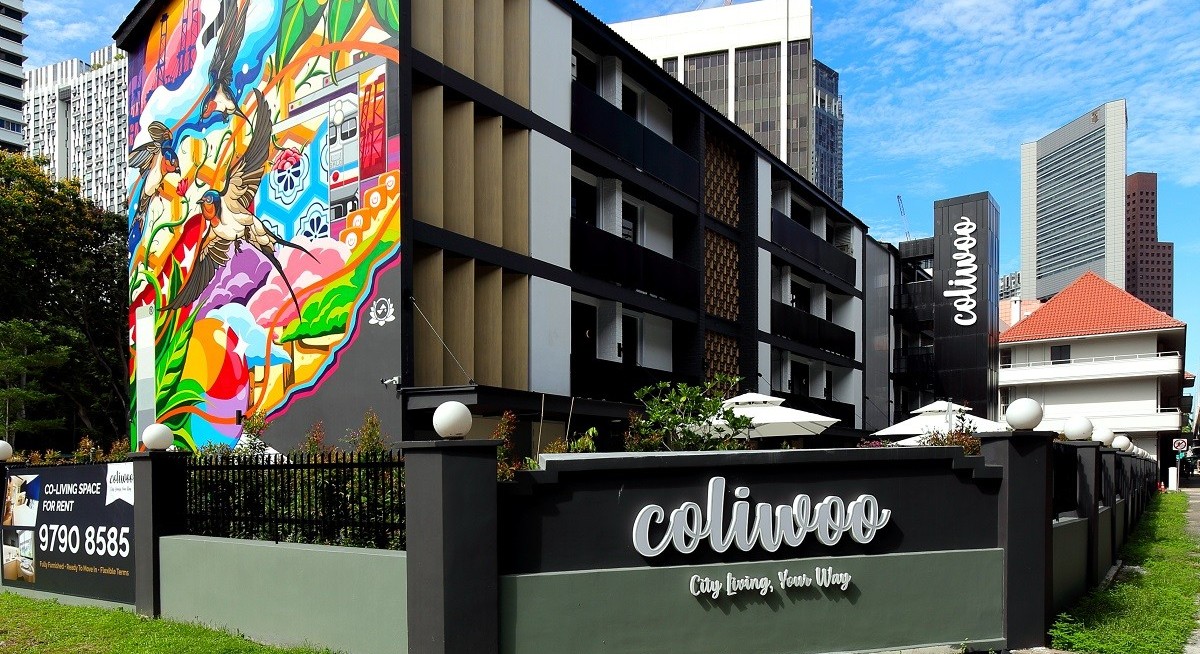


In a series of initiation reports, analysts from Maybank Securities, Tickrs, CGS International and RHB Bank Singapore have all rated this stock a “buy” or “add”.
Coliwoo is one of the largest co-living players in Singapore, with about 2,933 rooms across 25 strategic locations, including 714 rooms under renovation and not yet operational. In the coming two to three years, Coliwoo aims to add at least 800 rooms annually to its portfolio.
According to Maybank’s Eric Ong, Singapore’s safe-haven status as a regional business, medical, and educational hub makes co-living a preferred option for many young professionals and students, given flexible lease terms and unique value propositions.
Coliwoo currently holds a 19.5% share of Singapore’s co-living market, measured by room count. As at Sept 30, 2025, Coliwoo achieved a 96.1% occupancy rate across all operational properties in its portfolio.
See also: With no ‘sell in May’, SGX enjoys higher target prices on ‘strong’ May
To complement its organic expansion, Coliwoo is actively exploring capital-recycling strategies, including the recent sale-and-leaseback of its Pasir Panjang co-living hotel for $43.9 million. Ong sees this as more “positive” as it continues to retain its operational rights. “Overall, we believe this is part of the group’s strategy to go more asset light, improve ROE [return on equity], thus leading to potentially higher dividend payout than its guided 40% of core profits,” he adds.
Meanwhile, Tickrs analyst Jaimes Chao, noting that the post-IPO performance has been muted, sees a buying opportunity. He attributes the lukewarm post-listing market reception to broader sector rotation away from yield-sensitive real estate plays and to a misunderstanding of Coliwoo’s earnings quality, which is distorted by a series of non-cash fair value adjustments on its investment properties.
“When stripping out these accounting noises, Coliwoo’s core profitability reveals a business with significant pricing power, high occupancy (>95%), and expanding margins,” he says.
See also: DBS lays out case for DFI Retail to move ahead with Hong Kong supermarket consolidation
Chaos’s view is that investors are seemingly paying for a stagnant property play but receiving a high-growth hospitality platform. The disconnect lies in the market’s failure to fully price in the 36% capacity expansion scheduled over the next 12–18 months and the embedded operating leverage as the portfolio scales.
The market currently values Coliwoo at roughly 11.6 times FY2025E core P/E. In Chao’s view, the multiple fails to capture the company’s aggressive growth trajectory — with core patmi expected to grow 62.9% y-o-y in FY2025 — and its strategic pivot toward a capital-efficient, asset-light expansion model.
Currently, the co-living market in Singapore is fragmented by rapidly consolidating, observes Chao. Estimates suggest 30–40 active operators, with the “Big Five” controlling over 65% of the inventory. Coliwoo leads this pack, followed by The Assembly Place, which recently filed its application to list on SGX, Cove, Lyf (CapitaLand) and Habyt.
According to Chao, Coliwoo’s competitive advantages include its ability to capture capital appreciation in its underlying real estate, control over renovation quality and the ability to survive lease cycles as the group’s owned portfolio provides a stable earnings floor that acts as a hedge against the rental cycle.
In their Jan 14 note, Tan Jie Hui and Lim Siew Khee of CGS International describe Singapore’s co-living sector as “in the midst of a structural upswing”, which Coliwoo is well positioned to capitalise on, due to its “scale, brand strength and proven execution record”. Their target price of 74 cents is underpinned by strong earnings visibility and growth prospects.
Vijay Natarajan of RHB Bank Singapore is even more bullish, with a target price of 82 cents, based on 15 times FY2026 earnings, a 15% discount to comparable companies across Asia Pacific.
He notes that Coliwoo has demonstrated its capital management capabilities by monetising two owned assets through sale-and-leaseback transactions to date, and that further expansion will also come from leased sites and management contracts, rather than solely through acquisitions. It may also secure another niche through its recent partnership with the Ministry of Health to provide accommodation for healthcare workers.




