


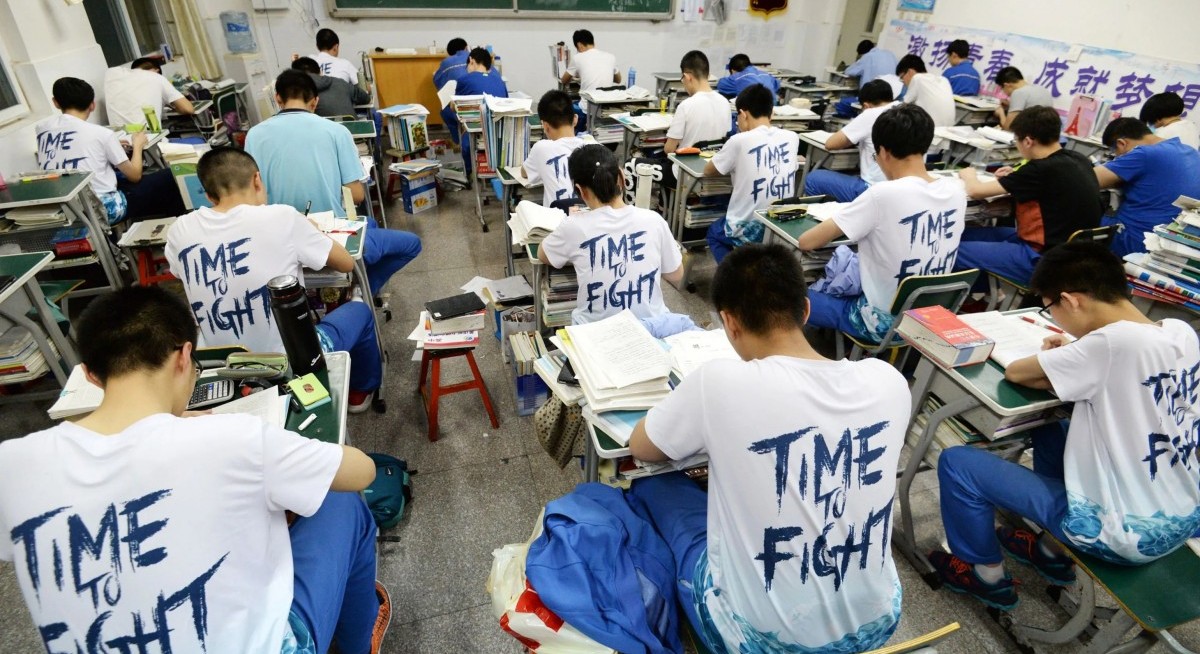


Continuing the long Imperial tradition, 12.9 million students sat the gaokao (高考) or national college entrance examination. This is a standardised, highly competitive annual test that determines university admissions and shapes a student’s academic future in Mainland China.
Unlike the ancient Imperial exams centred on Confucian thought, these exams include modern subjects such as physics, maths and chemistry, in addition to history and a foreign language.
Like the Imperial exams, these were open to everyone and offered an equal-opportunity path for students, regardless of their background.
Merit should determine destiny. Not birth. This was always the theory, but the reality was different. The “cold gate children of the family” (寒门子弟) were at a disadvantage compared with their richer fellow students, but the concept provided hope for advancement.
See also: Trading tycoon ‘Brother Leaf’ humbled by China's crackdown on offshore trade
The term “cold gate” comes from the idiom “studying by a cold window”, which captures the classic image of a poor student with no resources, grinding away alone. Originally, it referred to families of low social rank in imperial China, as opposed to powerful clans with political connections.
Today, it describes anyone who is successful despite starting with nothing and today the phrase appears frequently in discussions of education, class, and social mobility.
In America, the myth of the journey from log cabin to the presidency played the same role in society. In China and in countries with Chinese heritage, education paves the way to success.
See also: Alibaba, JD.com lead China selloff after latest Beijing warning
Equal access and social obligation are not theoretical concepts. They are embedded in policy and in the way business is conducted.
In 2021, the after-school tutoring industry was destroyed overnight by government regulation. In the competitive environment of the gaokao, advantages accrued to those who could afford after-school tuition. These tuition providers grew large and prosperous and some were listed on the stock exchange.
The industry was killed in a single regulatory blow, a move that made little sense to Western observers. A few understood that the move was designed to level the playing field so that the poor scholar could compete with those who came from more prosperous backgrounds. Most foreign observers cited this as an example of socialism at work. In reality, it was a return to the foundations of the Imperial exams, which were open to all.
In broad terms, China injects a sense of social responsibility into business. The larger a business becomes, the greater the sense of social obligation.
We do not want to romanticise this behaviour. Still, when doing business in China, we need to recognise that it is a business driver that, at times, is just as important as the need for commercial success. Bringing a community contribution to the negotiating table can be the tipping point in discussions.
Amidst the cut and thrust and hard-scrabble of business, the nation falls silent so as not to disturb the students concentrating on the gaokao exams. It’s a social obligation that reminds foreigners doing business in China that there are broader themes at play that go beyond profit and loss.

For more stories about where money flows, click here for Capital Section
Technical outlook of the Shanghai market
The Shanghai Index is struggling to arrest the fall in the new downtrend. The index has rebounded from the low at 3,928, but it is moving towards well-established resistance near 4,025.
The 4,025 level failed as support when the market fell, diminishing its effectiveness as resistance. However, historically, this level has been significant in capping trend moves.
The next strongest support level is near 3,900. The market has already fallen to 3,925, which is just above the historical support level. The weakness in the rebound suggests that the index may soon retest 3,900 as the downtrend continues.
The Guppy Multiple Moving Average (GMMA) relationships capture the changing trend pressure. The long-term average group indicates investors’ behaviour. Wide separation shows investor support for the trend and a willingness to enter the market when it retreats.
The degree of separation in this group has narrowed and is moving down. Further downside expansion shows that investors are sellers, which will accelerate the downtrend.
The short-term GMMA group average indicates how traders are thinking. They are always more excitable than investors, constantly testing for weakness and taking short-term profits.
The short-term GMMA has moved completely below the lower edge of the long-term GMMA. This is generally taken as confirmation of a full change in trend direction. The short-term GMMA has also expanded rapidly, again confirming the strength of the downtrend.
Traders will watch the development of the Relative Strength Index (RSI) indicator. Often, trend changes in the Shanghai index are foreshadowed by an RSI divergence pattern. This has not occurred with this change to a downtrend, but it may develop with a future change to an uptrend.
Daryl Guppy is an international financial technical analysis expert. He has provided weekly Shanghai Index analysis for mainland Chinese media for two decades. Guppy appears regularly on CNBC Asia and is known as “The Chart Man”. He is a former national board member of the Australia China Business Council.




