


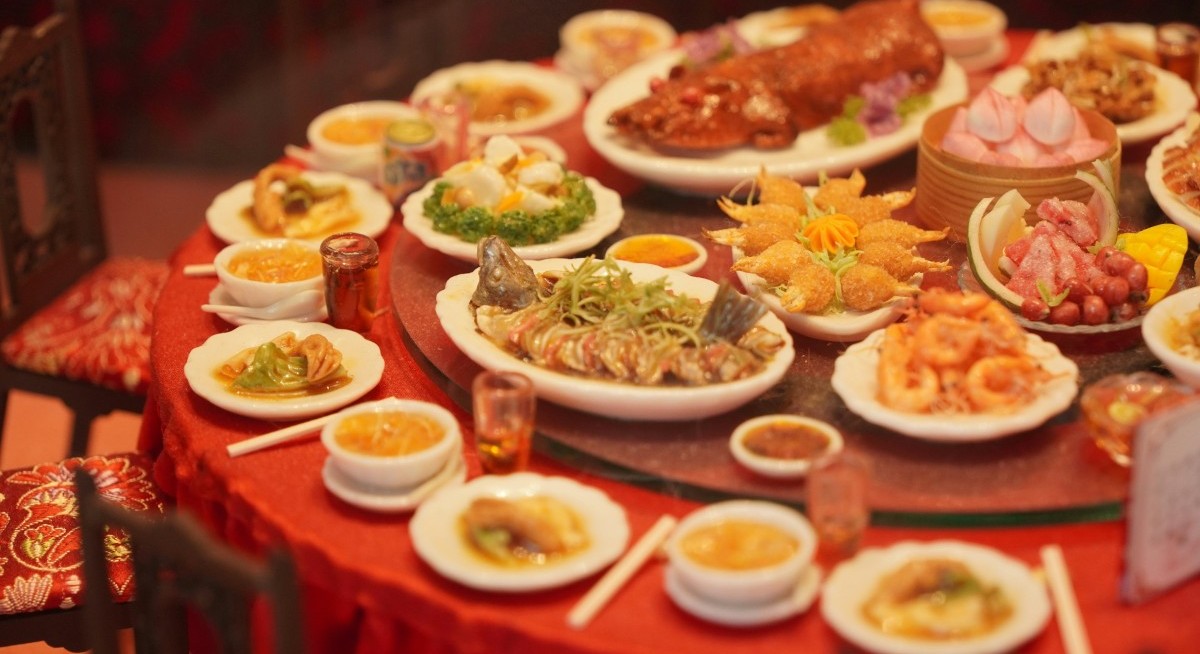


Trump was honoured with a Northern China state banquet and the menu reflected these preferences, which differ from those in Southern China. Knowing what to expect helps one survive any official banquet.
The extensive menu is for grazing. A small sample is taken from each dish, so that in total, they constitute a meal. Unlike a Western banquet, the entire meal is not served on a single plate containing both meat and vegetables. Each is served separately so the flavours and textures can be appreciated.
For very large dining tables, the central lazy Susan loaded with dishes is used. Wait staff will place a series of small dishes in front of each guest.
Each setting had two wine glasses. In a formal setting, the red wine glass is for toasting, not quaffing. Correct etiquette in Northern China requires that you toast with someone before drinking. This may be a friendly toast rather than an official toast. Drinking alone without toasting is a sign of lesser table manners. It also quickly distinguishes those from Southern China and Hong Kong as they drink alone without toasting.
See also: China’s reflation shows signs of peaking as Iran war shock fades
For Westerners, it is often particularly disconcerting when the host selects an item from a dish and places it on your plate. This is the host’s prerogative and the guest does not need to reciprocate.
The seating order at any table has a rigorous architecture of status. Guests should either find their named seat or wait to be directed. Swapping name tents to change seating preferences is an act of ignorance that will not enhance your chances of business success. If you are not seated next to people you consider important to your business, the seating order is delivering a subtle message about your chances of success.
There is a Chinese saying, “No meal is complete without rice.” The saying has two interpretations. In Southern China, it means every meal includes rice as an accompaniment and an integral part of the meal. Rice is typically served at the start of a meal.
See also: China auto sales drop even as exports help cushion slump
In Northern China, the saying has a different meaning. Here, it means a meal is completed, or ends when the rice is served. Northern cuisine is more cereal-based, consisting of wheat and noodles rather than rice. Often, the final course of a meal is noodles or rice served as a final filler.
Rice or noodles are the staple food element on the menu. It is a face-saving course that allows guests to fill up if the preceding courses have not been sufficient. Accordingly, it is polite to leave a bowl of staple food unfinished to signal that the host has provided sufficient food.
Rice remains a staple, but its position in the culinary order is a variable dependent upon where you find yourself in China. Its presence or absence at a meal is a gentle reminder that our ideas need constant reassessment when it comes to working with China.
A final note. Several weeks ago, I noted that in China, there is always a side door to get around problems. We saw this in operation this week. US Secretary of State Marco Rubio has been under sanctions by China since 2025, yet he was part of Trump’s delegation to China.
He has not been removed from the sanctions list, which would be a loss of face for China. Instead, the Chinese translation of his name was changed, so there was no barrier to his entering China. It is an elegant side-door solution to a problem.

Technical outlook of the Shanghai market
The Shanghai Index dropped below the uptrend line and tested support near the upper edge of the long-term group of averages in the Guppy Multiple Moving Average (GMMA) indicator.
For more stories about where money flows, click here for Capital Section
This is also just above the historical support level near 4,100. The retreat and rebound remain part of a longer-term bullish uptrend, with an upside target near 4,300.
Traders will watch for the uptrend line to act as new resistance as the index approaches 4,300. A very bullish resumption of the uptrend will move above the uptrend line and use it as support.
The 4,300 target level is calculated by projecting the width of the trading band above the historical support-and-resistance level near 4,100. This level has been a powerful feature, as the index previously spent many months oscillating around it.
This is a pause in a classic GMMA breakout with a retreat towards the long-term GMMA. The rebound from the upper edges of the long-term GMMA shows that investors returned to the market to buy on the temporary dip.
This continuity is evident in the long-term GMMA, which did not compress in response to the pullback. The continued expansion shows that investors remain confident about the uptrend.
Despite the pullback, the short-term group of averages maintained a steady degree of separation. This shows steady optimism from traders. Proof of long-term trend support from investors came as the long-term GMMA expanded. This behaviour indicated that investors become strong buyers.
The index’s retreat to the upper edge of the long-term GMMA remains consistent with a continuation of this uptrend.
Daryl Guppy is an international financial technical analysis expert. He has provided weekly Shanghai Index analysis for mainland Chinese media for two decades. Guppy appears regularly on CNBC Asia and is known as “The Chart Man”. He is a former national board member of the Australia China Business Council.




