


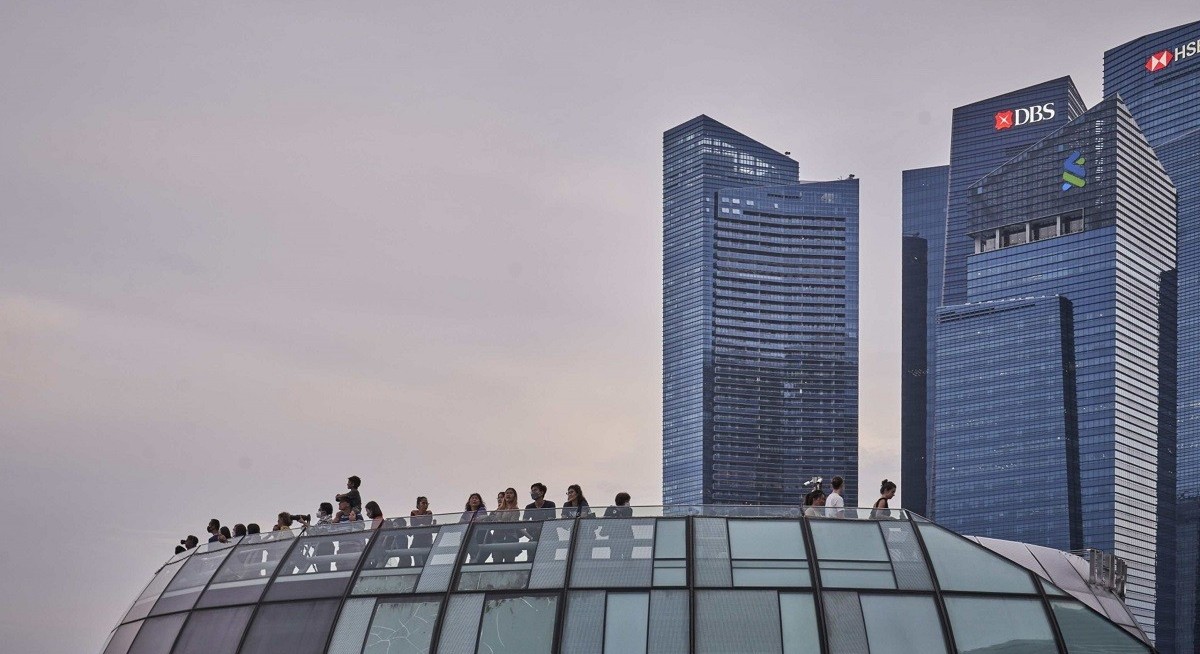


Fortunately, the economy’s strong performance this year gives us momentum as we enter 2026. That makes the short-term challenge, therefore, manageable. The key focus is the long-term policy changes Singapore must make to respond to a world that is structurally less supportive of a small, open economy like Singapore’s.
Singapore starts off 2026 on a good base, but things could get difficult later in the new year
As we look ahead to the next year, the lead indicators are mixed, signalling that this year’s unusual strength is not likely to be repeated:
The official composite leading index (CLI) rose by 3.1% in 3Q2025, after falling 0.5% in 2Q2025.
See also: Mild Singapore inflation points to policy hold, economists say
Fixed asset investments in manufacturing were running at a tad lower level in the first three quarters of this year compared to last year.
Construction demand in terms of contracts awarded fell by 35.9% y-o-y in 3Q2025, a reversal from the 11.4% increase in 2Q2025.
Businesses remain confident about future prospects. In the manufacturing sector, the net balance of views became increasingly positive as the year progressed. Similarly, a net weighted balance of 10% of service sector firms expected more favourable business for the period October 2025 to March 2026, an improvement over the previous two quarters.
See also: Singapore’s core inflation steady at 1.4% despite oil crunch
How the economy will perform depends on two key factors: whether the unusual factors driving strength in the global economy are sustained and whether vulnerabilities in the domestic economy could trigger or exacerbate an external shock.
Externally, a good start to 2026 can be expected, but it’s not clear if that can be maintained
Falling oil prices will reduce the burden of energy costs, acting as a significant tax rebate for the global economy. The coming year will also start well for the all-important US economy, with tax rebate cheques to be mailed to citizens soon, boosting consumer spending. Furthermore, the new accelerated depreciation rules will spur additional capital spending.
So, what could go wrong? One nagging question is whether the mind-boggling outlays of AI-related capital expenditures in the US and elsewhere can continue. Don’t forget that base effects mean sustaining our export growth would require this capital spending to accelerate further beyond its already elevated levels.
Technology consultants and AI-focused companies insist that capital spending will be sustained by anticipated revenue gains and cost savings, but expectations appear inflated. Surveys of firms show mixed responses, with many saying that the AI spending so far has yet to translate into strong, measurable returns that justify the expenditure.
Note also that more firms are resorting to debt financing to fund these investments, making them much more susceptible to earnings disappointments. Our baseline scenario is that overall US capital spending remains robust, but less will be spent on chips and other electronics Singapore exports, and more will be spent on other routine investments, reducing the “AI effect” on Singapore’s exports.
Singapore cannot escape the overall impact of the global economy
Sink your teeth into in-depth insights from our contributors, and dive into financial and economic trends
The critical question is when the dislocations caused by the Trump administration’s tariffs, immigration crackdowns, and cuts to critical government functions will hit the US and global economies. For example, many companies in the US are holding back on passing on cost increases to customers, delaying the impact until next year. The inefficiencies caused by tariffs will take time to percolate through the cost structure, while the labour supply challenges caused by outflows of immigrant workers will impact next year.
Moreover, trade uncertainty will keep businesses nervous. For example, if the US Supreme Court rules against Trump’s tariffs, the administration will have to resort to new trade measures, which could be even more inefficient. Uncertainty also stems from poorly worded trade deals that the administration forced on trading partners. Unsurprisingly, many of these are encountering difficulties. For instance, the UK’s technology deal with the US has been suspended amid disputes over the trade agreement. Similarly, the US and Indonesia have fallen out over the terms of their trade deal.
By next year, these adverse effects will work their way through the global economy and generate headwinds for Singapore’s heavily trade- and investment-reliant economy.
Most of Singapore’s exports are subject to the 10% baseline tariff rate, which is much lower than what its competitors face. While there is uncertainty over sectoral tariffs for the semiconductor and pharmaceutical sectors, available exemptions will limit the direct impact of tariffs on Singapore’s ability to export to the US.
However, Singapore’s exports remain exposed to second-order effects from tariffs. Singapore’s other trading partners face much higher tariffs and so could see depressed US import demand for such products. That could reduce their demand for Singapore-made inputs used in their manufacture.
Some domestic weaknesses are beginning to be evident
Even as Singapore’s economy prospered in 2025, some warning signs began to emerge:
Labour market weakening: A survey by the Singapore National Employers Federation found that 58% of Singapore employers planned to freeze headcount in 2026, up from 50% in 2024. A Channel NewsAsia feature summarising surveys found that 18% of Singapore firms reported eliminating roles or reducing headcount due to AI.
Sectoral difficulties have been reported, particularly in the retail and F&B sectors. Although new registrations still exceed closures in F&B, the sector appears to be undergoing a structural shakeout, with foreign firms expanding their presence visibly while local brands struggle. This trend is also emerging in the retail sector.
Challenging cost structure: Rising business costs in traditional sectors are well known but accepted as part of a more developed economy. However, we are now seeing Singapore suffering uncompetitive costs in high-tech areas as well. For example, Turner & Townsend’s 2025 Data Centre Construction Cost Report indicates that Singapore is the world’s second-most expensive market for data centre construction in 2025, with costs rising 5% over the same period last year. Regional competitors offer much lower costs, with Shanghai offering less than half the per-watt cost of Singapore.
These domestic vulnerabilities mean that an external shock, such as a major contraction in exports, could be amplified quickly.
The economic strategy is being updated
There are two major policy issues in Singapore. The first is managing near-term headwinds and the second is reinventing the Singapore economy to address a changing global economy.
In the short term, Singapore has the capacity to sustain growth even if the global economy weakens. Singapore is in the enviable position of having substantial space for monetary and fiscal policy actions to keep the economic engine humming. Low inflation gives the Monetary Authority of Singapore comfortable room to ease monetary conditions to help the local economy. Similarly, one reason the economy held up so well this year was the various government schemes that supported the household sector.
The bigger policy challenge is to address the structural degradation of world trade. Long-term strategies are still evolving, but three themes of the revised economic model are emerging: greater diversification, extracting more value from limited land and labour resources, and leveraging opportunities further off Singapore’s regional hinterland.
Diversification into green and digital economies, plus more trade deals
Singapore has been placing new bets in the green and digital sectors to move beyond the semiconductors and pharmaceuticals that have long dominated manufacturing.
The government has targeted the buildout of more than 2GWp of renewable capacity by 2030. Large investments from companies such as TotalEnergies, Keppel and EDP Renewables have been complemented by a domestic push for greener energy and appliances through grants.
Similarly, the government has allocated $3 billion to the National Productivity Fund for high-value investments in AI and quantum computing, and $150 million to the Enterprise Compute Initiative to accelerate AI adoption. In addition, the government has sought to position Singapore as a green finance hub through initiatives such as Climate Impact X, a carbon exchange that enables companies to access high-quality carbon credits.
Singapore is also pursuing more bilateral and multilateral economic partnerships to diversify beyond its reliance on the US economy. Examples include cofounding the Future of Investment and Trade Partnership (FIT) in September, as well as signing a Green Economy Partnership Agreement with Chile and New Zealand.
These diversified trade partnerships help to create buffers against the ongoing trade tensions between China and the US, providing alternative channels to keep international trade flowing through Singapore.
Strengthening links with the regional hinterland
Singapore is also seeking more synergies from integration with its immediate hinterland. For example, the Johor–Singapore Special Economic Zone (JS-SEZ) fuses Singapore’s higher-value functions with Johor’s larger land and labour pool. Some examples show how the JS-SEZ offers scope for mutually beneficial synergies:
Paris Baguette established a halal manufacturing plant in Johor while maintaining its regional headquarters and innovation centre in Singapore.
Agrocorp International’s joint venture with Megmilk Snow Brand is developing a protein-extraction facility in Johor, using technology developed in Singapore by the Singapore Institute of Technology.
There is some discussion of including Indonesia’s Riau Islands province in the JS-SEZ arrangement, which would significantly expand these synergies.
Complementing this, the energy deal with Sarawak and similar power-import projects aim to diversify Singapore’s fuel mix and boost energy resilience.
Extracting more value from limited land and labour resources
Domestically, the state is finding ways to make better use of scarce resources to support a broader economic base. The closure of Paya Lebar military airbase will free up about 800ha of valuable land for economic use. Similarly, relocating port activities from the central district will enable the redevelopment of the Southern Waterfront, releasing significant tracts of prime land over the next two decades for housing, logistics, advanced manufacturing and producer services clusters.
Expect more revelations on economic strategy as the year unfolds
Diversifying, increasing links to the hinterland and making more intensive use of existing resources are sound approaches. However, a comprehensive strategy to ensure Singapore’s future will need to address other areas.
The most compelling area is the need to boost innovation and ensure it translates into more Singapore-owned business success stories. Singapore has vigorously mobilised inputs for innovation, but the innovation outcomes have not yet matched those inputs. We need to learn how medium-sized economies such as Taiwan and Sweden succeeded in this area.
Another area where policy attention seems to be focused is on how to manage our massive national savings more profitably. It has been reported that Temasek is being restructured with this in mind, but nothing has been said about GIC, which manages the vast bulk of Singapore’s massive savings. GIC has performed well given the risk parameters set by its board.
The time may have come to reconsider how GIC is structured: Is having a single institution manage so much of our savings optimal? Is its governance structure, in which political leaders who are not investment professionals set key investment parameters, really the best way forward? These are important questions, as even a small improvement in annual returns will translate into significant increases in fiscal revenues, enabling Singapore to do much more to fund the growing demands of an ageing society and to finance the reinvention of our economy.
Overall, the coming year will be eventful, but there is good reason to believe Singapore will emerge from it in good shape.
Manu Bhaskaran is the CEO of Centennial Asia Advisors




