


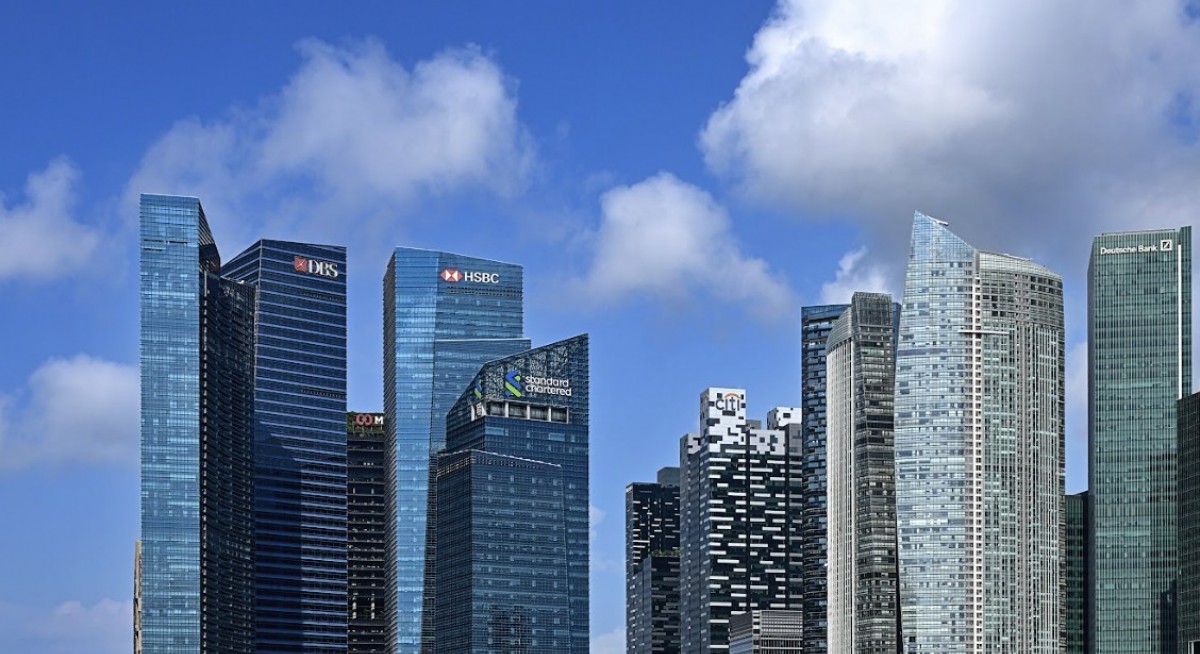


What does Temasek own in India? Top of mind are the subsidiary and branch networks of two banks, DBS India and Standard Chartered Bank (StanChart), India, respectively. Temasek Holdings owns 17.82% of StanChart and 28.26% of DBS Group Holdings.
StanChart, known for its series of marathons across its markets in Asia, is a colonial-era bank that has a limited presence in its home market, the UK; 90% of StanChart’s profits are from Asia. StanChart is also a global systemically important bank (G-SIB).
Of StanChart’s 1H2025 US$10.9 billion ($14.12 billion) income, Hong Kong accounted for 25%, Singapore 15%, UK 8%, India 7%, China and UAE 6% each, US and South Korea 5% each, and Taiwan 3%. The remaining 19% is contributed by “others”.

See also: HSBC, Standard Chartered weigh significant risk transfers as Asia-linked deals ramp up — Bloomberg
Piyush Gupta, who grew DBS from $2 billion in net profit to $11.4 billion
Passage to India?
In India, StanChart is the oldest and largest foreign/international bank. In 2010, StanChart listed its Indian Depository Receipts on the Bombay Stock Exchange (BSE) and National Stock Exchange (NSE) only to terminate them in 2020.
See also: UOB's wealth drive into Hong Kong to buoy revenue growth
The Indian economy has had a checkered history since British rule ended. However, the 21st century is turning out to be an Indian century of sorts. Digitalisation along with the addhaar card (a 12-digit unique identification number issued by the authorities) and Narendra Modi’s “Make In India” strategy have unleashed capital spending on transport, digital and other infrastructure, and attracted FDIs. Unlike China, India is viewed as having a potential demographic dividend, with an aspiring young and growing middle class.
In 2005, the India-Singapore Comprehensive Economic Cooperation Agreement (CECA) was signed. This allowed Singapore banks to expand their branches in India from a couple of representative offices. Only DBS took advantage of CECA. In fact, DBS’s digital bank, digibank, was first launched in India in 2016 before moving to Indonesia. It was subsequently turned into a phygital bank.
DBS raised its presence in India with the “amalgamation” of the troubled Lakshmi Vilas Bank (first announced in November 2020) with the blessing of the Reserve Bank of India. Although the amalgamation resulted in write-offs, write-downs and capital infusion, it gave DBS more than 500 branches, a current account savings account (Casa) base and new customers.
“Post the amalgamation of Lakshmi Vilas Bank, we now have a robust full-service platform spanning institutional, wealth and retail banking to more fully participate in India’s growth. Income grew 25%, led by large corporate banking, with SME and retail banking also seeing good traction,” says DBS in its FY2024 annual report.
In briefings before he retired from DBS, Gupta indicated that acquisitions would be mainly “bolt-on” acquisitions. These have been the private banking business of Société Générale, the retail business on ANZ Bank, and more recently the retail business of Citigroup Taiwan.
Current DBS group CEO, Tan Su Shan, said in the bank’s 1QFY2025 briefing: “M&A decisions are long-term in nature. We remain focused on being an Asian bank that is future-forward, digitally enabled, and transformative. We will continue to evaluate opportunities that align with our strategy, are appropriately priced, and where we have the capacity to onboard and integrate the target.”
Would DBS be interested in StanChart India? There’s also the wealth hub of Dubai. As is evident in their results briefings, both StanChart and DBS are after assets under management (AUM) and fee income from wealth management. In 3QFY2025, StanChart’s fastest y-o-y growth in underlying profit before tax was from Dubai. (The UK business reported a turnaround from loss to profit.)
Sink your teeth into in-depth insights from our contributors, and dive into financial and economic trends
According to a Jefferies report dated Nov 28, “the UAE, and Dubai in particular, has now achieved escape velocity in terms of moving from a regional hub to a global hub for the digitally enabled mobile wealthy.”
The two key catalysts for Dubai being on the wealth map were the pandemic and Russia. During and after the pandemic, Dubai turned out to be much more open and less restrictive than Hong Kong and Singapore. Secondly, the invasion of Ukraine by Russia triggered a surge in Russian residents into Dubai as they fled sanctions imposed elsewhere.
“Dubai’s population has grown from 2.47 million to 4.25 million since 2014 while the number of millionaires in Dubai has risen by 102% over the past ten years to 81,200 in 2024, according to the World’s Wealthiest Cities Report by Henley & Partners,” Jefferies says.
What the figures say
An acquisition makes sense if the target or the merged entity is able to grow at a faster clip than the acquirer can on its own. For DBS, this would mean that the target would need a higher return on tangible equity (ROTE) than DBS’s 18.8% based on its 9M2025 figure (year to end-September). StanChart announced an ROTE 13.6% for 3QFY2025 up 260 basis points (bps) y-o-y, and its ROTE of 13% is likely to be attained this year instead of 2026. DBS’s 3Q2025 ROTE was 18.9% down 180 bps y-o-y.
StanChart’s NAV as at end-September is US$16.84. It last traded at around HK$174.80 ($29.10), or 1.3 times book. DBS is trading at around 2.3 times book. DBS’s FY2024 net profit was $11.4 billion; StanChart’s was US$4.27 billion.
Although DBS’s dividend yield is around 5.5% depending on its share price, StanChart’s is less than 2%. However, DBS’s weighted average cost of capital (WACC), based on Bloomberg’s calculations, is upwards of 12% while StanChart’s is 7.3%.
On the face of it, there isn’t much point in DBS buying into StanChart Singapore, where the latter owns 60% of Trust Bank, a fully digital bank. Fast-growing Dubai and India are both smaller contributors to StanChart’s earnings than Hong Kong. And, although StanChart is more than Hong Kong, Hong Kong is still its largest market.
The Jefferies’ Nov 28 report highlighted the continued challenges of Hong Kong commercial real estate (CRE). In reference to HSBC’s Oct 9 offer to privatise Hang Seng Bank, Jefferies said: “Burying problems in a larger entity is said to be the key motivation behind HSBC’s recent decision to privatise its 63.5% owned subsidiary Hang Seng Bank. HSBC also warned in its earnings statement in late October that the city’s commercial property sector continues to face “downward pressure.”
A recent Morgan Stanley report said StanChart’s Hong Kong CRE exposure is HK$1.8 billion of which 53% are still in stage 1 (expected credit loss stage 1), and Hong Kong CRE remains challenging. Lorraine Tan, equity analyst at Morningstar, noted in a results update that StanChart increased the overlay for its Hong Kong commercial retail estate exposure by US$25 million.
Would a DBS shareholder be happy to support the acquisition of StanChart? Never say never, but at this point, the answer is probably “no”. DBS’s share price would fall and dividends could be cut because DBS has an alternate use of capital. DBS’s fully-loaded CET1 is above 15% while StanChart’s is 14.2% as of end-September.
The cost to DBS’s shareholders would be high. DBS has a higher WACC than StanChart’s. The orthodoxy requires the acquirer’s WACC to be lower than the target’s.
What could be interesting is if an activist investor acquires a stake in StanChart and lobbies for the sale or spin-off of some of its businesses. For instance, in 2022, Ping An Asset Management, a wholly-owned unit of Ping An Insurance, suggested spinning off HSBC’s Asian business to unlock substantial value for shareholders.
In such a scenario, Dubai and India would be attractive as bolt-on acquisitions. The second, third and fourth largest shareholders of StanChart, according to Bloomberg, are Capital Group, Blackrock and Vanguard.




