


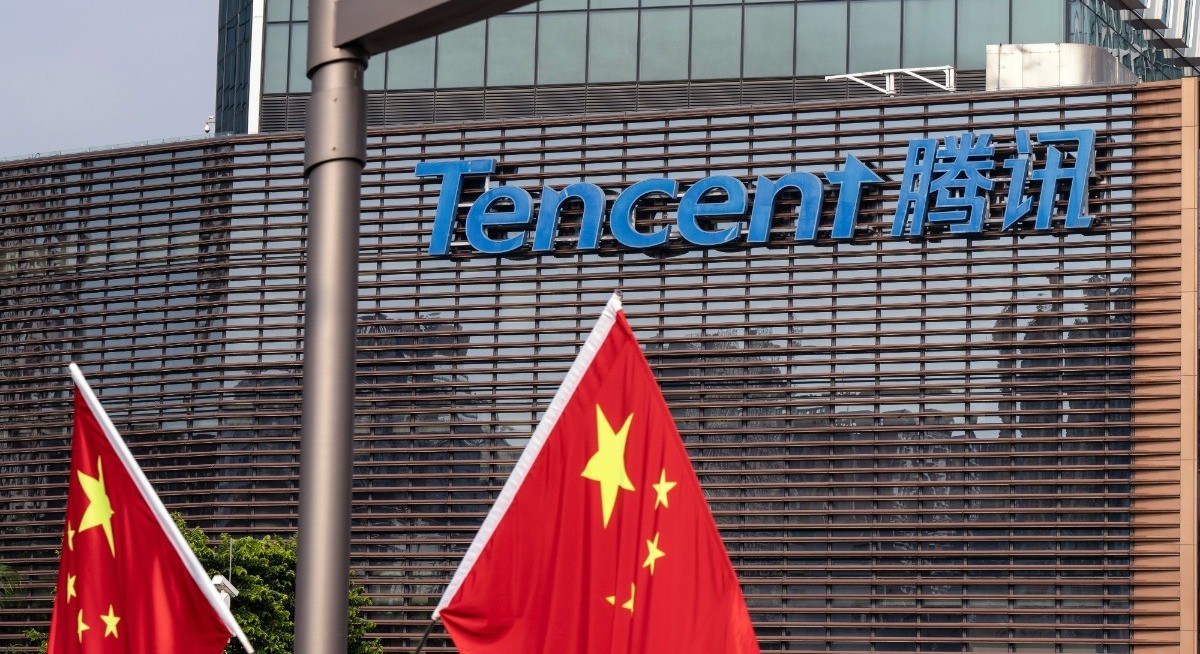


(May 13): Tencent Holdings Ltd reported its slowest revenue growth in six quarters, underscoring the urgency around its costly AI pivot while core businesses like games and advertising show signs of age.
Sales for the three months ended March climbed 9% to 196.5 billion yuan (US$28.9 billion or $36.82 billion), after the WeChat operator garnered weaker domestic game sales, while net income rose to 58.1 billion yuan, in line with estimates. The underwhelming top-line figure was partially due to the later timing of this year’s Lunar New Year holiday, a traditional catalyst for online entertainment spending.
The lukewarm performance could exacerbate investor concerns about how exactly China’s most valuable company will monetize AI. While Tencent has vowed to at least double investments in the field to more than 36 billion yuan this year, it trails peers like ByteDance Ltd and Alibaba Group Holding Ltd in terms of both user adoption and advances in developing state-of-the-art large language models.
“Our core businesses continued to grow their engagement, revenue and profit, providing the cash flow to fund our AI investments, as well as use cases for future AI deployment,” Tencent said in its earnings release on Wednesday.
Mirroring their peers in Silicon Valley, Chinese big tech firms are confronting scepticism over the timeline for an AI payoff as ballooning infrastructure costs compress margins. Tencent’s outlay remains among the most conservative of the bunch: Alibaba has pledged a rolling target of more than US$50 billion ($63.63 billion) over three years. Taken together, Chinese corporate spending falls drastically short of the hyperscale budgets seen in the US — where the quartet of Amazon.com Inc, Alphabet Inc, Meta Platforms Inc and Microsoft Corp plans to deploy more than US$700 billion this year.
Tencent has shed roughly US$160 billion — or 23% — of its market value this year, far exceeding the slide by Alibaba, which reports earnings on the same day. Investors in both Chinese internet icons have recently shifted their focus toward pure-play AI model creators like Zhipu and MiniMax Group Inc, whose valuations have multiplied since their stellar market debuts in January.
See also: SoftBank profit jumps, emboldens Masayoshi Son to bet more on OpenAI

The Shenzhen-based company last month revealed a major upgrade to its foundation model, Hunyuan, or HY — the first high-stakes test after it restructured its AI operations under the stewardship of OpenAI hire Yao Shunyu. The open source model still trails offerings from Moonshot and DeepSeek on key attributes like coding and linguistic nuance. Tencent also leverages DeepSeek to power its main ChatGPT-style chatbot, setting it apart from domestic internet peers.
“Tencent’s close partnership with DeepSeek offers an important fallback option should its proprietary HY LLM fail to reach the state-of-the-art tier,” Nomura analysts led by Jialong Shi wrote in a note before the results.
See also: Alibaba, Tencent AI bets face ‘show me the profits’ scrutiny
Outside AI, Tencent’s new game releases have met with a mixed reception while evergreen titles like Honor of Kings remain cash cows. The developer of Honor of Kings: World — a high-budget open-world title leveraging Tencent’s most popular franchise — recently apologised to players for a bad experience, citing “presumptuous assumptions” regarding the game’s direction.
Still, Tencent remains anchored by WeChat, the ubiquitous social clearinghouse that feeds its revenue streams from gaming to e-commerce. The company views the app as the natural launchpad for AI-powered agents designed to automate tasks like ride-hailing and travel bookings — though it has yet to provide a rollout schedule.
Uploaded by Chng Shear Lane




