


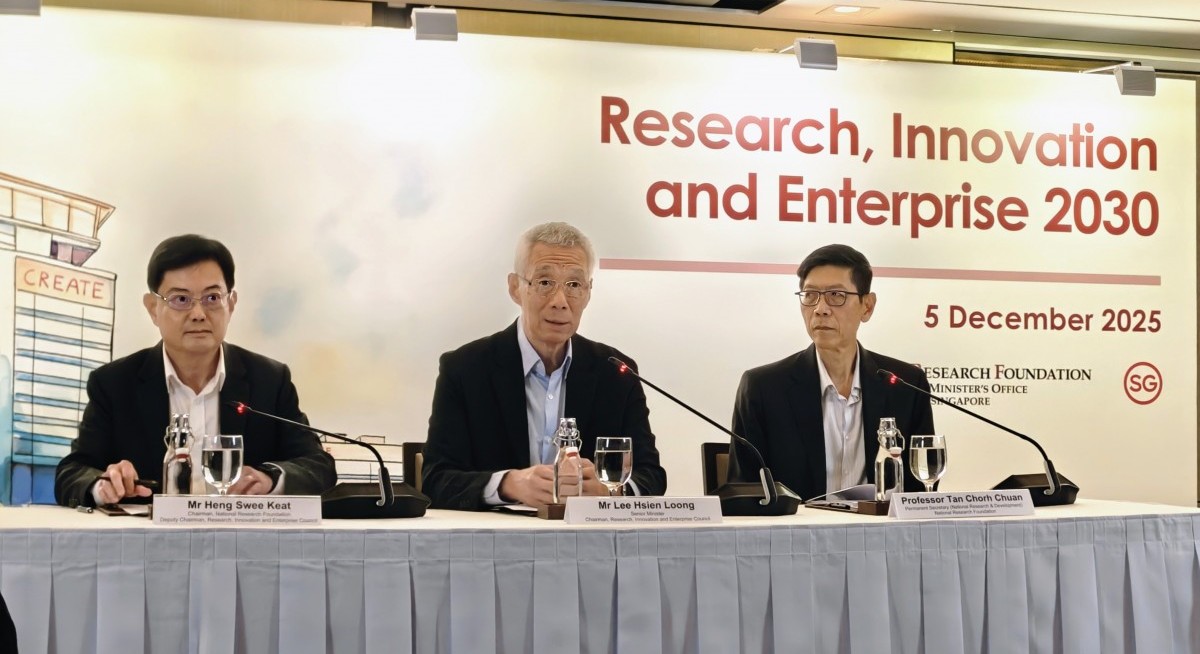


"The government believes in sustaining stable and consistent investments in RIE through thick and thin over the long term, and through RIE2030 we will be investing $37 billion over the next 5 years in R&D, which is about 1% of GDP, and that's a level we have been maintaining now for nearly 20 years," says Senior Minister Lee Hsien Loong during the launch of RIE2030 on Dec 5.
Lee, who was Singapore's prime minister from 2004 to 2024, chairs the Research, Innovation and Enterprise Council (RIEC). The RIEC comprises government ministers as well as research and business leaders in the field of science and technology. The council advises the government on Singapore's research and innovation efforts.
According to Singapore's National Research Foundation (NRF), MNCs continue to be the largest contributors to business expenditure on research and development (BERD). Singapore's BERD reached $8.1 billion in 2022, up from $4.2 billion in 2012.
Singapore ramps up national R&D budget by nearly a third
See also: Samsung shares reverse drop as executive touts HBM4 advantage
RIE2030 is about 32% higher than its predecessor, RIE2025, and will be apportioned across five areas. The largest segment, at $10.8 billion or 29% of the budget, will be used to support the initial investments made by RIE2025 across four domains: manufacturing, trade and connectivity, human health and potential, urban solutions and sustainability, smart nation and digital economy.
Out of the $10.8 billion, $3 billion will be used to support two new types of cross-cutting research and development programmes: RIE Flagships and RIE Grand Challenges. The former focuses on areas that can create economic value for Singapore, while the latter will address national priorities.
The government says it will be launching an RIE Flagship to grow Singapore’s semiconductor industry. The city-state currently produces 10% of the world’s chips and is responsible for 20% of global semiconductor equipment output
See also: Alphabet set to raise almost US$32 bil debt in intense AI race
"The Semiconductor Flagship’s goal is to make Singapore a strategically important R&D node in the industry, and it will anchor and expand high-value corporate research and manufacturing in Singapore, to support the growth of globally competitive local companies and deep tech startups," Lee says.
Singapore has secured more than $18 billion worth of semiconductor investments over the past two years. The NRF did not specify how much of the RIE2030 budget will go into semiconductor-related investments.
The government says it will also be embarking on an RIE Grand Challenge to maximise health and promoting successful longevity as people age. A second RIE Flagship and RIE Grand Challenge will be unveiled at a later date.
Singapore’s planned investments into the semiconductor industry come amid growing fears of a possible AI bubble. Chip giant Nvidia as well as Google’s parent company Alphabet have seen their stock prices go up by nearly 37% and 68% year to date respectively, as tech companies race against each other to gain a foothold in AI.
"I don't know whether there's an AI bubble. Some people say yes, some people say no. The thing with bubbles is that you only know afterwards that there was one, and sometimes even afterwards, you were not sure," Lee says.
"But whether there's an AI bubble or not, electronics is a very important part of our economy and a very important part of the world economy. You need electronics for all kinds of things, and we are a significant electronics player, producer of semiconductors, and I think that we need to upgrade that, and what we are doing will work towards," he adds.
The second largest segment of the RIE2030 budget, at $8.9 billion or 24% of it, will go toward foundational research, such as by strengthening the research capabilities of local universities and A*STAR research institutes.
The rest of the budget will be spent on nurturing and fostering talent ($3.5 billion; 10%), anchoring innovation activities and building deep-tech clusters ($7.5 billion; 20%), and on “white space” research to meet future needs and emerging opportunities ($6.4 billion; 17%).




