


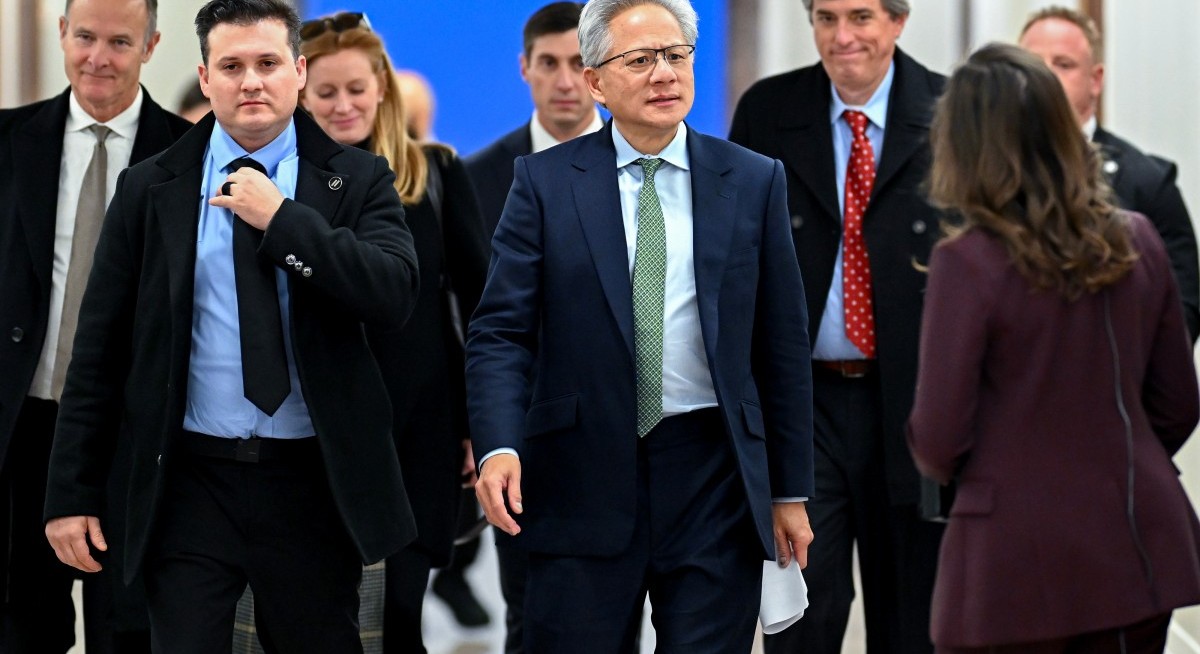


The SAFE Act emerged just a day after Nvidia chief executive officer Jensen Huang met behind closed doors with Republican members of the Senate Banking Committee, which has jurisdiction over export control programs. Huang also met privately Wednesday with President Donald Trump, and the Nvidia chief said they discussed export controls but declined to offer specifics.
Backed by a key Republican and Democrat on the Senate Foreign Relations Committee, the legislation would effectively bar Nvidia from selling its H200 AI chips or its even more advanced Blackwell-design products to customers in China. Republican Senator Pete Ricketts said the bill was crucial for maintaining the US edge over the world’s second-largest economy in artificial intelligence.
“The best AI chips are made by American companies. Denying Beijing access to these AI chips is essential to our national security,” Ricketts said in a statement. He was joined by Democratic Senator Chris Coons as one of the measure’s lead sponsors, along with Senator Tom Cotton, the Republican chairman of the Intelligence Committee.
The proposal marks a fresh challenge to Nvidia’s bid to persuade the Trump administration and Congress to relax export controls that keep the company from selling its market-leading AI chips in China. Its introduction came a day after the world’s most valuable company had secured a lobbying win by getting lawmakers to abandon efforts to pass a separate export control bill known as the GAIN AI Act.
See also: Nvidia-led boom set to turn chips into trillion-dollar industry
“As the President’s AI Action plan wisely recognises, nonmilitary businesses everywhere should be able to choose the American technology stack, promoting US jobs and promoting national security,” an Nvidia spokesperson said in response to the SAFE bill introduction.
The senators are acting as Trump and his advisers consider whether to allow Nvidia to sell its H200 chips to China, a move that would mark a significant shift from policies imposed starting in 2022 to keep Beijing and its military from accessing the most powerful US technologies. According to Georgetown University’s Center for Security and Emerging Technology, the H200’s total processing performance is nearly 10 times the limit for a data centre chip of its performance density under rules in place since 2023.
On Wednesday, Huang said he wasn’t sure whether China would accept the H200 should it win Trump administration approval. “We don’t know. We have no clue,” Huang said, as he entered a meeting with members of the Senate Banking Committee. “We can’t degrade chips that we sell to China, they won’t accept that.”
See also: TikTok hit by EU ultimatum over addictive design dangers
This summer, Nvidia won approval to sell its less-powerful H20 chip, designed to fall just below existing export limits, but China promptly told potential domestic customers to shun the product and rely instead on processors made by Chinese companies. More recent efforts by Nvidia to win US permission to export a hobbled version of its most advanced Blackwell-generation chip failed to materialise during an October meeting between Trump and Chinese President Xi Jinping.
The H200, which began shipping to customers last year, is designed to both train and run AI models. The prospect of selling a higher-caliber processor to China bolstered arguments by lawmakers from both parties who have pressed unsuccessfully for the GAIN AI Act’s adoption. The GAIN AI Act would have required chipmakers, including Nvidia and Advanced Micro Devices, to give US customers first dibs on their powerful AI chips before selling in China and other arms-embargoed countries.
Uploaded by Isabelle Francis




