


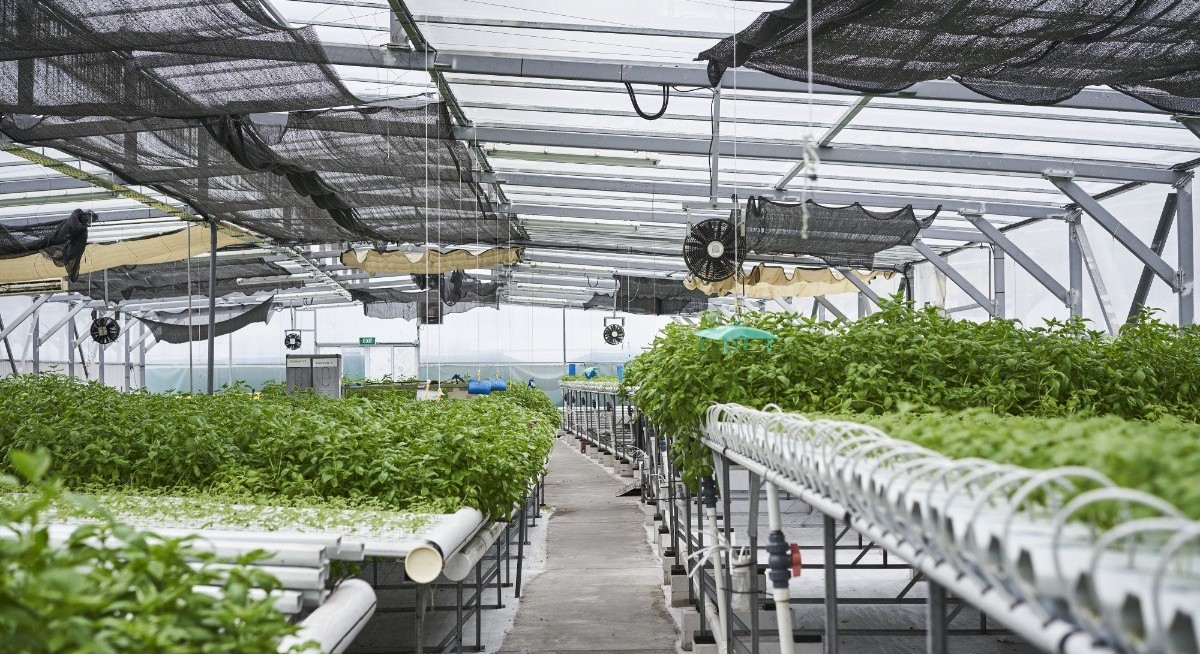


Wei is confident of securing farmers for the 200-acre site, promising they can “reduce their cost of setup and operations” there. Representing a joint venture between his agri-tech firm Archisen and Southern Catalyst backed by Malaysia’s Ministry of Finance, he aims to get them going by the third quarter of this year, offering 25-year land leases bundled with infrastructure and electricity.
“It’s an aggressive timeline,” Wei admitted, as earth diggers roamed the plot clearing it of palm trees. But wait any longer and some of those ventures may already be out of business, he said.
Singapore, a country smaller than New York City, has tried in recent years to reinvigorate its farming industry, which over decades has been crowded out by skyscrapers and housing blocks. Just this month, it opened the world’s tallest vertical farm valued at $80 million and set to produce up to 2,000 tons of vegetables like lettuce and spinach a year.

See also: New workgroup to draw growth capital into Singapore
Yet, a string of farm and start-up closures has underlined how high-tech agriculture is far from being a definitive solution for the island-state’s food security.
The fledgling sector has been buffeted by “headwinds — supply chain disruptions, inflationary pressures on energy and manpower costs, and a tougher financing environment”, Sustainability and Environment Minister Grace Fu said in November.
That’s forced the government to scale back an ambitious plan to meet a third of its population’s nutritional needs through local production by the end of this decade. Still keen to protect against disruptions like those seen during the Covid-19 pandemic and Russia-Ukraine war, the country’s new target is to meet 20% of fibre and 30% of protein needs locally by 2035.
See also: Singapore’s economy is on a roll, but for how long?
While Singapore has poured more than $300 million into agri-tech research and development, some farmers complain that does little to ease the cost pressures of actually running a farm. Grace Lim, a co-founder of vertical farm GroGrace, has been losing about $25,000 a month since her electricity bill doubled between 2019 and 2025. She called for the government to subsidise the sector, like in the European Union, which is expanding payments and simplifying financing for farmers.
“Why are they letting perfectly working commercial farms die while they continue to pour money into research that doesn’t actually grow your real food?” she said.

The mounting losses have also frightened off investors. Private funding for agriculture ventures in Singapore peaked at US$1.1 billion in 2021 but had dwindled to just a tenth of that by last year, according to venture capital firm AgFunder.
Wei believes the industry is in a “fundraising winter”, where start-ups are hard-pressed to find investors because they are unable to turn a profit.
Enter the Johor-Singapore Special Economic Zone (JS-SEZ) where Wei, his clients, and other firms are starting to shift or expand their operations.
Singapore-based Vegeponics, for instance, is expanding its container and vertical farms to the JS-SEZ. By having facilities in both countries, the vegetable grower expects to cut operational costs — which can reach $70,000 a month — by about a third, said marketing manager Jesper Fan.
To stay ahead of Singapore and the region’s corporate and economic trends, click here for Latest Section
The move will also be welcome for retailers and customers seeking price and supply stability. Singapore is one of the world’s most expensive countries where essentials like milk and eggs are flown in from as far away as Australia and Poland, resulting in eye-watering grocery bills.
But what would be a boost to farmers’ bottom lines may end up deepening the island-nation’s dependence on food imports. Singaporean growers who dream of building out their local industry to bolster the country’s food security will have to get used to growing their produce on foreign soil.
Wei said the agriculture hub in the JS-SEZ could nonetheless support closer cross-border cooperation and strengthen regional food resilience in Southeast Asia and further afield as Japanese, South Korean and Chinese farmers also show interest.
For Wei, what began as investor pitches and site walks around overgrown fields is gradually giving way to discussions on farm layouts and investment timelines.
“I think it is high time something like this is done,” he said. “If you don’t work with your neighbour, who do you work with?”
Uploaded by Tham Yek Lee




