


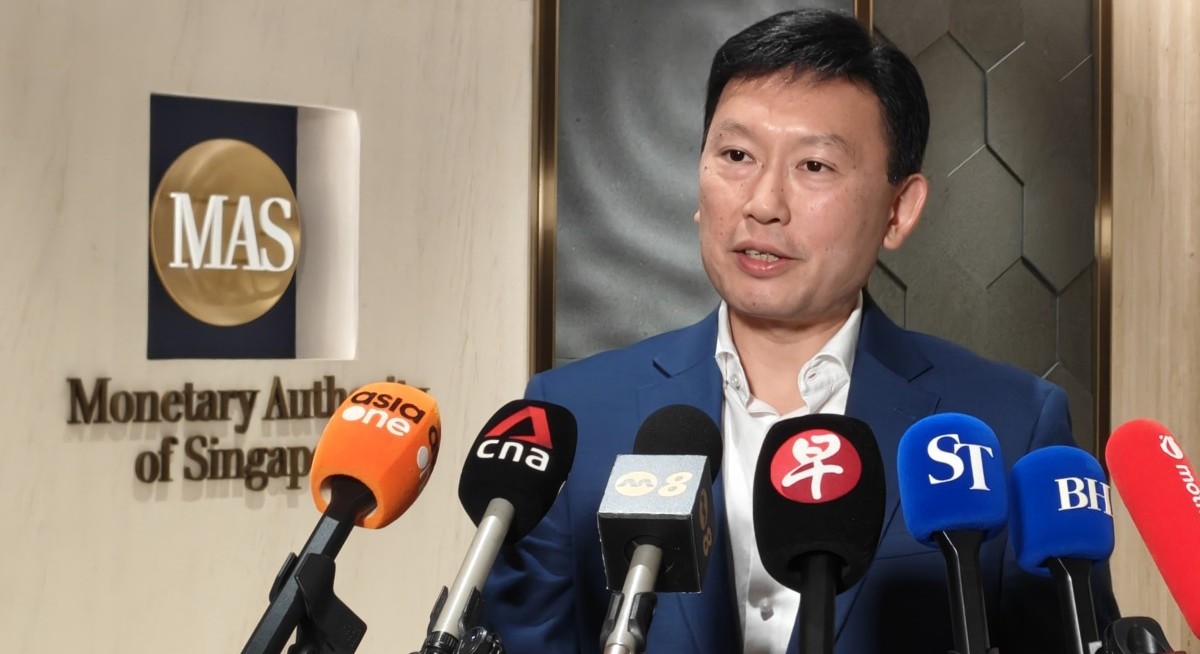


“We will convene a new workgroup led by Minister [for National Development] Chee Hong Tat, working closely with the industry, to develop strategies to position Singapore as a leading centre for growth capital,” said Wong on Feb 12. Chee is also the deputy chairman of the MAS.
According to the MAS and MTI, the work group will look at various aspects of the growth capital markets, including venture capital, private equity and private credit as well as securitised assets. In addition, it will examine the full value chain of financing from deal origination, capital raising and mobilisation to capital recycling.
“We see, on one hand, companies in Asia expanding, growing and they will need capital. On the other hand, we also see investors who want to diversify portfolios and see new opportunities in Asia and wanting to come into this region,” says Chee during a doorstop interview held at the MAS building on Feb 13.
“So I think the supply of capital and the demand for capital presents an opportunity for us as a trusted financial hub, to see how we can benefit from this growth,” he adds.
See also: Connecting genuine growth with employment
When asked about the timing of the workgroup’s establishment, Chee said that the work the government has done, via the Equities Market Review Group, has “helped to energise and bring about greater interest in our public markets." The group was set up by the MAS in August 2024 and its final report was published in November 2025.
“But now we need to also look at the entire value chain, see how we can support companies who are coming in at the earlier stages and who are growing in the earlier stages before they are ready for listing.”
He adds that the private markets are a “useful complement” to capital from banks and the public markets. With that, the group would be able to allow companies to “tap on venture capital, private capital, through private equity, private credit, and for some of them, securitised assets as well.”
See also: Singapore households face record power bills as war impact hits
The group, which comprises members from the private and public sector, is targeting to complete its review by end-2027 and will provide interim updates on its recommendations along the way.
Members of the group include: Andy Tai, head of Southeast Asia Investment Banking, Goldman Sachs; Bryan Yeo, group CIO, GIC; Chia Der Jiun, managing director, MAS; Dilhan Pillay, executive director and CEO of Temasek Holdings; Edwin Low, partner, global infrastructure partners at BlackRock; Jenny Lee, senior managing partner, Granite Asia; Jermaine Loy, managing director, EDB; Kevin Shum, deputy secretary (planning) at the Ministry of Finance (MOF); Lee Chuan Teck, Enterprise Singapore chairman; Keppel CEO Loh Chin Hua; AIA’s group CIO Mark Konyn; Neil Parekh, Asia Pacific vice chairman at Sumitomo Mitsui Banking Corporation and deputy chairman, Global Finance & Technology Network; Sanijv Misra, chairman of Clifford Capital Holdings; Shawn Huang, senior parliamentary secretary at MOF and the Ministry of Manpower (MOM); and DBS Group CEO Tan Su Shan.
On whether the government sees a gap between private funding and public listings, Chee replied in the affirmative, adding that the group will see how it can explore different options for companies at different stages of their growth.
“Some of them will be at a stage where they can benefit from venture capital, but some when, as they grow bigger, they can tap on more sources of funding, including from private markets, and eventually, for some of them, through the public markets. But this is something which we have to think about it as an ecosystem,” he says.
“If you do it well, different components of the ecosystem will reinforce one another, and that network effect will then enable us to be able to grow the range of services, the range of options for companies and for investors. That is what we hope to achieve,” he adds.
On Feb 12, Prime Minister Lawrence Wong said in his Budget 2026 speech that he will invest an additional $1 billion into the Startup SG Equity scheme.
Under the scheme, the government works with private investors and venture capital firms to invest in eligible startups. It was initially focused on companies seeking early-stage funding but will now be expanded to cover growth-stage companies as well.
To stay ahead of Singapore and the region’s corporate and economic trends, click here for Latest Section
“Globally, growth-stage capital has tightened,” says Wong. “As a result, many firms, especially in deep tech, find it harder to raise the larger and longer-term funding that is needed to scale. We will therefore do more to catalyse growth capital in Singapore.”
According to the National Research Foundation, deep tech startups in Singapore have raised at least US$1 billion ($1.26 billion) of venture capital funding annually in the past five years, or 20% of Singapore’s total venture capital investments. Over 500 venture capital firms and 4,500 tech startups are headquartered in the city-state.
Part of Singapore’s broader capital push
The formation of the new work group is part of a larger push by Wong to strengthen Singapore’s enterprise ecosystem under Budget 2026. Wong says the government will launch a second $1.5 billion tranche of the Anchor Fund. Set up in 2022, the Anchor Fund supports promising startups and encourages them to list in Singapore.
In addition, Wong says he will expand the Equity Market Development Programme (EQDP) fund to $6.5 billion, up from the original $5 billion.
First announced in 2025, the EQDP aims to raise investor interest and channel capital into Singapore’s equities via private asset managers. The EQDP is part of a wider range of measures recommended by the Equities Market Review Group to bolster the Singapore stock market.
Thus far, $3.95 billion has been placed with nine asset managers to invest in Singapore-listed stocks. The nine selected asset managers are: Avanda Investment Management, Fullerton Fund Management, JP Morgan Asset Management, Amova Asset Management (formerly Nikko Asset Management), AR Capital, BlackRock, Eastspring Investments, Lion Global Investors, and Manulife Investment Management. The MAS says the next batch of asset managers is expected to be announced in mid-2026.
Avanda Investment Management, Fullerton Fund Management and JP Morgan Asset Management were the first batch of asset managers to be selected under the EQDP. MAS announced their appointments in July 2025. All three asset managers have named their portfolio managers and launched their respective funds.
The remaining six asset managers were the second batch of asset managers to be selected. MAS announced their appointments in November 2025. Lion Global Investors has channeled their allocation under the EQDP into their existing LionGlobal Singapore Trust Fund. The other asset managers have yet to launch their funds.
The expansion of the EQDP fund comes amid a turning point for Singapore’s stock market which had been sluggish in the past few years. On Feb 12, Singapore’s flagship Straits Times Index (STI) passed the 5,000 mark for the first time when it opened at 5,003 points. The STI closed 0.65% higher at 5,017 points on Feb 12, after hitting an intra-day high of 5,021 points.




