


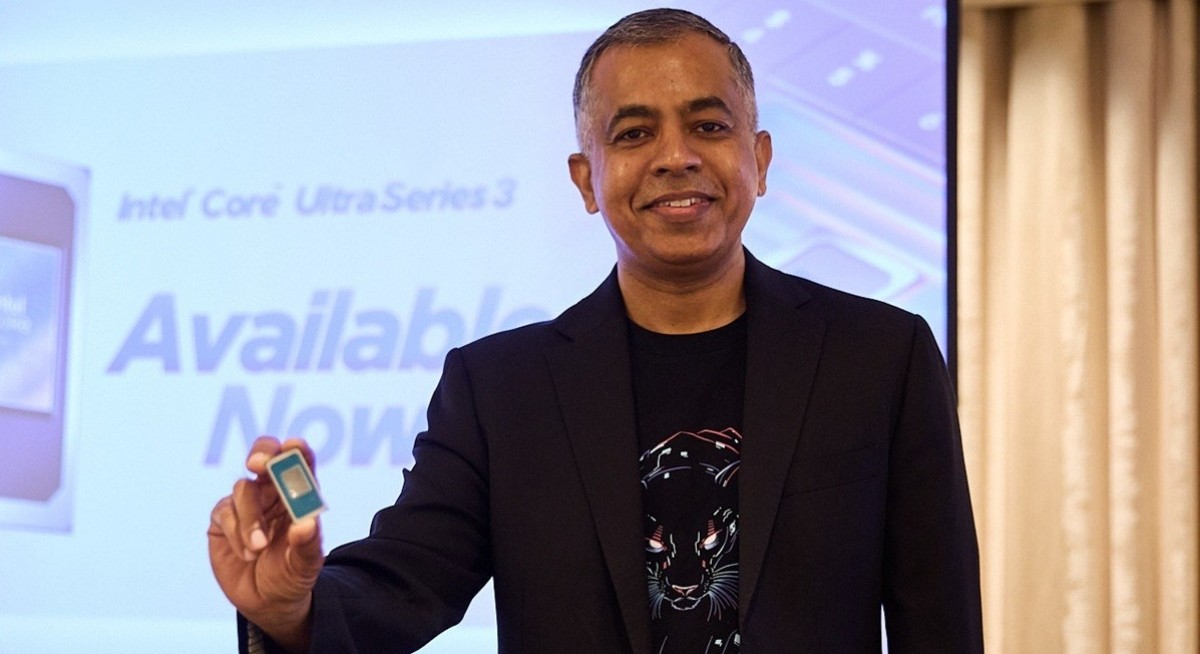


"This one is a really big step up," says George Chacko, general manager of Intel's sales group for south east Asia, Australia and New Zealand. "This is for the first time that our partners have been able to bring everything together in really new and exciting form factors."
Intel believes that this range of processors can also help address some reasons why AI adoption is not as widespread as it should be: right at the devices of the end users and not merely computing power drawn from the cloud.
Most users now tap Large Language Models (LLMs) through cloud-based interfaces that require an internet connection, which may result in privacy and confidentiality concerns sharing sensitive personal or corporate data with these services.
Intel says the Core Ultra Series 3 processors can run AI workloads such as a local LLM directly on the laptop rather than in the cloud, and deliver up to 1.9x higher large language model performance.
See also: Applied Materials taps on NUS and SIT for AI chipmaking push
By running these AI tasks locally, users can benefit from lower latency, reduced reliance on an Internet connection, and greater privacy by keeping sensitive data on their own device.
This “AI at the edge” capability is supported by a dedicated Neural Processing Unit (NPU) with up to 50 Trillions of Operations Per Second (TOPS), giving the laptop the specialised processing power needed to handle demanding AI tasks even without an internet connection.
"I know that there are some doubters on is AI really reaching the edge. We continue to believe that AI has to move to the edge. That's the only way it will scale. And there's nothing better defining the edge than a PC today," says Chacko.
See also: Applied Materials opens new US$500 mil facility in Singapore as AI chip demand rises
In addition, this range of processors, with their integral graphics processing muscle said to comparable to Nvidia's GeForce RTX 4050, will find traction with gamers too.
"When you enter a store, you have one area cordoned off for gaming PCs that are noticeably thick and heavy," says Chacko. In contrast, less power-hungry devices tend to be thinner and lighter. "You'll see those lines blurring with the Intel Core Ultra Series."




