




Then the cycle turned as Intel stumbled. Delays in advancing manufacturing nodes allowed Intel’s rivals, such as TSMC, to pull ahead, while execution missteps and intensifying competition eroded its long-held dominance in personal computers and data centres. Intel ended up on the back foot just as the semiconductor industry entered a new phase driven by AI and high-performance computing.
For AEM, the consequences were immediate. As its largest customer faltered, growth slowed, visibility weakened and investor confidence ebbed. From a high conviction growth story, AEM suddenly became a worry for investors, who dumped its shares as they figured the company was too closely tied to a single customer whose own trajectory had become unpredictable.
The turning point for AEM came only after the release of its 2025 results in February this year. Revenue rose for the first time since 2022, driven by a ramp-up in high-volume manufacturing linked to AI and high-performance computing demand.
More importantly, the quality of earnings improved. In 2025, AEM returned to positive free cash flow, rebuilt its balance sheet into a net cash position, and reinstated dividends at 1.3 cents per share, equivalent to about 24% of earnings — not far off from its minimum 25% payout pledge.
See also: Taiwan detains Super Micro workers in China chip smuggling probe
For this year, AEM is targeting revenue of $460 million to $510 million, up from its actual $399 million top line for 2025. Growth is expected to be driven by increased orders from key AI and high-performance computing customers, one of which is slated to become its new top revenue contributor in 2026.
Reducing customer concentration
Since the release of its 2025 results and 2026 revenue guidance on Feb 25, AEM’s share price has more than doubled. Its market cap is now back above $1 billion.
While the rally is welcome news for shareholders who endured AEM’s downturn in recent years, it also raises deeper questions. Is this simply a cyclical rebound tied to a recovery in semiconductor demand? Or is AEM undergoing a more fundamental shift?
See also: Applied Materials taps on NUS and SIT for AI chipmaking push
For much of the past decade, AEM’s fortunes rose and fell with Intel. That’s changing, and one of the most visible signs of this shift came last month.
AEM announced on March 21 a strategic partnership with Taiwan-based ASE Technology Holding, one of the world’s largest outsourced semiconductor assembly and test providers. The tie-up includes a $12 million equity investment by ASE, along with warrants, that could increase its stake in AEM meaningfully if certain performance targets are met.
The structure of the deal is telling. The warrants are linked to revenue targets tied to ASE, effectively aligning both parties around growth outcomes. This goes beyond a supplier relationship. It’s a strategic alignment built around scaling AEM’s technologies across ASE’s global manufacturing footprint.
ASE sits at a critical juncture in the semiconductor value chain, bridging chip design and mass production through advanced packaging and high-volume testing. Integration into ASE’s ecosystem allows AEM to reach a far broader customer base than it could on its own.
Elevating Intel ties
While concerns remain over its heavy reliance on Intel, AEM is seeking to take that relationship further. This is evident in its collaboration with Intel Foundry, a relatively new business unit that marks Intel’s shift from making chips mainly for itself to manufacturing for other companies.
The timing is notable. Intel is no longer deteriorating as rapidly as before. The chipmaker has embarked on an aggressive effort to regain competitiveness, investing heavily in advanced manufacturing, attempting to close the gap with TSMC, and repositioning itself in AI and foundry services. Intel’s turnaround remains a work in progress, but the trajectory has shifted from decline to stabilisation.
For AEM, that distinction is critical. It doesn’t need Intel to return to dominance. It only needs the situation to stop worsening.
Sink your teeth into in-depth insights from our contributors, and dive into financial and economic trends
Against this backdrop, its collaboration with Intel Foundry, announced in May last year, opens up AEM’s production-proven test infrastructure to fabless chip designers and other customers within the foundry’s network.
The benefits are clear. For customers, it provides access to a scalable, high-volume test environment without having to build it from scratch. This shortens time-to-market and lowers capital expenditure.
For AEM, Intel Foundry offers direct access to new customers, expands its addressable market and reduces the friction of customer acquisition.
All about AI
At the heart of AEM’s repositioning is a simple reality: AI is changing the nature of semiconductor demand. The shift isn’t just about more chips. It’s about different chips.
AI workloads require higher performance, greater power density and more complex architectures. These developments place increasing strain on testing processes, which must ensure reliability under real-world operating conditions.
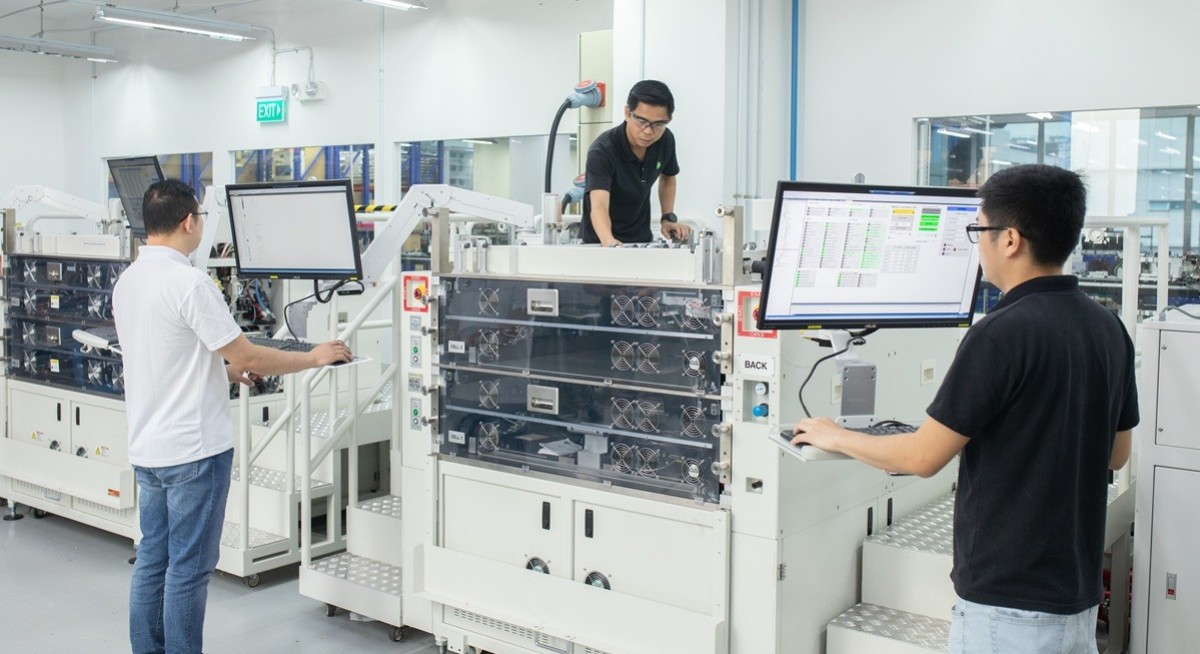
AEM’s technologies are built for such demands. They’re meant to handle high-power chips, larger designs and complex heat conditions, all of which are increasingly common in AI and high-performance computing. In that sense, AEM isn’t just benefiting from the AI cycle. It’s positioned within one of AI’s key enabling layers.
That positioning is already translating into traction. Since taking over last July, CEO Samer Kabbani has expanded AEM’s technology roadmap and strengthened its thermal capabilities, helping the company win customers across AI, high-performance computing, memory and hyperscaler segments.
The leadership change itself was abrupt. Amy Leong stepped down as CEO last July after just over a year in the role, in what AEM described as a “board-led leadership realignment for growth”.
The change at the top was more than cosmetic. Kabbani, who joined AEM in 2020, had been closely involved in shaping the company’s next-generation test technology roadmap and expanding its intellectual property, particularly in advanced thermal control, as chips become more powerful and generate more heat.
In effect, AEM’s board was elevating a technologist at a time when the industry was moving in the same direction. As semiconductor design shifts towards more complex, performance-driven applications, the importance of testing — and the technologies that underpin it — rises in tandem.
But whether that positioning is fully understood or appreciated is an open question. Much of the market’s attention remains focused on chip designers and manufacturers, the companies at the front end of the value chain.
Testing, by contrast, is often seen as a secondary activity, even though it’s increasingly critical as complexity increases.
Raising the bar
Despite its progress, AEM’s transformation is not without risks. Diversifying a customer base isn’t a one-off event. The transition from a single-anchor model to a multi-customer platform comes with complexities. These include greater coordination, deeper engineering capabilities and a more scalable operating model.
There’s also the question of sustainability. Margins, for one, remain below historical highs. That suggests AEM’s recovery is still in its early stages. The company’s operating profit margin for 2022, when revenue reached an all-time high, was 18.4%. Last year’s margin was 5.5%.
It also suggests that while AEM has stabilised, it hasn’t fully regained its former earnings power. The rebound in revenue and cash flow in 2025 is encouraging, but it doesn’t, on its own, signal a complete turnaround.
The market, however, appears to be looking ahead. The sharp re-rating in AEM’s share price in recent weeks suggests investors may be expecting something more than a cyclical recovery.
The question now is whether AEM can evolve from a company defined by a single customer into one positioned across a broader, structurally growing segment of the semiconductor industry.
The early signs are there. AEM’s exposure to AI and high-performance computing is deepening. Its partnerships, with ASE on one hand and Intel Foundry on the other, are expanding its reach beyond traditional boundaries. Its solutions are also increasingly relevant as chip designs grow more complex and testing becomes more critical.
The next phase will depend less on narrative and more on execution. AEM will need to convert partnerships into revenue, show that new customers can scale meaningfully, and rebuild margins closer to historical levels. It will also need to show that its diversification efforts can offset the inherent cyclicality of the semiconductor industry.
In that sense, the bar has been raised. AEM is no longer being judged on whether it can recover from its downturn. It’s being assessed on whether it can sustain a new phase of growth, one that’s less dependent on any single customer and more anchored to broader industry trends.
The distinction is important. Recovery is cyclical, while reinvention is structural. AEM has made meaningful progress on the former. Whether it can achieve the latter will determine if its recent rally marks the start of a new chapter or simply another turn in the cycle.




