


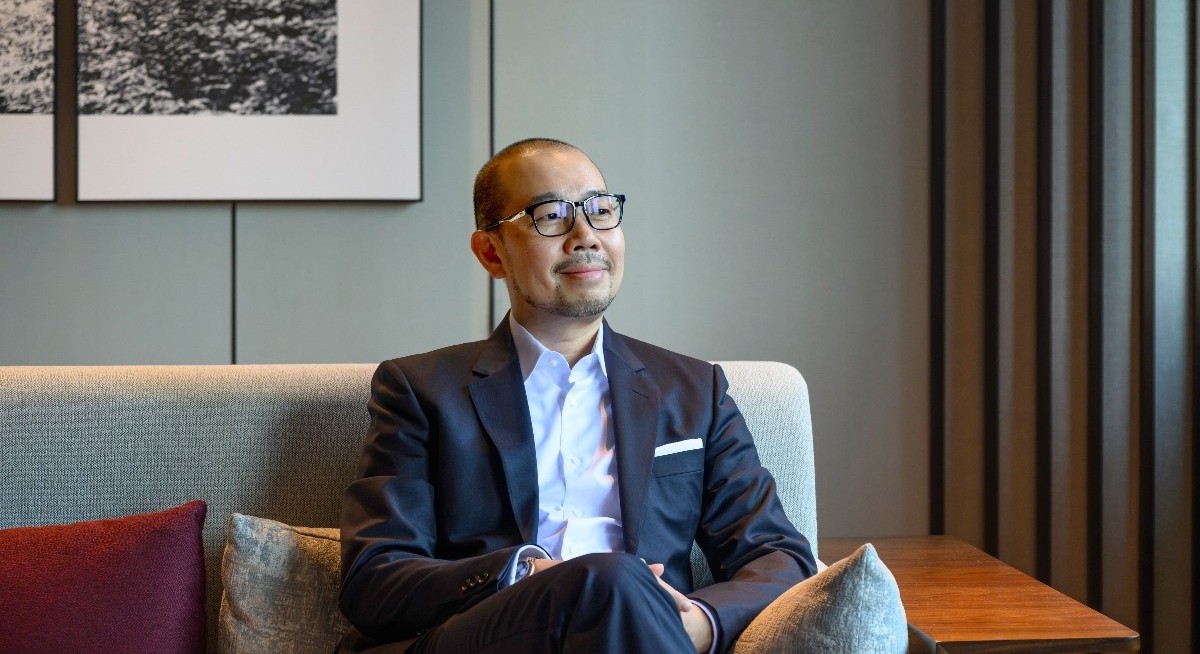


OUE REIT CEO Han Khim Siew spent three years overhauling the REIT he inherited, from capital structure and portfolio to strategy. The transformation of a flagship Orchard Road hotel reflects a broader conviction: in an era of persistent uncertainty, the right assets in the right locations can turn volatility into an advantage.
In February 2022, after two years of closure, OUE REIT completed the $150 million asset enhancement of the former Mandarin Orchard Singapore, reopening the property as Hilton Singapore Orchard.
The 1,080-room property, now Hilton’s largest flagship hotel in Asia Pacific, had been redesigned, repositioned and rebranded. The first tower opened to near-full occupancy; the second tower followed in January 2023, completing the hotel’s full room inventory. “It was a flight to quality,” adds Han. “A new, improved, revamped Hilton. We really benefited from that first wave of tourism coming back post-Covid-19.”
The hotel also shifted its focus away from the regional leisure market. The former Mandarin Orchard had largely catered to visitors from Southeast Asia, China, Japan and Korea, who typically arrived in waves during peak holiday seasons.
With the rebrand, the hotel pivoted towards corporate guests. The share of American visitors rose from low single digits to the mid-teens. Daily room rates, which had hovered at $270–$280 before refurbishment, climbed to $400–$450, touching $500 in peak periods.
The result, Han says, was a fundamentally more stable earnings profile. “During the travel holiday season, you still get the regional tourists coming through. During the non-holiday season, you have the corporate travellers from the US and from Europe. That balances out quite nicely.”
See also: Fuxing CEO Hong: Margin discipline matters more than revenue
A new management team installed at the Hilton in September and October 2025 sharpened execution further, responding more quickly to corporate bookings, refreshing food and beverage menus every two months and partnering with the Singapore Tourism Board on events and experiences along Orchard Road. “We can’t sit back on our past successes,” adds Han. “We have to look forward.”
Rebuilding through three phases
The hotel’s reinvention mirrors what Han has been working through at the REIT level since he joined in February 2022. He describes his tenure in three phases.
See also: StarHub CEO on staying the dividend course through headwinds By Julian Wong
The first was structural: fixing the capital architecture of a REIT whose debt was mostly on a secured basis, and whose cost of borrowing was higher than he believed it should be. “We focused inwards,” he says. “Improving our capital structure.”
Over three years, the team shifted OUE REIT’s financing from secured to unsecured, working with S&P Global along the way. By late 2023, OUE REIT had secured a BBB-minus investment grade credit rating, broadening its access to the bond market and institutional capital, while prompting more competitive pricing from banks.
According to Han, the REIT’s current cost of debt sits at approximately 3.7% as of March 31, 2025. A seven-year bond issued in October 2025 printed at 2.75%, and he expects the overall cost of debt to move lower over the next one to two years.
The second phase was portfolio discipline. The most significant move was the divestment of Lippo Plaza Shanghai, the only large commercial transaction of its kind to complete in that market during the period.
“We divested at a 5% discount to valuation,” adds Han. “And we’ve seen occupancy fall another 20 to 30 percentage points, and rents come off another 20 to 30%, since we divested.” The December 2024 divestment released capital and reduced leverage, positioning the REIT to pursue accretive acquisitions.
The third phase was about closing the disconnect between the REIT’s market price and the net asset value (NAV) of its underlying assets. Trading at roughly 0.65 times NAV, the REIT sits at what Han calls an “irrational” discount. Yet he is clear-eyed about what it will take to close that gap: not persuasion, but proof.
This is where One Raffles Place comes in. The asset, which represents about 25% of portfolio revenue, is now being brought to market. Han argues that a sale at or above book value would demonstrate the discount is unsustainable while releasing capital for redeployment into newer freehold assets with stronger return potential.
To stay ahead of Singapore and the region’s corporate and economic trends, click here for Latest Section
Separately, at OUE Bayfront, the team is decanting an M&E floor into approximately 22,600 sq ft of prime office space by connecting the building to the district cooling system — a project Han says offers an 11% return on investment.
Stability and upside
At the portfolio level, Han describes OUE REIT’s structure as a barbell. On one side sits its commercial office portfolio: OUE Bayfront, OUE Downtown and One Raffles Place in Singapore, anchored by longer leases and 14 consecutive quarters of positive rental reversions (tenants renewing at rates above previous rents) and Salesforce Tower in Sydney.
On the other side is hospitality and retail, which together account for roughly half of portfolio revenue. Crowne Plaza Changi Airport, the REIT’s second hotel, complements the Hilton with a different guest profile: transit passengers on long-haul layovers, airline crew and tourists drawn to Jewel Changi. Aviation-themed rooms, developed with a children’s brand, now attract guests willing to pay a premium for the experience.
Han describes hospitality and retail as “experiential infrastructure” — assets positioned to capture a structural shift in consumer spending as incomes rise. Pop-up collaborations at Mandarin Gallery, the retail component beneath the Hilton, and a new live event venue opening nearby all follow the same logic.
The asset class’s structural appeal to the REIT, Han adds, is daily repricing. Office leases can take years to catch up with inflation, while hotel room rates can adjust overnight. He continues: “If you believe inflation will stay sticky, then what in your portfolio can reprice to align with rising inflation?”
A 10% decline in room rates, he notes, would affect overall REIT income by roughly 3.5% — a manageable downside, in his view, relative to the upside potential from a growing travel market across a regional catchment of around three billion people in China, Southeast Asia and India.
OUE REIT’s February 2026 acquisition of a 19.9% stake in Sydney’s Salesforce Tower illustrates how the phases connect. The building — one of the newest prime office towers in Sydney’s CBD, completed in 2022 — was acquired at an implied valuation of approximately A$1.8 billion ($1.6 billion), below the A$2.2 billion at which it had previously traded.
Occupancy stood at 99.2% as of March 31. The asset is freehold, limiting near-term capital expenditure, and Sydney’s prime CBD office supply pipeline is even tighter than Singapore’s, with the next significant delivery three to five years away.
Han also highlights the market’s structure. Nine of the last ten prime Sydney CBD office transactions were pre-empted by incumbent owners buying out departing partners. That leaves few openings for new entrants, while those already in the asset are natural beneficiaries when opportunities arise. “Our peers can’t access it,” he adds. “But we’re there.”
Designed for uncertainty
Han returns often to the word volatility. He sees it not as a threat to hedge against, but as a condition to anticipate and position for.
That logic runs through much of OUE REIT’s strategy: the flight to quality that filled Hilton Singapore Orchard in its opening months, the widening divide between prime CBD offices and secondary locations, the intra-Asia travel flows he expects to strengthen as geopolitical uncertainty drives up the cost of long-haul flights and the daily repricing power that lets hotel room rates track inflation in ways office leases cannot.
“Volatility will always come,” he adds. “The question is whether your portfolio is positioned to capitalise on it. That is why we focus on prime core assets, because whenever uncertainty rises, there’s always a flight to quality.”
The thesis is not new. What has changed at OUE REIT over the past three years is the capital structure, portfolio mix and balance sheet needed to act on it.
About OUE REIT
OUE Real Estate Investment Trust (“OUE REIT”), formerly known as OUE Commercial Real Estate Investment Trust, is one of the largest diversified S-REITs with total assets under management of $6.1 billion.
OUE REIT aims to deliver stable distributions and provide sustainable long-term growth in return to holders of units (“Unitholders”) by investing in income-producing real estate used primarily for hospitality, retail and/or office purposes in financial and business hubs, as well as real estate-related assets.
OUE REIT’s portfolio comprises seven high-quality office, hospitality and retail assets located in Singapore and Australia. Rooted in Singapore, OUE REIT’s three office assets, OUE Bayfront, One Raffles Place and OUE Downtown Office, are situated within the Central Business District, with a total net lettable area (“NLA”) of approximately 1.7 million sq ft.
OUE REIT’s two hotels, Hilton Singapore Orchard and Crowne Plaza Changi Airport, are strategically located along the prime Orchard Road belt and within the Changi Airport vicinity, offering a total of 1,655 upper upscale hotel rooms. Complementing Hilton Singapore Orchard is Mandarin Gallery, a 126,283 sq ft high-end retail mall that has been a preferred destination for international brands in the heart of Orchard Road.
The latest addition to OUE REIT’s portfolio is 180 George Street (also known as Salesforce Tower), Sydney, a premium-grade commercial asset in which OUE REIT holds a 19.9% interest. Comprising 666,437 sq ft of NLA, 180 George Street is strategically situated in Circular Quay, one of Sydney’s key corporate and cultural precincts. As Sydney’s tallest office tower, 180 George Street is a landmark asset that strengthens the portfolio’s exposure to high-quality office real estate in a prime gateway city.
Listed on the Main Board of the Singapore Exchange Securities Trading Limited since Jan 27, 2014, OUE REIT is managed by OUE REIT Management (the “Manager”), a wholly owned subsidiary of OUE (the “Sponsor”). The Sponsor is a leading real estate and healthcare group, growing strategically to capitalise on growth trends across Asia. Its real estate activities include the development, investment and management of real estate assets across the commercial, hospitality, retail, residential and healthcare sectors.
About kopi-C: The Company Brew
kopi-C is a regular column by SGX Research in collaboration with Beansprout (https://growbeansprout.com), a MAS-licensed investment advisory platform, that features C-level executives of leading companies listed on SGX. These interviews are profiles of senior management aimed at helping investors better understand the individuals who run these corporations.




